

How to Choose an Air-Cooled Xenon Lamp Aging Chamber

1. Working Principle and Structural Composition
1. Working Principle
The QINSUN air-cooled xenon arc weathering test chamber adopts long-arc xenon lamps to simulate full-spectrum sunlight (including ultraviolet UV, visible light and infrared IR). It cools the lamps through forced air convection without a water cooling unit. Combined with temperature-humidity adjustment, spraying and rainfall circulation systems, it simulates outdoor conditions such as sunlight exposure, high temperature and high humidity, and rain erosion to conduct accelerated weathering aging tests on materials. The material failure that takes years under natural aging can be completed within 200–1000 hours.
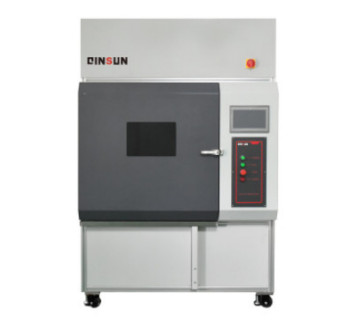
The equipment is equipped with closed-loop irradiance control. UV sensors monitor irradiance at 340nm/420nm in real time and automatically adjust lamp current to maintain stable light intensity. Circulating air ducts ensure uniform temperature, irradiance and humidity inside the chamber, meeting the requirements of GB/T 16422.2 and ASTM G155.
2. Overall Structure
Light Source System: Air-cooled xenon arc lamps (rated power: 1.8kW/3kW), air cooling ducts, optical filters (CIRA daylight filter / window glass filter), lamp housing assembly
Irradiance Control System: UV irradiance sensors (340nm/420nm), PID controller, automatic irradiance compensation module
Temperature & Humidity System: Heating tubes, centrifugal fan, humidifier, platinum resistance thermometers, humidity sensor
Spray & Rainfall System: High-pressure spray pump, stainless steel nozzles, spray solenoid valve, rainwater recovery loop
Specimen Movement System: Rotating frame (360° rotation at 1r/min), specimen clamps, sample mounting plates
Safety Protection System: Over-temperature protection, lamp overload protection, water shortage protection, door interlock switch, fan failure alarm
Chamber Body: SUS304 stainless steel inner tank, internal dimensions 500×500×600mm, double-layer tempered observation window, insulation layer thickness ≥50mm
2. Technical Parameters and Performance Indicators
(Compliant with GB/T 16422.2, ASTM G155 and ISO 4892-2)
Lamp Type: Air-cooled long-arc xenon lamp, rated power 1.8kW/3kW
Irradiance Range: 0.30~1.20W/m² at 340nm; 0.50~2.00W/m² at 420nm; control accuracy ±2%
Black Panel Temperature (BPT): 35~85℃, temperature fluctuation ±1℃
Chamber Temperature: 25~70℃, temperature uniformity ±2℃
Relative Humidity: 30%~95% RH, humidity control accuracy ±3% RH
Sample Rotating Frame: Diameter Φ450~Φ500mm, rotation speed 1r/min for uniform irradiance
Spray Function: Spray pressure 0.1~0.15MPa, adjustable spray cycle (1min~999h)
Optional Filters: CIRA daylight filter or Window glass filter (single selection)
Nominal Lamp Service Life: 500h; replacement after 400h is recommended to stabilize irradiance
Power Supply: AC220V±10%/50Hz, rated power 4.5~6kW
Uniformity Standard: Irradiance deviation ≤5% and temperature deviation ≤2℃ at any three points of the sample area
3. Installation, Commissioning and Operating Procedures
(I) Installation Specifications
Ambient Requirements: Ambient temperature 23±2℃, relative humidity 20%–80% RH; avoid direct sunlight, dust and corrosive gas
Ventilation Requirements: Reserve heat dissipation space ≥300mm on the top and rear of the equipment with smooth exhaust; operation in fully enclosed spaces is forbidden
Water Supply Requirements: Deionized water or pure water with resistivity ≥1MΩ·cm, water pressure 0.1~0.3MPa; tap water is prohibited
Electrical Requirements: Independent circuit with grounding resistance <4Ω; equipped with air switch and leakage protection (trip current ≤30mA)
(II) Commissioning Steps
No-load trial run: Turn on temperature control, fan and rotating frame for 2 hours; check stable temperature and abnormal noise
Irradiance calibration: Ignite the xenon lamp and preheat for 30 minutes, set standard irradiance (e.g. 0.51W/m² at 340nm) and stabilize for 1 hour; it is qualified if the deviation ≤±2%
Spray system commissioning: Activate spraying function and check uniform atomization, unobstructed nozzles and zero water leakage
Safety interlock test: The light source cuts off automatically when the door is opened; the equipment shuts down automatically after simulating over-temperature alarm
(III) Standard Operating Procedures (Cycle example per GB/T 16422.2)
Specimen preconditioning: Condition specimens at 23℃/50% RH for 24 hours with clean surfaces free of scratches and oil stains
Specimen mounting: Fix specimens on the rotating frame with spacing ≥5mm to prevent shielding and contact between samples
Close the door and set parameters: Irradiance, black panel temperature, humidity, light/spray/condensation cycle
Lamp startup and operation: Preheat for 30 minutes first; formal test begins after irradiance and temperature stabilize
Periodic inspection during test: Record irradiance, temperature and humidity every 24 hours; check the spray system, rotating frame and water level
Test completion: The lamp turns off automatically; maintain ventilation for 30 minutes for cooling, and open the door for sampling only when the temperature drops below 40℃
Specimen storage: Take photos, grade samples and conduct mechanical, appearance, color difference and gloss tests
4. Daily Maintenance Specifications
1. Daily Inspection
Check the water tank level and replenish deionized water
Observe lamp operation for flicker and tube blackening
Confirm normal operation of the rotating frame, fan and spray system
2. Weekly Maintenance
Clean and unclog spray nozzles
Gently wipe the glass window of the UV sensor with anhydrous ethanol
Clear accumulated water and debris at the chamber bottom and ensure smooth drainage
3. Monthly Maintenance
Clean air duct filters and lamp housing heat dissipation vents to guarantee air cooling efficiency
Inspect bearings of the rotating frame and add high-temperature resistant grease
Calibrate black panel temperature and zero point of irradiance
4. Lamp Replacement (Critical Item)
Replace the lamp after 400 cumulative working hours; the maximum service life shall not exceed 500 hours
Wear gloves during replacement; direct hand contact with the lamp tube is forbidden
Irradiance recalibration is mandatory after lamp replacement before resuming tests
5. Annual Maintenance
Thoroughly clean the chamber, pipelines, heating and humidifying components
Calibrate irradiance, temperature and humidity and file internal/external calibration records
Inspect electrical circuits, wiring terminals and all safety protection devices
5. Test Standards and Test Methods
1. Applicable Standards
GB/T 16422.2 Plastics — Methods of Exposure to Laboratory Light Sources — Part 2: Xenon Arc Lamps
ISO 4892-2 Plastics — Methods of Exposure to Laboratory Light Sources — Part 2: Xenon Arc Lamps
ASTM G155 Standard Practice for Operating Xenon Arc Light Apparatus for Exposure of Nonmetallic Materials
ASTM D4459 / ASTM D6695 / SAE J2527 / PV1303
2. Common Industry Test Cycles
Dry Aging Cycle (No Spraying)
Light exposure: Continuous irradiation at 60℃/50% RH
Light & Spray Combined Humid Aging Cycle
102 minutes of light exposure + 18 minutes of spraying
Comprehensive Outdoor Simulation Cycle (Light + Spray + Condensation)
Light exposure stage + spray stage + dark high-humidity condensation stage
3. Common Irradiance Settings
340nm: 0.51W/m² (general standard), 0.65W/m² (accelerated test), 1.0W/m² (high-intensity accelerated test)
420nm: 1.10W/m², 1.5W/m² (widely used for coatings and automotive exterior parts)
6. Fault Diagnosis and Troubleshooting
Fault: Xenon lamp fails to ignite or extinguishes frequently
Causes: Aged lamp, faulty trigger board, incompletely closed door switch, unstable power supply, poor heat dissipation
Solutions: Replace the lamp; inspect the door control switch; stabilize power supply; clean air ducts for sufficient cooling
Fault: Low or continuously declining irradiance
Causes: Lamp attenuation, contaminated sensor, aged optical filter, incorrect parameter settings
Solutions: Clean the sensor; replace the optical filter; replace the lamp; complete recalibration
Fault: Excessively high temperature or failed temperature control
Causes: Clogged air ducts, faulty fan, adhered heating contactor, drifted sensor
Solutions: Clean filter screens; replace the fan; calibrate the temperature probe
Fault: No spray output or insufficient water flow
Causes: Blocked nozzles, faulty water pump, damaged water solenoid valve, water shortage
Solutions: Dredge nozzles; inspect the water pump; replace the solenoid valve; replenish deionized water
Fault: Rotating frame stalls or generates abnormal noise
Causes: Faulty drive motor, loose chain, seized bearing, triggered overload protection
Solutions: Inspect the motor; tighten the chain; lubricate bearings; rearrange specimens to eliminate jamming
7. Safe Operation and Protection Requirements
Xenon lamps generate intense ultraviolet radiation. Door opening and direct eye contact with the light source are prohibited during operation; protective goggles must be worn for inspection
Tap water is forbidden to avoid scaling blockage of the spray system and corrosion of the chamber and lamps
The equipment operates at high temperatures; do not touch the chamber, lamp housing and heating components to prevent scalds
Press emergency stop and cut off power supply immediately upon abnormal noise, peculiar smell or smoke; operation with faults is prohibited
Cut off power supply and cool the lamp for more than 30 minutes before replacement to avoid high-temperature scalds and electric shock
8. Irradiance Control and Calibration Methods
Control Logic: Real-time signal collection by UV sensor → PID adjustment → automatic irradiance stabilization
Calibration Cycle: Internal calibration once a month, third-party metrological calibration once a year
Calibration Procedure: Use a standard radiometer to conduct multi-point testing in the sample area and adjust equipment coefficients until the deviation ≤±2%
Key Requirement: Recalibration is required after optical filter aging or lamp replacement; otherwise, test data is invalid
9. Specimen Preparation and Test Result Analysis
Specimen Requirements: Flat, undeformed and scratch-free with dimensions complying with standards; at least 3 parallel specimens per test group
Post-test Evaluation Items: Surface discoloration, gloss loss, cracking, chalking, blistering, peeling and mildew growth
Performance Testing Items: Color difference ΔE, gloss, tensile strength, impact strength, adhesion and light transmittance
Judgment Criteria: Grade specimens in accordance with product standards; qualified products feature color difference ≤ΔE 3.0 without cracking or chalking
10. Application Fields and Model Selection Guide
1. Main Test Materials
Conduct weathering aging tests on plastics, coatings, paints, inks, rubber, textiles, leather, automotive exterior trims, photovoltaic materials, outdoor electronic products and more.
2. Key Model Selection Points
Air-cooled model: Simple structure, low maintenance cost and small footprint, ideal for R&D and routine quality inspection (most widely used)
Capacity Options: 150L (standard), 300L, 500L (for mass specimen testing)
Optical Filter Selection: CIRA filter (simulate direct outdoor sunlight); Window filter (simulate light transmitted through glass for indoor articles)
Mandatory Configurations: Automatic irradiance control, rotating sample frame and spray system
Viewpoints
The stability of air-cooled xenon arc weathering test chambers mainly relies on lamp service life and irradiance calibration. Continuous use over 400 hours causes irradiance attenuation and distorted test cycles. 80% of data deviations are caused by overdue lamp replacement and uncalibrated sensors.
Deionized water is an essential matching medium. Tap water leads to nozzle blockage, lamp scaling and chamber corrosion within 3 months, which will completely damage the water circuit system.
Comparison between air-cooled and water-cooled models: Air-cooled units require no cooling water tower, feature simple installation and lower failure rates, suitable for weathering tests of most materials. Water-cooled models are only recommended for ultra-high power and high-precision continuous operation scenarios.
Xenon lamp aging test results cannot be directly converted into actual service years and are only used for formula comparison, quality control and certification testing. Data correction combining local total irradiance, temperature and humidity is required for service life prediction.
2026-07-08 11:20
- Related News
How to Choose a Suitable Drying Rate Tester?
What Is a Fabric ICI Pilling and Snagging Box?
How to Choose an ICI Mace Snag Tester?
What a Fiber Oil Extractor Actually Does?
Snap Button Pull Tester: Garment Accessory Tensile Strength Testing Guide
Guide to Block-on-Ring Friction Wear Equipment
How to Choose Universal Multifunction Tribology Test Machine
How to Choose an Air-Cooled Xenon Lamp Aging Chamber
What Does an Ozone Aging Chamber Test? Standards and Operating Methods
Fabric Cool Feeling Tester: Working Principle, Standards and Selection Guide