

Working Principle of Kinematic Viscosity Tester

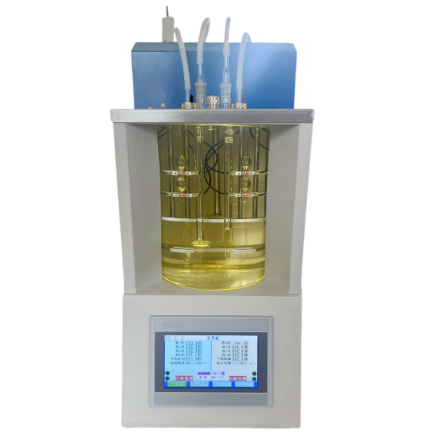
The core principle of the automatic kinematic viscosity tester is based on the national standard GB/T 265 “Test Method for Kinematic Viscosity of Petroleum Products”. It adopts the gravity capillary method to measure the time required for a liquid to flow through a standard capillary at a constant temperature, and then calculates the kinematic viscosity.
1. Basic Physical Principle
The liquid flows through a calibrated glass capillary with uniform inner diameter under gravity.
According to Poiseuille’s law, the kinematic viscosity is:
ν = C × t
ν: kinematic viscosity (mm²/s)
C: capillary constant (calibrated, fixed value)
t: flow time between two marked lines (seconds)
The temperature must be strictly constant, as any variation directly affects viscosity.
2. Constant Temperature Control Principle
The instrument is equipped with a constant temperature bath (liquid bath or metal block), typically set at 40°C, 100°C, or other test temperatures, with a control accuracy of ±0.01°C.
Only under stable temperature conditions can the measured flow time be valid.
3. Automatic Sampling and Liquid Level Detection
After placing the sample into the tube, the instrument uses a vacuum pump to automatically draw the sample into the capillary to the required level.
Photoelectric sensors (infrared) are installed at both marks of the capillary.
As the liquid flows down naturally, passing the upper and lower marks, the sensor signals change, and the instrument records the time automatically with millisecond precision.
4. Automatic Calculation Principle
The controller calculates kinematic viscosity based on:
ν = C × t
It can also calculate:
Dynamic viscosity
Viscosity index (VI)
Flow index
Results are automatically displayed, stored, and printed.
5. Automatic Cleaning and Drying Principle
After testing:
The instrument automatically cleans the capillary with solvent
Then dries it with gas
This prevents residue from affecting the next test and enables continuous, unattended operation.
6. Overall Workflow
Sample loading → Temperature stabilization → Automatic suction
Gravity flow → Photoelectric timing → Viscosity calculation
Automatic cleaning → Result output
Operating Method of Kinematic Viscosity Tester
Before operation, check the instrument appearance, power supply, and bath liquid level. Ensure the capillary is clean and dry, and the environment is free from vibration and dust. After powering on, enter system settings and set the test temperature (e.g., 40°C or 100°C). Wait until the bath temperature stabilizes.
Inject the sample into the viscometer tube to the specified level, place it into the constant temperature bath, and allow it to reach thermal equilibrium.
Start the automatic test program. The instrument draws the sample into the capillary using a vacuum system. Under gravity, the liquid flows naturally. The photoelectric sensors detect when the liquid passes the upper and lower marks and record the time precisely.
After the test, the instrument automatically calculates and displays the kinematic viscosity value. It then performs automatic cleaning and drying of the capillary to avoid contamination.
During operation, do not touch the capillary. Maintain proper liquid level. After testing, record the data in time, shut down the instrument, and perform routine cleaning and maintenance.
2026-04-22 16:03
- Related News
How to Choose a Suitable Drying Rate Tester?
What Is a Fabric ICI Pilling and Snagging Box?
How to Choose an ICI Mace Snag Tester?
What a Fiber Oil Extractor Actually Does?
Snap Button Pull Tester: Garment Accessory Tensile Strength Testing Guide
Guide to Block-on-Ring Friction Wear Equipment
How to Choose Universal Multifunction Tribology Test Machine
How to Choose an Air-Cooled Xenon Lamp Aging Chamber
What Does an Ozone Aging Chamber Test? Standards and Operating Methods
Fabric Cool Feeling Tester: Working Principle, Standards and Selection Guide