

Melt Flow Index (MFI) Guide

Melt Flow Index (MFI), also known as Melt Flow Rate (MFR), is the most commonly used indicator to evaluate the flowability of thermoplastics in the molten state.
1. Core Definition
MFI is defined as the mass of polymer melt that flows through a standard die (capillary) within 10 minutes under specified temperature and load conditions.
Unit: g/10 min
Physical Meaning:
Higher MFI → Lower melt viscosity → Better flowability → Lower molecular weight
Lower MFI → Higher melt viscosity → Poor flowability → Higher molecular weight
2. Test Standards and Conditions
Testing must strictly follow international standards. Different materials require different temperature and load conditions.
Main Standards:
ISO 1133 (International)
ASTM D1238 (USA)
Typical Test Conditions:
| Material | Temperature | Load |
|---|---|---|
| PP (Polypropylene) | 230°C | 2.16 kg |
| PE (Polyethylene) | 190°C | 2.16 kg |
| ABS | 220°C | 10 kg |
| PC (Polycarbonate) | 300°C | 1.2 kg |
3. Test Method
(1) Preparation
Add plastic granules into a preheated barrel and allow them to melt.
(2) Loading
Apply standard weight on the piston to generate pressure.
(3) Measurement
After stable flow, cut the extrudate at fixed time intervals.
(4) Calculation
Weigh the sample and convert it into mass per 10 minutes (g/10 min).
4. Key Influencing Factors
(1) Molecular Weight (Most Critical)
Higher molecular weight → longer chains → more entanglement → lower MFI
(2) Molecular Structure
More testing and flexible chains → higher MFI
(3) Additives
Plasticizers / oils → increase MFI
Fillers / glass fiber → decrease MFI
(4) Test Conditions
Higher temperature or load → higher MFI value
5. Industrial Applications
(1) Material Selection
Injection molding (thin-wall / complex parts):
Use high MFI (e.g., 30–50) for better filling
Extrusion / blow molding (pipes / bottles):
Use low MFI (e.g., 0.5–5) for better melt strength
(2) Quality Control
Monitor batch consistency
Detect degradation of recycled materials (MFI usually increases)
(3) Process Optimization
Guide temperature and pressure settings
6. MFI vs. MFR vs. MVR
MFI / MI / MFR: Mass flow rate (g/10 min), most commonly used
MVR: Volume flow rate (cm³/10 min), suitable for materials with density variation
7. Melt Flow Index Testers
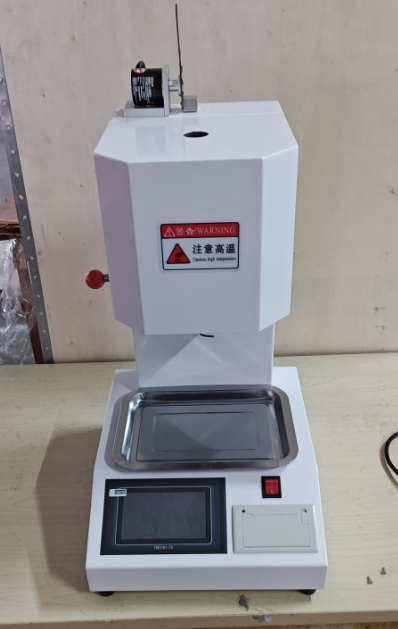
MFI is measured using a Melt Flow Index Tester (MFI Tester / Melt Flow Rate Tester).
1. Classification by Function
(1) Manual Type
Manual cutting, weighing, and calculation
Low cost, basic testing
Measures MFR only
(2) Automatic Cutting Type
Automatic timing and cutting, manual weighing
Improved consistency
Suitable for factory QC
(3) Fully Automatic Type
Automatic cutting, weighing, calculation, and printing
Displays MFR, MVR, density
High precision temperature control
(4) Multi-load Type
Supports multiple weights (2.16 kg, 5 kg, 10 kg)
Used for FRR (Flow Rate Ratio)
(5) Dual Measurement Type (MFR + MVR)
Measures both mass and volume flow
Suitable for filled/modified plastics
2. Classification by Method
Mass Method (Mainstream, ISO 1133 / ASTM D1238)
Volume Method (MVR)
Advanced models with auto cleaning and feeding
3. Accuracy Comparison
| Type | Temperature Accuracy | Timing Accuracy | Weighing | Repeatability |
|---|---|---|---|---|
| Manual | ±1–3°C | Large error | Manual | 5%–15% |
| Auto Cut + Manual Weigh | ±0.5–1°C | <0.1 s | Manual | 2%–5% |
| Fully Automatic | ±0.2–0.5°C | <0.05 s | Automatic | 1%–2% |
| High-End (MFR+MVR) | ±0.1°C | <0.01 s | Auto + displacement | <0.5%–1% |
4. Key Factors Affecting Accuracy
Temperature stability (most critical)
→ 1°C variation may cause 3%–10% error
Manual cutting errors
Dirty or degraded die
Non-standard weights or piston misalignment
Summary
Manual tester: Suitable for rough evaluation only
Semi-automatic: Best cost-performance for factory QC
Fully automatic: Required for R&D and certification
High-end dual method: Used for advanced material characterization
2026-04-22 14:36
- Related News
How to Choose a Suitable Drying Rate Tester?
What Is a Fabric ICI Pilling and Snagging Box?
How to Choose an ICI Mace Snag Tester?
What a Fiber Oil Extractor Actually Does?
Snap Button Pull Tester: Garment Accessory Tensile Strength Testing Guide
Guide to Block-on-Ring Friction Wear Equipment
How to Choose Universal Multifunction Tribology Test Machine
How to Choose an Air-Cooled Xenon Lamp Aging Chamber
What Does an Ozone Aging Chamber Test? Standards and Operating Methods
Fabric Cool Feeling Tester: Working Principle, Standards and Selection Guide