

Los Angeles Abrasion Test Machine & Method

1. What is the Los Angeles Abrasion Test?
The Los Angeles abrasion test (LA abrasion test) is a standard test widely used in civil engineering, road construction, and aggregate testing. It is used to determine the resistance of coarse aggregates (crushed stone, gravel, manufactured sand coarse aggregates, etc.) to impact, friction, abrasion, and crushing.
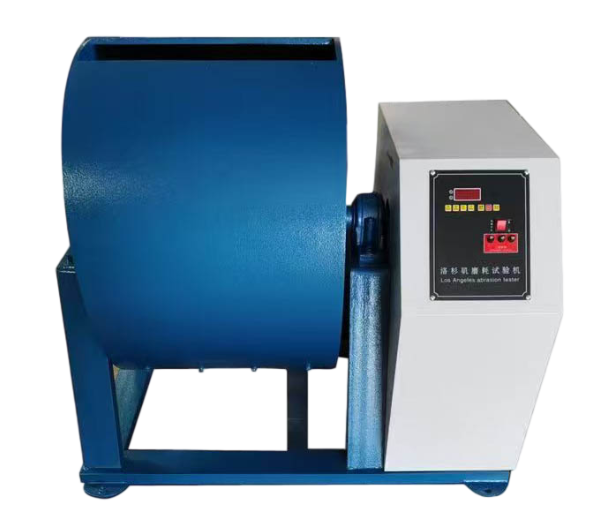
Principle:
Dried and graded coarse aggregates are placed in a rotating steel drum together with standard steel abrasion balls. As the drum rotates, impact and grinding occur. After the test, the fine particles are sieved out, and the mass loss due to abrasion is calculated.
Lower abrasion value: higher hardness, better durability, stronger wear resistance
Higher abrasion value: weaker material, easily crushed, not suitable for surface layers or high-strength applications
2. How to Perform the Los Angeles Abration Test?
Sample Preparation
Select representative coarse aggregates, clean thoroughly, and dry in an oven at 105–110°C to constant weight. Sieve and combine according to standard gradations (A/B/C/D) to obtain the required total mass.
Charging the Drum
Place the prepared aggregate sample and the specified number of standard steel balls into the drum. Secure and seal the cover.
Machine Operation
Start the machine. The drum rotates at 30–33 r/min and stops automatically after 500 revolutions.
Post-Test Sieving
Discharge all materials and sieve through a 1.70 mm (No.12) sieve to remove fine particles generated during the test.
Drying, Weighing & Calculation
Dry the retained aggregates again, cool, and weigh.
Abrasion loss formula:
LA(%)=W1−W2W1×100LA(\%) = \frac{W_1 - W_2}{W_1} \times 100LA(%)=W1W1−W2×100
Where:
W₁ = original sample mass
W₂ = retained mass after test
3. ASTM Standards for Los Angeles Abrasion Test
ASTM C131 / C131M
Applicable to small-size coarse aggregates (particle size < 37.5 mm), commonly used for asphalt and concrete aggregates.
ASTM C535
Applicable to large-size coarse aggregates (particle size > 19 mm), such as large base course stones.
4. Test Requirements
(1) Equipment Requirements
Drum inner diameter: 711 mm; length: 508 mm; equipped with lifter shelf; rotation speed 30–33 r/min; automatic counter and stop device.
(2) Sample Requirements
Samples must be oven-dried to constant weight and prepared strictly according to A/B/C/D gradations with specified total mass.
(3) Abrasion Ball Requirements
Standard steel balls (approx. 48 mm diameter) must meet hardness and weight specifications. Quantity must match the gradation.
(4) Test Parameters
Fixed at 500 revolutions; sieving with 1.70 mm standard sieve.
(5) Acceptance Criteria (Typical Engineering Values)
Surface course/high-grade pavement: ≤ 35%
Base/subbase aggregates: ≤ 45%
High-strength concrete aggregates: require low abrasion values
5. Required Equipment
Los Angeles abrasion testing machine (drum + counter)
Standard steel abrasion balls (complete set)
Standard sieves (including 1.70 mm sieve)
Drying oven (105–110°C)
High-precision electronic balance (0.1 g accuracy)
Auxiliary tools (tray, brush, scoop, cooling container, etc.)
6. Number of Abrasion Balls
According to ASTM C131:
A gradation: 12 balls
B gradation: 11 balls
C gradation: 8 balls
D gradation: 6 balls
7. Precautions
(1) Sample Preparation
Aggregates must be clean and free from dust and impurities.
Dry to constant weight and cool before weighing.
Follow standard gradation strictly.
Avoid abnormal particles (cracked, weathered).
(2) Equipment & Balls
Ensure drum and lifter are intact and not deformed.
Steel balls must be free of damage, deformation, or corrosion.
Do not mix ball quantities between gradations.
Calibrate rotation speed and counter regularly.
(3) Operation
Secure the drum cover before operation.
Avoid material blockage during loading.
Do not stop the test midway; complete 500 revolutions continuously.
Keep personnel away from rotating parts.
(4) Sieving & Weighing
Collect all materials completely after the test.
Use 1.70 mm sieve uniformly and thoroughly.
Dry and cool retained aggregates before weighing.
Ensure balance accuracy (≥0.1 g) and proper calibration.
(5) Results & Environment
Maintain stable temperature and humidity.
Record data clearly and ensure repeatability.
Clean and maintain equipment after testing to extend service life.
2026-04-21 17:14
- Related News
How to Choose a Suitable Drying Rate Tester?
What Is a Fabric ICI Pilling and Snagging Box?
How to Choose an ICI Mace Snag Tester?
What a Fiber Oil Extractor Actually Does?
Snap Button Pull Tester: Garment Accessory Tensile Strength Testing Guide
Guide to Block-on-Ring Friction Wear Equipment
How to Choose Universal Multifunction Tribology Test Machine
How to Choose an Air-Cooled Xenon Lamp Aging Chamber
What Does an Ozone Aging Chamber Test? Standards and Operating Methods
Fabric Cool Feeling Tester: Working Principle, Standards and Selection Guide