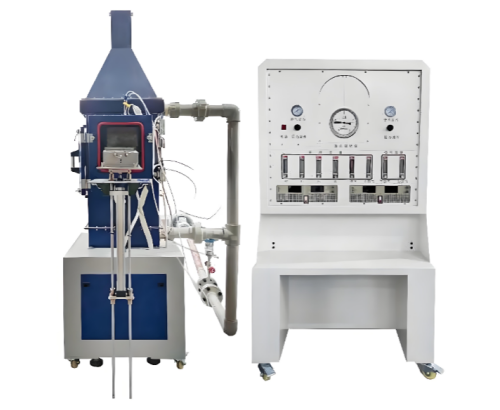
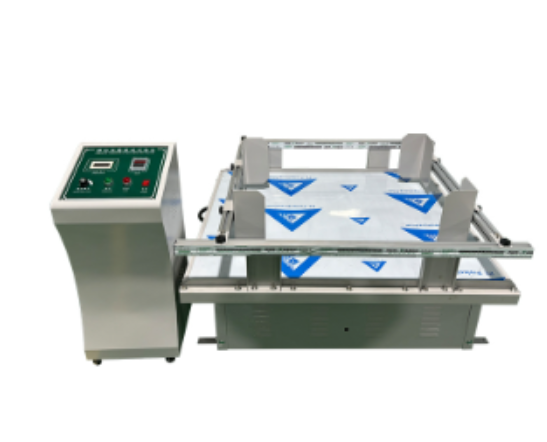
Oil Thread Leak Test System
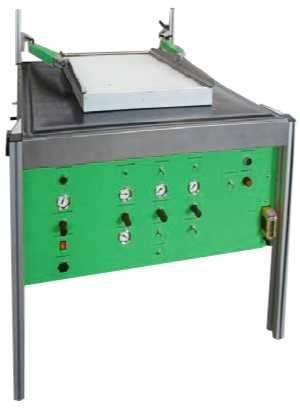


The oil thread test is used for visual proof of the absence of leakage of HEPA filters. This simple quality test procedure may be an alternative to the scan method. The oil thread test is also applicable if the scan method is not fully applicable because of the filter design (e.g. V-shaped arrangements). For scanning of HEPA and ULPA filters, Topas offers the AFS 150 and AFS 152 - proven and reliable solutions.
Principle
The filter element (sample) is mounted horizontally with the upstream side down on the test bench and secured with a pneumatically operated fixing device. For testing, the filter is then exposed to a flow of a polydisperse aerosol of oil droplets (DEHS). An existing leak is made visible on a rising oil thread on the downstream side (upper side) of the filter.
Features
◆ Cost-effective solution for leak testing of filters ranging up to group H (filter class H13 and H14)
◆ Easy manual operation
◆ Constant test conditions according to EN 1822-4 due to pre-adjustable test parameters
◆ Effective testing of larger numbers with preadjusted test parameters
◆ Flexible and easily configurable filter holder in case of different filter dimension
Applications
Quality control and assurance in filter production based on the filter oil thread test according to EN1822-4, Appendix A
Technical Parameters
| Items | Parameters |
| Filter dimensions (W x H x D) | Min. 305 x 305 x 30 mm max. 915 x 800 x 300 mm |
| Aerosol volume flow | 50 ... 600 l/min |
| Face velocity | ca.1.3 cm/s |
| Aerosol concentration | 1.5 g/m³ |
| Aerosol substance | DEHS |
| Compressed air supply | 6 bar |
| Power supply | 230 V AC; 1 A; 50 Hz |
| Dimensions (L x W x H) | 91 x 120 x 61 cm |
| Required work space (L x W x H) | Approx. 100 x 120 x 150 cm |
FAQ
(1)What is an Oil Thread Leak Test System used for?
An Oil Thread Leak Test System is used to evaluate the sealing performance and leakage resistance of threaded connections used in oil and gas equipment. It helps detect potential leakage caused by thread defects, poor sealing, or connection problems during manufacturing and inspection.
(2)How does an Oil Pipe Thread Leak Tester work?
An Oil Pipe Thread Leak Tester works by sealing the threaded connection and applying controlled pressure or vacuum conditions. The system monitors pressure changes or leakage signals to determine whether the connection meets sealing requirements.
(3)Why is thread leakage testing important for oil pipes?
Thread sealing is critical for oil and gas pipes operating under high-pressure conditions. Oil Thread Leak Testing helps verify connection reliability, reduce leakage risks, and ensure the performance of tubing, casing, and other threaded components.
(4)What standards are used for oil thread leak testing?
Common standards related to oil pipe thread testing include API 5B, API 5CT, ISO 13679, and API RP 5C5. The applicable standard depends on the pipe type, thread design, and industry requirements.
(5)What types of threaded connections can be tested?
An Oil Thread Leak Test System can be used for testing various threaded components, including oil casing threads, tubing connections, OCTG products, pipe fittings, and other pressure-containing threaded connections.
(6)What factors affect oil pipe thread sealing performance?
Thread sealing performance can be affected by thread machining accuracy, surface condition, seal design, make-up torque, material properties, and connection assembly quality. Testing helps identify potential sealing issues before field use.
Leave Message Get Price