Wet Leakage Current Test System
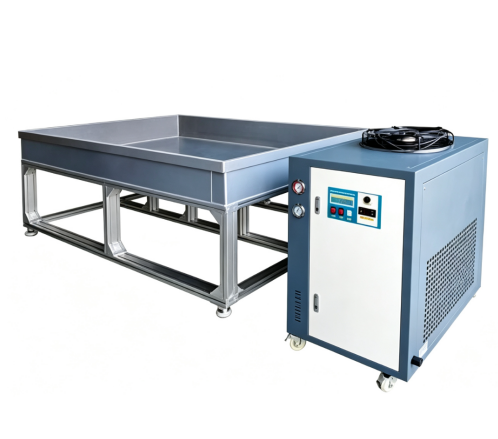


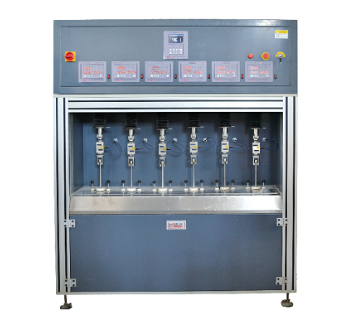
The Wet Leakage Current Test System evaluates the insulation performance of PV modules under humid conditions and verifies whether moisture from rain, fog, or dew penetrates internal circuitry, causing leakage or corrosion. Featuring a PVC water tank and an in-house developed constant-temperature system, paired with a programmable insulation and withstand voltage tester supporting 0.01–12 kV DC withstand and insulation resistance measurement, it is widely used for PV module reliability and safety verification.
Application
The Wet Leakage Current Test System is mainly used for reliability and safety testing of photovoltaic modules and related electrical components.
(1)PV Module Safety Verification
Testing whether solar modules maintain proper insulation performance under wet conditions.
(2)Moisture Resistance Evaluation
Simulating rain, humidity, and water exposure environments to evaluate protection against moisture penetration.
(3)Insulation Performance Testing
Measuring insulation resistance and leakage current to identify potential electrical safety risks.
(4)Quality Control for Solar Manufacturers
Used for production inspection and reliability verification of photovoltaic modules.
Standards
Complies with the requirements of IEC 61215-2:2016 and IEC 61730-2:2016.
Technical Specifications
Category | Item | Specification |
1. Test Water Tank | Dimensions | Approx. L 2110 × W 1610 × H 250 mm |
Material | PVC | |
2. Temperature Control | System | Water constant-temperature system, independently developed by Hongtu |
Temperature | 20–24 °C | |
3A. DC Withstand Voltage Test | Output voltage range | 0.01 kV – 12.000 kV |
Output voltage accuracy | ±(3% of set value + 5 V) | |
Output voltage resolution | 10 V | |
Maximum rated output power | 36 VA (6000 V, 6 mA) | |
Output voltage stability | ±(1% of set value + 5 V) | |
Voltage display range (DC) | 0.01 kV – 12.000 kV | |
Voltage display resolution (DC) | 0.001 kV | |
Voltage measurement accuracy (DC) | ±(3% of set value + 0.005 kV) | |
Current display range (DC) | 0.000 mA – 6.000 mA | |
Current display resolution (DC) | 0.001 mA | |
Current measurement accuracy (DC) | ±(1% of set value + 2 digits) | |
Rise time | 0.4 s – 999.9 s | |
Fall time | 0.1 s – 999.9 s | |
Test time | 0.1 s – 999.9 s | |
Time resolution | 0.1 s | |
Time accuracy | ±(0.1% of set value + 0.05 s) | |
3B.Insulation Resistance Test | Output voltage range | DC 0.5 kV – 3 kV |
Output voltage resolution | 1 V | |
Output voltage accuracy | ±(3% of set value + 0.005 kV) | |
Resistance measurement range | 0.1 MΩ – 99.9 GΩ | |
Resistance display accuracy | ±(2% of displayed value + 3 digits) for 100 kΩ ≤ R ≤ 9.99 GΩ;±(20% of displayed value + 3 digits) for 10 GΩ ≤ R ≤ 99 GΩ | |
Rise time | 0.4 s – 999.9 s | |
Fall time | 0.1 s – 999.9 s | |
Test time | 0.1 s – 999.9 s | |
Time resolution | 0.1 s | |
Time accuracy | ±(0.1% of set value + 0.05 s) | |
4.Main Configuration | Components | a. Insulation & withstand voltage tester; b. Water constant-temperature system (control box); c. Insulation water tank; d. Conductivity meter |
Equipment List
No. | Equipment Name |
1 | Water tank |
2 | Insulation & withstand voltage tester |
3 | Constant temperature & humidity system control cabinet |
4 | Sample holder / rack |
5 | Resistivity meter |
6 | Power cord |
FAQ
(1)What is the purpose of the Wet Leakage Current Test System?
The system is used to verify whether photovoltaic modules maintain electrical insulation performance when exposed to moisture. It helps identify potential problems such as leakage current, insulation degradation, and moisture-related electrical failures before products are installed in real environments.
(2)Why do PV modules need wet leakage testing?
Solar modules are often exposed to rain, humidity, and condensation during outdoor operation. Wet leakage testing simulates these conditions to evaluate whether moisture can affect internal circuits and ensures long-term safety and reliability.
(3)What parameters can be measured during testing?
The system can measure DC withstand voltage performance, leakage current, and insulation resistance. These parameters provide important information about the electrical safety and insulation condition of photovoltaic modules.
(4)What is the function of the constant-temperature water system?
The constant-temperature system maintains stable water conditions during testing, reducing environmental variation and ensuring repeatable results when evaluating moisture-related insulation performance.
(5)Who typically uses this testing system?
It is mainly used by photovoltaic module manufacturers, solar testing laboratories, certification organizations, and research institutions for product development, quality inspection, and safety verification.
Leave Message Get Price