Pressure Conductive Thermal Resistance Tester
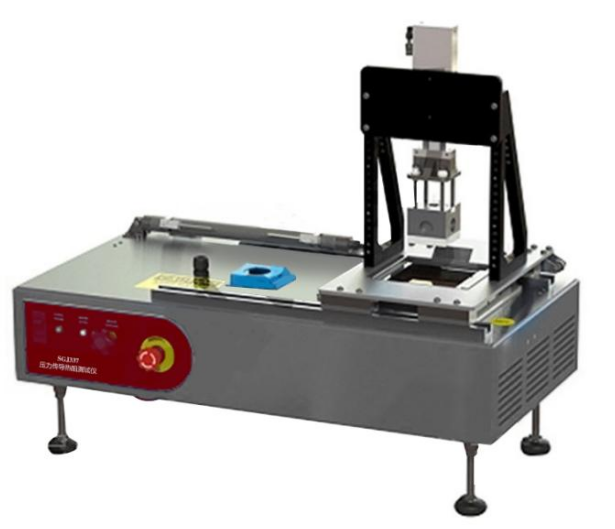


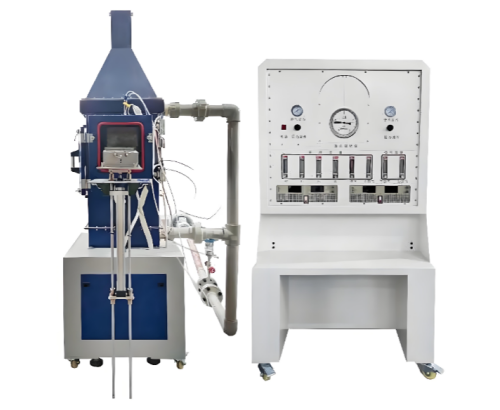
The Pressure Conductive Thermal Resistance Tester is designed to evaluate the thermal protective performance of protective clothing materials when they are pressed against a heated surface. The tester applies controlled heat and pressure to a fabric specimen and measures the resulting heat transfer to evaluate thermal insulation performance and potential burn risk.
Application
(1) The Pressure Thermal Resistance Tester is designed according to the thermal protective performance test methods specified in NFPA 1971 and ASTM F1060 for evaluating the thermal protection performance of protective clothing fabrics under contact with heated surfaces.
(2) When protective clothing fabrics are pressed against a heated surface, the transferred heat may be released toward the wearer’s skin under pressure, causing potential burn injuries if sufficient heat energy is transmitted. To measure the amount of energy transferred through protective fabrics to the wearer, standardized fabric exposure conditions and precise parameter analysis are required.
(3) The ASTM F1060 test method is used to measure and calculate the thermal insulation performance of protective clothing fabrics when placed in contact with a heated surface at temperatures up to 600°F (316°C). The tester fully complies with this standard and integrates a precisely temperature-controlled heating plate, a uniformly heat-conductive test surface, specimen holder, movable calorimeter, pneumatic transmission tray, compressed air system, and data acquisition and control system.
Standards
(1) NFPA 1971 — Standard on protective clothing and equipment for structural fire fighting and proximity fire fighting
(2) ASTM F1060 — Standard Test Method for Thermal Protective Performance of Materials for Clothing When Exposed to Contact with a Heated Surface
Technical Specifications
| Parameter | Specification |
|---|---|
| Heating Plate | 8 × 8 in stainless steel heating plate |
| Maximum Heating Temperature | Up to 371°C |
| Heating Temperature Accuracy | 371°C ± 1.5°C |
| Specimen Size | Maximum 6 × 6 in (15 × 15 cm) |
| Maximum Specimen Thickness | 2 in (5 cm) |
| Pneumatic Pressure Range | 0.5–8.0 psi |
| Maximum Pneumatic Pressure | 8.0 psi |
| Pressure Control | Computer-controlled pneumatic system |
| Pressure Adjustment | User-defined |
| Pressure Monitoring | Precision gravity valve system |
| Heat Transfer Test Plate | Removable |
| Test Operation | Automatic and manual modes |
| Specimen Exposure | Electronically controlled |
| Test Plate Material | Copper heat-transfer plate |
Features
(1) Evaluates the potential skin burn risk caused by heat transfer when protective fabrics are pressed against heated surfaces.
(2) Supports both automatic and manual testing modes to meet different laboratory requirements.
(3) The pneumatic compression pressure applied to the specimen ranges from 0.5 psi to 8.0 psi.
(4) The pressure applied to the specimen is monitored in real time through a precision gravity valve system, ensuring accurate pressure control during testing.
(5) The heating surface can be accurately heated up to 371°C ± 1.5°C, providing stable and reliable thermal exposure conditions.
(6) The specimen holder is electronically controlled to precisely regulate the exposure time of the sample to the heat source.
(7) During testing, the copper plate provides uniform heat conduction, ensuring consistent heat transfer across the specimen surface and improving test accuracy.
FAQ
(1) What does the Pressure Conductive Thermal Resistance Tester evaluate?
The tester evaluates how effectively protective clothing materials limit heat transfer when pressed against a heated surface. The test is intended to characterize conductive thermal protection and help assess the potential for heat energy to reach the wearer.
(2) Why are both heat and pressure applied during the test?
Pressure can increase contact between the fabric and heated surface, affecting heat transfer through the material. ASTM F1060 establishes controlled exposure conditions so different protective materials can be evaluated using a consistent thermal contact test method.
(3) What is the maximum heating temperature of the tester?
The heating plate can reach 371°C ± 1.5°C, while ASTM F1060 describes testing with heated surfaces up to approximately 316°C (600°F). The actual temperature should be selected according to the applicable test procedure.
(4) How is the pressure applied to the specimen?
A computer-controlled pneumatic system applies pressure to the specimen, with a specified range of 0.5–8.0 psi. The pressure is monitored through the control system, allowing the laboratory to establish the required loading condition.
(5) Can QINSUN help configure the tester for ASTM F1060 testing?
Yes. QINSUN engineers can review your protective clothing material, specimen dimensions, required pressure, heating temperature, exposure procedure, and applicable standard before recommending the configuration.
Leave Message Get Price