Vacuum Low Pressure Test Chamber
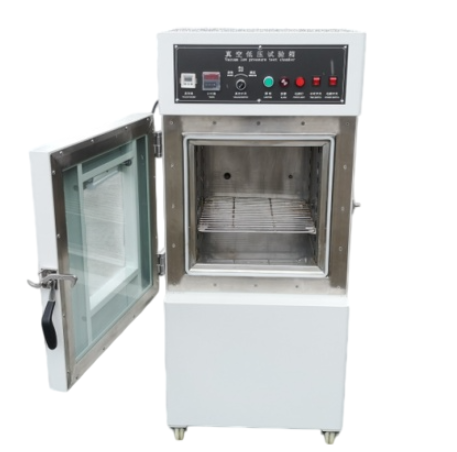


The Vacuum Low Pressure Test Chamber is designed for vacuum and low-pressure environmental simulation tests. By reducing the air pressure inside the chamber, it can simulate high-altitude or low-pressure conditions and evaluate how test samples perform under a controlled negative-pressure environment.
The chamber uses a reinforced SUS304 stainless steel inner chamber and an automatic vacuum control system. The vacuum pump stops automatically when the preset level is reached and restarts when the pressure rises above the lower limit, helping maintain a stable test condition during the test.
Application
(1) Electronic and Electrical Products
Testing electronic components, electrical assemblies, power supplies, connectors, and other products that may be exposed to low atmospheric pressure.
(2) Battery and Energy Products
Evaluating applicable battery cells, battery components, and energy-storage components under simulated high-altitude pressure conditions.
(3) Automotive Components
Testing automotive electrical and electronic components, sensors, connectors, and other parts intended for high-altitude applications.
(4) Packaging and Sealed Products
Evaluating sealed packages, containers, housings, and components for deformation or leakage under reduced pressure.
(5) Aerospace and High-Altitude Products
Simulating reduced atmospheric pressure for components and materials designed for high-altitude environments.
(6) Reliability and R&D Testing
Supporting product development, design verification, incoming inspection, and reliability evaluation where low-pressure exposure is required.
Standards
(1) IEC 60068-2-13 — Environmental testing — Low air pressure
(2) MIL-STD-810 — Environmental Engineering Considerations and Laboratory Tests, including low-pressure/altitude testing
(3) GB/T 2423.21 — Environmental testing — Test methods for low air pressure
The applicable standard and test conditions should be confirmed according to the tested product and the latest edition of the required standard.
Parameters
| Parameter | Specification |
|---|---|
| Inner Chamber Dimensions | 400 × 400 × 400 mm (W × D × H) |
| Outer Chamber Dimensions | Approx. 600 × 500 × 1200 mm (W × D × H), subject to actual product |
| Inner Chamber Structure | Single-layer chamber with one mesh plate |
| Inner Chamber Material | SUS304 stainless steel, 3.0 mm thick |
| Outer Chamber Material | 1.0 mm cold-rolled steel plate with powder coating |
| Viewing Window | Tempered glass, 19 mm thick |
| Viewing Window Size | 150 × 150 mm |
| Door Sealing | High-temperature-resistant silicone sealing strip |
| Insulation | Rock wool |
| Machine Structure | Integrated one-piece structure |
| Vacuum Pump | VP-1 direct-drive vacuum pump |
| Vacuum Gauge | Panasonic digital vacuum gauge |
| Vacuum Range | 0 to -93.0 kPa |
| Optional Vacuum Range | Up to -100.0 kPa |
| Vacuum Accuracy Deviation | ≤ ±0.2 kPa |
| Vacuum Holding Leakage Rate | 1.0 kPa/h |
| Vacuum Control | Automatic cyclic control |
| Vacuum Holding Timer | Available |
| Pressure Release | Manual |
| Power Supply | 220 V |
| Current | 3 A |
| Total Power | 0.5 kW |
| Safety Protection | Grounding protection, fast fuse protection, and other safety functions |
Features
(1) Automatic vacuum control maintains the preset negative-pressure condition.
(2) Automatic pump stop and restart reduce the need for continuous manual adjustment.
(3) Digital vacuum gauge provides direct relative vacuum-pressure indication.
(4) Reinforced 3.0 mm SUS304 inner chamber helps resist deformation during vacuum operation.
(5) Integrated vacuum pump is installed in the lower section of the machine.
(6) Vacuum holding timer supports preset-duration testing with an alarm when the test time is reached.
(7) Tempered-glass viewing window allows observation of the specimen during testing.
(8) Manual pressure release allows controlled return to atmospheric pressure after testing.
(9) Compact integrated structure is suitable for laboratory installation.
FAQ
(1) What is the difference between vacuum pressure and absolute pressure in this chamber?
This chamber uses relative vacuum pressure. For example, at standard atmospheric pressure of approximately 101.3 kPa, a vacuum reading of -89.7 kPa corresponds to an approximate absolute pressure of 11.6 kPa. The required setting should follow the test procedure.
(2) Can the chamber simulate high-altitude environmental conditions?
Yes. Reducing chamber pressure can simulate the low atmospheric pressure experienced at altitude. However, the required pressure should be calculated from the applicable test altitude or standard rather than selected arbitrarily.
(3) How stable is the vacuum during a holding test?
The specified vacuum holding leakage rate is 1.0 kPa/h, with a maximum vacuum accuracy deviation of ±0.2 kPa. The automatic control system restarts the pump when the vacuum falls below the configured lower limit.
(4) What should I consider when selecting the vacuum range?
Selection should be based on the required absolute pressure, simulated altitude, sample characteristics, and applicable test standard. The standard configuration reaches -93.0 kPa, while a -100.0 kPa range is available as an option.
(5) Can QINSUN help configure the chamber for a specific low-pressure test?
Yes. QINSUN engineers can review your sample size, required vacuum or absolute pressure, test duration, standard, and operating conditions to recommend a suitable configuration. QINSUN also calibrates and tests equipment before delivery. For customized requirements, contact a QINSUN engineer for further guidance.
Leave Message Get Price