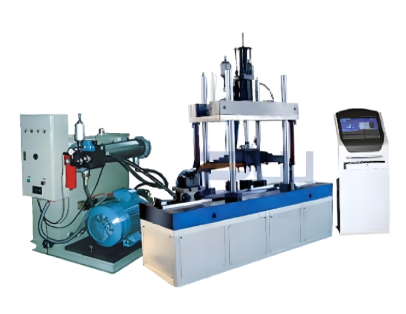
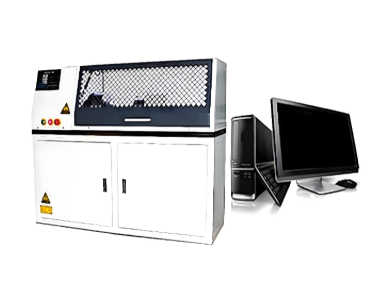
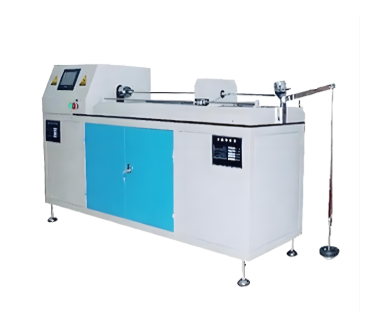
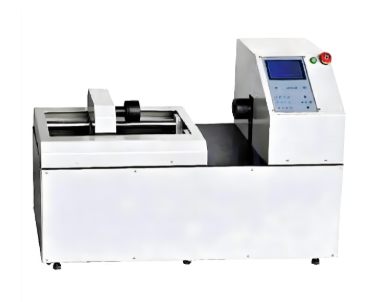
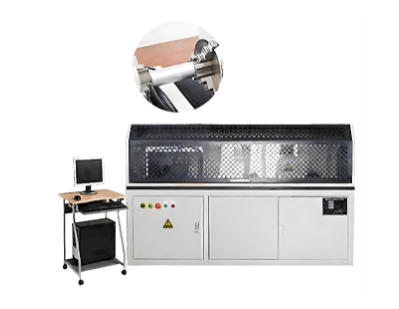
Sponge Indentation Hardness and Fatigue Testing Machine
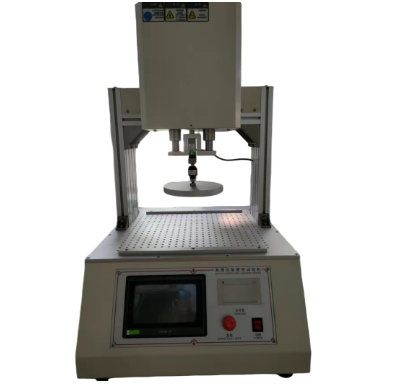


I. Application
This machine is used to determine the indentation hardness of cellular elastic materials. It can be used to perform tests on polyurethane sponge foam specimens in accordance with the requirements of applicable national standards, accurately determining the indentation hardness of materials such as sponge and foam.
It can also be used to measure the specified indentation hardness of manufactured seat foams, such as backrest and seat cushion foams, accurately determining the indentation hardness of various foam components used in seats.
II. Principle
In the sponge foam compression stress test, the specimen is placed between the upper and lower compression plates. The upper compression plate moves downward at a specified speed and compresses
the specimen to the specified indentation depth required by the national standard for Method A (Method B or Method C).
The load cell detects the applied pressure and feeds the signal back to the controller for processing and display, thereby determining the indentation hardness of sponge, foam, and other test materials.
III. Functional Features
1.Automatic Zeroing: After receiving the test start command, the computer automatically resets the system to zero.
2.Automatic Return: After the specimen breaks, the machine automatically returns to the initial position.
3.Automatic Range Switching: Different measurement ranges can be switched according to the applied load to ensure measurement accuracy.
4.Adjustable Test Speed: The test speed can be freely adjusted according to different specimens.
5.Indication Calibration: The system enables accurate calibration of the force value.
6.Control Methods: According to test requirements, various test methods can be selected, including test force, test speed, displacement, and strain.
7.Multi-Purpose Machine: Equipped with load cells of different specifications, the machine can perform multiple types of tests.
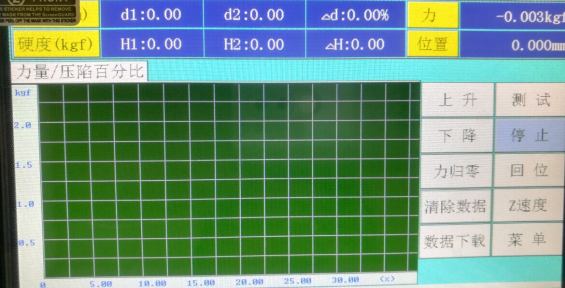
8.Curve Data Tracking: After the test is completed, the force and deformation data at individual points on the test curve can be selected and analyzed using the mouse.
9.Display: Test data and curves are dynamically displayed throughout the test process.
10.Results: Test results can be saved and retrieved, and data curves can be analyzed.
11.Limit Protection: The machine is equipped with both programmable and mechanical limit protection.
12.Overload Protection: The machine automatically stops when the applied load exceeds the rated value.
IV. Technical Specifications
No. | Item | Specification |
1 | Control Method | Touchscreen control |
2 | Sensing Method | Precision load cell |
3 | Capacity | 200 kg |
4 | Unit Conversion | kg, N, lb |
5 | Upper Compression Plate | Diameter: 200 mm; Bottom corner radius: R1 mm |
6 | Lower Platform | 420 × 420 mm; Ventilation hole diameter: 6 mm; Hole spacing: 20 mm |
7 | Maximum Stroke | 75 mm |
8 | Test Speed | 100 ± 20 mm/min |
9 | Drive System | Servo motor |
10 | Transmission System | Precision ball screw |
11 | Power Supply | Single-phase, 220 V, 50 Hz/60 Hz, 2.5 A |
12 | Weight | 160 kg |
Leave Message Get Price