Constant Temperature Room
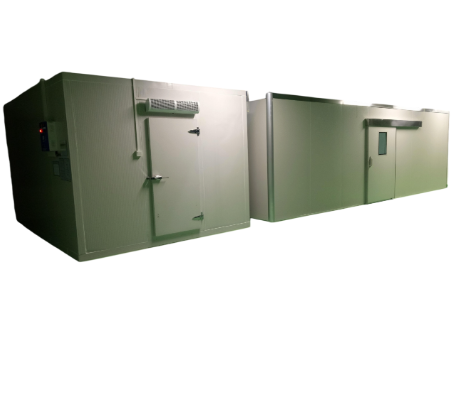


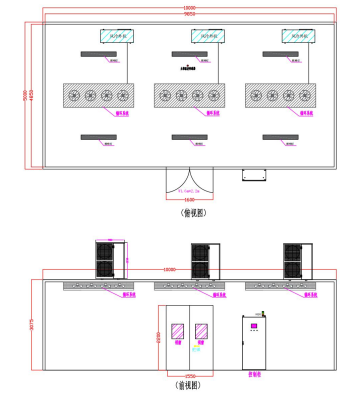
Test Area External Dimensions | 10000 × 5000 × 3075 mm (W × D × H), 1 Room |
Test Area Internal Dimensions | 9850 × 4850 × 3000 mm (W × D × H) |
Preliminary Layout Drawing:
| |
Design Temperature Range | 10°C to 20°C (Adjustable) |
Operating Temperature Range | 15°C to 18°C (Adjustable) |
Temperature Change Rate | Average cooling rate: 0.5°C to 2.5°C/min |
Controller Resolution | 0.1°C |
Temperature Control Accuracy | ±0.5°C |
Temperature Fluctuation | ±2°C |
Temperature Uniformity | ±2°C (No-load condition) |
Temperature Sensor | High-precision Platinum PT100 temperature sensor with Teflon high-temperature cable |
Equipment Noise Level | <65 dB (Measured at a distance of 1.5 m from the chamber with the door closed) |
Fire Protection Rating | Class A Flame-Retardant Construction |
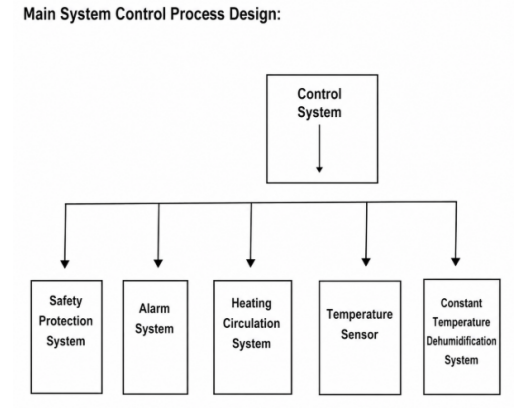
Safety Features | Overcurrent protection, electronic dry-run over-temperature protection, phase sequence protection, smoke alarm, circulating fan overload protection, compressor overload protection, exhaust fan overload protection, etc. |
Standard
Reference Standards:
l GB 7691-2003: General Principles for Safety Management
l GB 25295-2010: Guidelines for Safety Design of Electrical Equipment
l GB 50016-2006: Code for Fire Protection Design of Buildings
l GB 16297-1996: Comprehensive Emission Standard of Air Pollutants
l GBJ 87-85: Code for Design of Noise Control in Industrial Enterprises
l GB 50034-92: Standard for Lighting Design of Industrial Enterprises
l GBZ 1-2002: Hygienic Standards for the Design of Industrial Enterprises
l GBJ 81-95: Code for Occupational Safety and Health Design of Machinery Industry
Technical Reference Standards:
l GB/T 2423.2-2001: Environmental Testing for Electrical and Electronic Products
l GB 50054-95: Code for Design of Low-Voltage Electrical Installations
l GB 50052-95: Code for Design of Power Supply and Distribution Systems
Structure and Materials
1 | Chamber Structure | · Five-sided insulated wall system: · Room body materials: · Excellent thermal insulation performance: · Good sound insulation performance: · Edge sealing of the structure: |
2 | Test Door | Double outward-opening door, 1 set; size: W1600 × H2200 mm (quantity and opening direction subject to final confirmation) |
3 | Viewing Window | Tempered insulated glass viewing window installed on test door; size: W400 × H500 mm, thickness 50 mm |
4 | Interior Lighting | Clean LED ceiling light panel, size 1200 × 300 mm (L × W), AC 220V power supply, ceiling-mounted with uniform distribution |
5 | Power Socket | Standard 5-hole concealed socket, 220V, 10A; quantity and location to be determined |
Air Supply and Circulation System:
(Circulation fan, effectively ensuring uniform temperature distribution within the chamber)
The circulation system adopts the latest independently developed design concept, with the heating circulation operating within the interior of the chamber.
1. Design Advantages:
Energy-saving and power-efficient: this design reduces energy consumption by up to 60%, with low noise levels below 65 dB.
2. High-quality heating circulation unit:
Equipped with a high-performance heating circulation unit to achieve forced convection vertical diffusion circulation.
3. Circulation fan configuration:
The circulation fan adopts a high-temperature resistant external rotor axial flow fan, with an F-class thermal resistance rating.
4. Airflow circulation design:
The airflow system is designed with upper side air supply and lower return air configuration. Hot air is distributed through forced convection and vertical diffusion circulation, ensuring uniform temperature consistency within the constant temperature chamber’s heating control system. It also enables rapid temperature recovery when the door is opened and closed.
5. Optimized ventilation design:
Strong air supply and circulation eliminate any dead zones, ensuring even temperature distribution throughout the chamber.
6. Energy efficiency compliance:
Improved energy efficiency, fully meeting current international and domestic environmental protection standards.
7. Noise reduction performance:
Lower noise operation ensures a better working environment for office staff and operators.
8. Compact and maintenance-friendly structure:
Minimal duct volume and ultra-compact design ensure a clean, spacious, and aesthetically pleasing interior, while also facilitating easy installation, maintenance, and servicing.
Heating System:
(PID control of heating output power for improved energy efficiency)
1. Heater Parameters:
l Heating power: 36 kW
l Voltage: Three-phase / AC 380 V
l Current: 55 A
l Heater: Stainless steel fin-type heater with over-temperature protection on the surface to prevent overheating.
It adopts high-quality #304 stainless steel finned high-speed electric heaters, featuring low heating power consumption, fast heating speed, and energy-saving performance.
2. Heating control system:
The heating control system uses a power regulator, which is a linear input control module. This module replaces conventional mechanical relays, making the equipment more energy-efficient.
3. Power regulation function:
The power regulator can adjust output power according to different temperature requirements and does not cause oscillation or interference to the power grid.
4. Heating method:
The heating system adopts a hot air circulation heating method, ensuring uniform temperature distribution. The system operates independently and does not interfere with the control circuit.
5. Intelligent energy control:
The temperature control output power is calculated by a microcomputer system, which automatically adjusts heating power based on internal load conditions, achieving high precision and efficient energy utilization, while being more environmentally friendly and energy-saving.
Constant Temperature System: (High efficiency and energy saving)
1. Cooling System: The refrigeration system consists of three 10 kW cooling units, using original-brand high-efficiency, low-noise, and energy-saving refrigeration compressors.
2. Cooling method: The system uses a compressor-based refrigeration unit to provide cooling capacity. The cooling system starts automatically when the chamber temperature exceeds the set value.
3. Refrigerant: The entire system uses environmentally friendly low-temperature refrigerant.
4. Copper tubing: Internal spiral K-type refrigerant copper tubes are adopted.
5. Leak detection: All pipelines in the system undergo leak testing to eliminate any possibility of refrigerant leakage.
6. Condenser: Wave-fin type forced-air cooling condenser.
7. Evaporator: Sloped FIN-TUBE evaporator design.
8. Control system: The heating and cooling systems operate completely independently. All refrigeration operation sequences are controlled by a microcomputer controller, ensuring maximum efficiency and energy saving.
9. Overall performance: More energy-efficient, quieter operation, and improved cooling performance.
Control System: (The controller can display real-time temperature and aging time)
1. Control method: PLC controller + PT100 temperature sensor jointly achieve temperature control.
Control cabinet door panel: emergency stop button, start switch, power indicator light, lighting switch, and nameplate.
The control cabinet can be optionally equipped with a three-color signal tower light, and company logo customization is available.
Control method: PLC controller + PT100 temperature sensor jointly achieve temperature regulation.
Remote control: The remote control system supports two monitoring methods: the first is LAN-based monitoring, and the second is mobile APP-based monitoring.
1.1 Remote PC control: Dedicated software installed on the PC enables remote computer-based operation and control.
1.2 Mobile APP: After the controller is connected to the internet, users can download and install the APP on their mobile phones to remotely monitor or control the controller.
2. The controller adopts a full-color touchscreen LCD interface, and the entire temperature control system is automatically managed by PLC.
3. Resistive high-precision touchscreen operation allows users to use a USB mouse or stylus for function selection and parameter setting.
4. Programmable capacity: 160 patterns × 1600 steps × 999 cycles.
5. Display function: LCD screen shows test conditions including temperature stages, cycle counts, running time, and remaining time.
6. Supports both program control and constant value control for various application requirements.
7. Temperature gradient setting allows flexible control of running time and heating rate.
8. Scheduled start function: the system automatically starts when the preset time is reached.
9. Power failure restart function: selectable cold start / hot start / resume from interruption.
10. Synchronized coordinated temperature control improves system stability and service life of components and interface.
11. Real-time and historical curve viewing for easy monitoring of temperature changes.
12. Data export function with two USB ports for convenient storage of historical data.
13. File backup function.
14. External computer interface allows PC connection for remote operation, data saving, and printing of curves and test reports.
15. Operation runtime accumulation function for tracking equipment usage and maintenance scheduling.
16. Screen saver function to extend LCD service life.
17. Fault diagnosis system displays error information, causes, and solutions.
18. User permission level settings prevent unauthorized or incorrect operations.
19. Language switching between Chinese and English for user convenience.
20. Control mode: PID (Proportional-Integral-Derivative) automatic calculation. The PID control is simple to operate and does not require an accurate system model.
21. Warning signals are issued in case of input or setting errors.
22. Power switch and lighting control via controller to reduce cost and improve usability.
23.Temperature sensor: high-precision temperature sensor.
Power Supply
Power Supply | AC 380V, 50Hz, three-phase four-wire system + protective earth |
Voltage Fluctuation Range | AC (380 ± 38) V |
Frequency Fluctuation Range | (50 ± 0.5) Hz |
Grounding Requirement | Protective grounding resistance < 4Ω; TN-S or TT power supply system |
Installation Requirement | User must provide an air switch or power switch with appropriate capacity at the installation site |
Maximum Power | 50 kW |
Maximum Current | 76 A |
Cable Specification | Three-phase five-wire system: 3 × 25 mm² + 2 × 10 mm² |
Main Cable Requirement | The main power cable shall be provided by the buyer and connected to the equipment control cabinet installation position |
Operating Environment
1. Temperature: 0–35°C.
2. Relative humidity: ≤85% RH.
3. Atmospheric pressure: 86–106 kPa.
4. No strong vibration in the surrounding area.
5. No direct sunlight or direct radiation from other heat sources.
6. No strong airflow in the surrounding area; if forced air circulation is required, the airflow shall not be directed onto the chamber body.
7. No strong electromagnetic interference in the surrounding area.
8. No high concentration of dust or corrosive substances.
9. Well-ventilated installation site.
Accessories
1. Operation Manual.
2. Electrical Wiring Diagram.
3. Certificate of Inspection / Certificate of Conformity.Main Components
Control System
No. | Name | Specification | Quantity |
1 | Control Cabinet | W1800 × H800 × D380 mm | 1 set |
2 | Temperature Controller | 7-inch | 1 set |
3 | Power Indicator Light | AC220V | 3 pcs |
4 | Push Button | AC220V | 3 pcs |
5 | Three-color Alarm Light | Three-color | 1 pc |
6 | Power Switch | 3P | 1 batch |
7 | Miniature Circuit Breaker | 1P C10A | 1 pc |
8 | Phase Loss Protector | 380V | 1 pc |
9 | Intermediate Relay | AC220V | 1 batch |
10 | AC Contactor | AC220V | 1 batch |
11 | Solid State Relay | 40A | 3 sets |
12 | Thermal Overload Relay | LRD | 4 pcs |
13 | Sensor | PT100 | 4 pcs |
14 | Over-temperature Controller | 220V | 3 sets |
15 | Cooling Fan | 220V | 1 set |
16 | Wiring Cable | Yellow / Green / Red | As required |
17 | Terminal Accessories | — | As required |
Heating Circulation System
No. | Name | Specification | Quantity |
1 | Sheet Metal | 2400 × 800 × 300 (W × D × H) mm | 3 sets |
2 | Fan | 380V | 1 batch |
3 | Heater | 36 kW | 1 batch |
4 | Consumables | As required | 3 sets |
Constant Temperature Air Exchange System
No. | Name | Specification | Quantity |
1 | Outdoor Unit | Cooling capacity 10 kW | 3 sets |
2 | Evaporator | Fin-tube type | 12 sets |
3 | Copper Pipe | As per specification | 1 batch |
4 | Insulation + Drain Pipe | As per specification | 1 set |
5 | Auxiliary Materials | As required | 1 set |
Leave Message Get Price