Impulse Voltage Test System
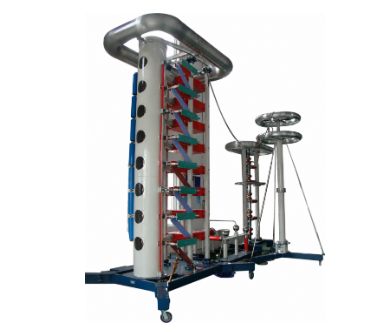


An Impulse Voltage Test System is a specialized testing device used to simulate lightning strikes or switching overvoltages in power systems in order to evaluate the ability of electrical equipment insulation to withstand transient high voltages. It is mainly used to assess the safety and reliability of high-voltage products such as transformers, cables, surge arresters, and switchgear.
Applications
Impulse voltage test system can generate lightning voltage and switching voltage with impulse amplitude over 1350kV. The system can carry the insulation withstand test for insulating materials and power equipment, it meets the requirements of IEC 60099-4 and relevant standards.
Standards
IEC60099-4
IEC60060
Technical Parameters
| Impulse Voltage | Waveform | ||
| Front Time | Duration Time | Peak | |
| 1.2/50 | 1.2μs ± 30% | 50μs ± 20% | 100-1500kA ± 10% |
| 250/2500 | 250μs ± 20% | 2500μs ± 60% | 100-1500kA ± 10% |
| Tested Sample | Electrical material or equipment | ||
Features
Wide Voltage Output Range: Capable of generating extremely high test voltages ranging from several kilovolts to several megavolts (such as from hundreds of kilovolts up to multiple megavolts).
Flexible Waveform Adjustment and High Efficiency: Featuring low internal inductance, convenient waveform adjustment, and high voltage utilization efficiency, the system can accurately and efficiently simulate real surge impulse conditions.
High-Precision Measurement and Control: The system is typically equipped with precision damping voltage dividers, chopping devices, and advanced digital measurement systems to ensure that the front time and time to half-value strictly comply with international standards.
Excellent Synchronization and Reliability: Multi-stage generators provide outstanding synchronous discharge performance, ensuring stable and reliable operation.
Compact Modular Design: Adopts a compact structure to save laboratory space, while some systems also support flexible configurations for generating impulse currents.
Maintenance Information
Cleaning Procedure: Regularly remove dust and contaminants from the surfaces of insulating columns, capacitors, and voltage dividers to prevent surface discharge or leakage current caused by dust accumulation.
Visual Inspection: Inspect all stages of wave-shaping resistors, triggering spark gaps, high-voltage cables, and grounding wires for physical damage, aging, burn marks, erosion, or poor electrical contact.
Mechanical Structure Inspection: Check whether the gap adjustment mechanism of the spark gaps operates smoothly, and ensure that all transmission and moving parts are properly lubricated.
FAQ
1. What is the working principle of the system?
The system mainly consists of a charging unit, generator body (multi-stage capacitors), wave-shaping resistors, voltage dividers, and a control and measurement system. During operation, each stage capacitor is charged in parallel through charging resistors to a preset voltage level. Once the preset value is reached, the first-stage triggering sphere gap is ignited, and the resulting overvoltage sequentially triggers the remaining cascade sphere gaps to discharge synchronously. At this moment, the capacitor connection changes from parallel to series, allowing the voltage to multiply and instantaneously release a high-voltage impulse wave to the test object.
2. How are the voltage level and energy configured for a specific test object (such as a transformer)?
When selecting a system, its maximum output voltage must exceed the Basic Insulation Level (BIL) of the test object. The total generator energy (expressed in kilojoules, kJ) must be sufficient to satisfy the energy demand of the specimen under the specified test voltage. For large-capacity test objects (such as large power transformers), evaluation based on their capacitive load characteristics is required, and multiple generators may need to be connected in parallel or cascaded to meet the waveform requirements.
3. How is waveform adjustment (front time and tail time) achieved?
The waveform is mainly adjusted by damping resistors connected in series within the circuit, including the front resistor and tail resistor. By replacing or adjusting resistors with different resistance values, the charging and discharging time constants of the circuit can be modified, thereby ensuring that the output waveform complies with the tolerance range specified by the relevant standards.
4. What are the acceptance criteria for the test?
The tested equipment must withstand the specified impulse voltages with both polarities (typically 10 positive and 10 negative impulses). The acceptance criteria generally include:
No obvious internal discharge sound or flashover occurs during the test.
No abnormal distortion appears in the voltage and current waveforms before and after voltage application.
Routine electrical tests conducted after the impulse test (such as insulation resistance and dielectric loss tests) show no insulation deterioration or breakdown.
5. What are the key safety precautions when operating the system?
Since the system involves extremely high transient voltages (commonly ranging up to several thousand kV), very strict safety requirements must be followed:
Hardware Grounding: Before testing or modifying any wiring connections, the generator body must be physically discharged and reliably grounded using a grounding rod.
Environmental Safety: The test area must be equipped with interlocked safety doors and warning indicator lights. Unauthorized personnel are strictly prohibited from entering the high-voltage danger zone.
Grounding Resistance: During chopped-wave tests, impulse current flowing through the grounding resistance may generate a high voltage drop. Therefore, the grounding resistance must be strictly limited according to the specified requirements (typically not exceeding the prescribed value) to prevent back-strike damage to measuring instruments.
Leave Message Get Price