Vacuum Cleaner Full-Unit Charge-Discharge Life Tester
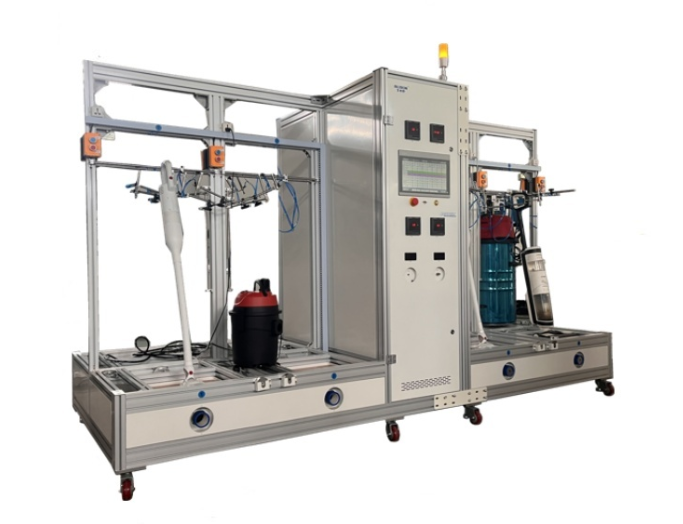


The Vacuum Cleaner Full-Unit Charge-Discharge Life Tester is designed for long-term evaluation of vacuum cleaner battery performance and overall unit durability. You use this equipment to simulate extended charge and discharge cycles, monitoring voltage, current, power, suction force, and temperature variations. PLC-controlled automation enables precise recording of cycle counts and durations, while the system automatically pauses upon fault detection or completion. This tester ensures accurate life-cycle analysis, enhances operational efficiency, and allows unattended, fully automated testing of complete vacuum cleaner units.
Applications
Extended battery life testing for complete vacuum cleaner units
Charge-discharge performance analysis under repeated cycles
Operational aging tests for cordless vacuum cleaners and floor scrubbers
Quality assurance and R&D for manufacturers of vacuum cleaners
Testing institutions and certification laboratories evaluating battery and full-unit durability
Standards
IEC 60312: Household and Similar Electrical Appliances – Vacuum Cleaners – Methods for Measuring Performance
GB/T 20291.1-2014: Household and Similar Electrical Appliances – Vacuum Cleaners – Part 1: Methods for Measuring Performance
IEC 62885-2:2020: Surface Cleaning Appliances – Part 2: Dry Vacuum Cleaners for Household or Similar Use – Methods for Measuring Performance
IEC 62133-2:2017: Secondary Cells and Batteries Containing Alkaline or Other Non-Acid Electrolytes – Safety Requirements for Portable Sealed Secondary Cells, and for Batteries Made from Them
GB/T 31467.3-2015: Lithium-ion Battery Pack and Systems for Electric Vehicles – Test Methods for Performance
Technical Parameters
| Item | Specification |
|---|---|
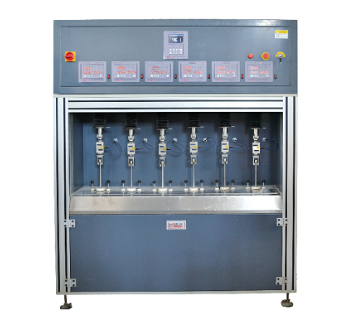
| Test Stations | 12 stations, 6+6 back-to-back configuration |
| Control Interface | 7-inch color touch screen + Mitsubishi PLC (Japan) |
| PLC | Mitsubishi (Japan), with power failure data memory function |
| Voltage & Current | Voltage: AC 0–300V (adjustable), DC 0–36V (adjustable); Current detection: 0–30A |
| Time Setting Range | 1–9999999 hours/minutes/seconds |
| Detection Function | Whole machine service life testing |
| Equipment Power Supply | 220V, 3.5KW |
| Equipment Dimensions | 1650×1200×1650 mm |
Features
You can monitor voltage, current, power, suction force, and temperature in real time.
Fully automated testing with PLC control and fault detection reduces safety risks.
Multi-station design allows simultaneous testing of 12 vacuum cleaner units.
Data retention after power loss ensures uninterrupted testing cycles.
Compatible with various vacuum cleaner models, including handheld, upright, and canister types.
Enhances testing speed, data accuracy, and laboratory efficiency.
Accessoriess
(1) Universal test sockets for each station
(2) Vacuum level detectors for real-time suction monitoring
(3) 7-inch touchscreen with Mitsubishi PLC control
(4) Power supply modules and circuit protection devices
(5) Rack and profile assembly for multiple stations
FAQ
1. What types of vacuum cleaners can be tested on this equipment?
You can test handheld, upright, canister, and cordless vacuum cleaners.
2. How does the system monitor battery performance?
The system tracks voltage, current, power, suction force, and temperature during charge-discharge cycles, recording all changes automatically.
3. Can the tester run unattended?
Yes, the PLC-controlled system allows fully automated testing, pausing automatically upon completion or fault detection.
4. How many units can be tested simultaneously?
You can test 12 vacuum cleaner units simultaneously in a 6+6 back-to-back configuration.
5. What happens if there is a power outage during testing?
The Mitsubishi PLC retains all data, allowing testing to resume without data loss once power is restored.
6. Can test durations and cycles be customized?
Yes, you can set time durations from 1 to 9.999.999 hours, minutes, or seconds, and customize the number of cycles per unit.
7. Is this tester suitable for R&D and quality assurance purposes?
Yes, it is suitable for both R&D testing and QA inspections, providing detailed and repeatable battery and unit lifespan data.
Leave Message Get Price