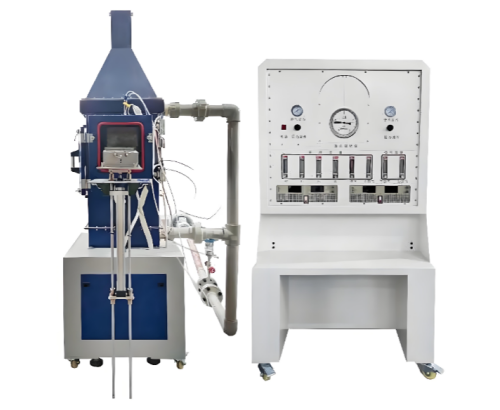
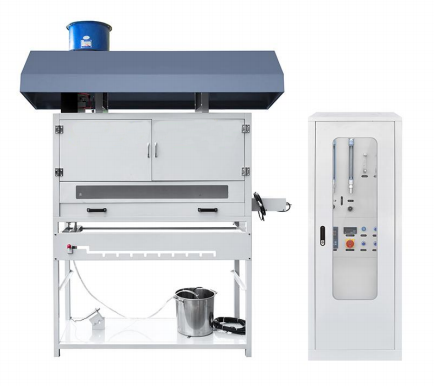
Flooring Material Combustion Performance Tester


Application
The Flooring Material Combustion Performance Tester is designed according to GB/T 11785-2005: Determination of the burning behavior of floor coverings – Radiant heat source method. It is suitable for testing various flooring materials, including textile carpets, cork boards, plywood, rubber sheets, plastic floors, and floor coating materials.
The results reflect the combustion performance of the flooring material, including its substrate. This tester is used to evaluate and describe the burning behavior of flooring materials under controlled laboratory conditions.
Standards
GB/T 11785-2005 – Determination of burning behavior of floor coverings, Radiant heat source method
Technical Parameters
Specimen size: 1050 mm × 230 mm × ≤19 mm; 1025 mm × 230 mm × ≥19 mm
Radiant plate size: 300 mm × 450 mm
Exhaust velocity: 2.5 ± 0.2 m/s
Exhaust capacity: 39–85 m³/min
Propane flow rate: 0.026 ± 0.002 L/s
Radiant temperature range: 400–1200°C
Temperature sensor accuracy: ±0.5°C
Armored thermocouple range: 0–1000°C, resolution 1°C
Heat flux meter range: 0–15 kW/m²
Heat flux meter accuracy: ±0.2 kW/m²
Control cabinet voltage: AC 220V, 50 Hz
Maximum power: 3.5 kW
Test gas: Commercial propane
Alarm: Activates when smoke duct temperature exceeds 400°C
Combustion chamber size: 1450 × 570 × 2500 mm
Control cabinet size: 650 × 600 × 1850 mm
Test Setup
Includes: control box, test chamber, radiant heat source, specimen fixture, igniter, exhaust system, anemometer, radiation thermometer, thermocouples, heat flux meter, calibration plate, and event recording device.
Must be installed at least 0.4 m from walls and ceiling.
Test Chamber
Constructed from 13 ± 1 mm thick calcium silicate, density 650 kg/m³, with fireproof glass (110 ± 10 mm × 1100 ± 100 mm) on the front.
Observation window with a tight-closing door for moving specimens in/out.
Steel rulers installed along specimen edges at 50 mm and 10 mm intervals.
Sliding platform ensures specimen fixture is level.
Air flow area between chamber and fixture: 0.23 ± 0.03 m³, evenly distributed along specimen edges.
Radiant Heat Source
Porous refractory plate mounted on a metal frame, 300 ± 10 mm × 450 ± 10 mm, withstands 900°C.
Gas-air mixture system ensures stable and repeatable tests.
Installed above specimen fixture, long side angled at 30 ± 1° to horizontal.
Specimen Fixture
L-shaped stainless steel, 2.0 ± 0.1 mm thick.
Exposed area: 200 ± 3 mm × 1015 ± 10 mm.
Fixed to sliding steel platform with screws.
Total fixture thickness: 22 ± 2 mm.
Igniter
Stainless steel, inner diameter 6 mm, outer diameter 10 mm.
Two rows of radially distributed holes: 19 on centerline, 16 on 60° line below centerline, hole diameter 0.7 mm.
Propane flow: 0.026 ± 0.002 L/s.
Flame contacts specimen 10 ± 2 mm from zero point after 2-min preheating.
Flame height: 60–120 mm.
Commercial propane heat value ~83 MJ/m³.
Exhaust System
Removes combustion smoke without connecting directly to chamber duct.
Airflow speed: 2.5 ± 0.2 m/s.
Exhaust capacity: 39–85 m³/min at 25°C.
Anemometer
Measures airflow in exhaust channel.
Accuracy ±0.1 m/s.
Positioned 250 ± 10 mm above lower edge of chamber duct, centered.
Radiation Thermometer
Measures radiant heat output.
Range: 480–530°C (blackbody), accuracy ±0.5°C.
Distance from radiant plate: ~1.4 m.
Senses 250 mm diameter circular area on plate.
Sensitivity wavelength: 1–9 μm.
Thermocouples
K-type stainless steel armored, diameter 3.2 mm, insulated, non-grounded junction.
Installed 25 mm below top panel, 100 mm behind chamber duct inner wall, along vertical centerline.
Second thermocouple: 150 ± 2 mm from duct top.
Must be cleaned after each test.
Heat Flux Meter
Diameter: 25 mm, closed type.
Range: 0–15 kW/m².
Cooling water: 15–25°C.
Accuracy: ±3%.
Calibration Plate
Calcium silicate, thickness 20 ± 1 mm, density 850 ± 100 kg/m³, uncoated.
Size: 1050 ± 20 mm × 250 ± 10 mm.
Centerline holes: 26 ± 1 mm at 110, 210… up to 910 mm from zero point.
Time Recording Device
Precision: seconds.
1 h timing error: ≤1 s.
Specimen Preparation
Represent actual usage.
Prepare 6 specimens: 3 along one direction, 3 perpendicular.
If thickness >19 mm, reduce length to 1025 ± 5 mm.
Fix on representative substrate with representative adhesives.
Multi-piece specimens: joints 250 mm from zero point.
Heat-shrinkable materials: ensure secure mounting for consistent results.
Test Procedure
Calibration:
Monthly or after major changes, or extend to 6 months if stable.
Measure airflow at 2.5 ± 0.2 m/s, ignite radiant plate, preheat ≥1 h.
Measure radiant flux at 410 mm; adjust gas/air flow to achieve 5.1 ± 0.2 kW/m².
Stabilize gas flow ≥10 min before reading each new value.
Testing:
Check all connections, power, and gas supply.
Turn on power; input exhaust airflow, close doors, ignite radiant plate; preheat ≥1 h.
Measure blackbody temperature: deviation ≤±5°C; chamber temp deviation ≤±10°C. Adjust gas/air if necessary. Stabilize 15 min before testing.
Mount specimens on fixture; secure with steel clips or as per product instructions.
Ignite igniter, position ≥50 mm from zero point, start sliding platform, close doors, start timing/recording.
Flame contacts specimen after 2 min; maintain for 10 min; then retract igniter ≥50 mm.
Observe flame propagation, melting, bubbling, re-ignition, and record distance/time at every 50 mm.
Test ends after 30 min unless otherwise requested.
FAQ
1.What is a Flooring Material Combustion Performance Tester?
A Flooring Material Combustion Performance Tester is a specialized device used to assess the fire-resistant properties of various flooring materials. It evaluates how well these materials can withstand combustion and how they behave under fire conditions, ensuring safety standards are met in residential and commercial spaces. The tester simulates fire exposure to determine critical parameters such as flame spread rate, smoke production, and heat release.
2.Why is Combustion Performance Testing Important for Flooring Materials?
Combustion performance testing is crucial for flooring materials as it helps identify their fire safety characteristics. This testing plays an essential role in preventing fire hazards, ensuring compliance with building codes and regulations, and protecting occupants. Flooring that meets high combustion performance standards minimizes the risk of ignition and reduces smoke generation, which is vital for safe evacuation during a fire incident.
3.What Standards are Used in Combustion Performance Testing?
Various standards and regulations govern combustion performance testing of flooring materials, including ASTM E648 for critical radiant flux and ASTM E662 for smoke density. Compliance with these standards ensures that flooring materials are tested under consistent conditions, allowing manufacturers, builders, and regulators to evaluate performance accurately. Familiarity with industry standards helps in selecting safe and reliable flooring options.
4.How Often Should Flooring Materials Be Tested for Combustion Performance?
The frequency of combustion performance testing for flooring materials depends on several factors, including changes in manufacturing processes, material formulations, or applicable building codes. Generally, it is recommended to conduct these tests whenever new materials are introduced or existing materials undergo significant modifications. Regular retesting helps manufacturers maintain compliance with safety standards and assures end-users of the product performance over time.
5.What Types of Flooring Materials are Commonly Tested?
Common flooring materials subjected to combustion performance testing include carpets, vinyl, laminate, hardwood, ceramic tile, and resilient flooring. Each material presents unique fire safety challenges, and testing ensures that they perform within acceptable limits. The choice of testing methods may also vary based on the material type, allowing for tailored assessment approaches to meet specific fire safety requirements.
6.Can Consumer Products Be Tested for Combustion Performance?
Yes, consumer flooring products can be subjected to combustion performance testing to ensure they meet safety regulations and guidelines. Manufacturers may choose to have their products tested to improve marketability and assure consumers of their safety. By indicating compliance with recognized fire safety standards, tested products help consumers make informed decisions when selecting flooring materials that provide both aesthetic appeal and safety.
Leave Message Get Price