Friction Sensation Tester STD-SE
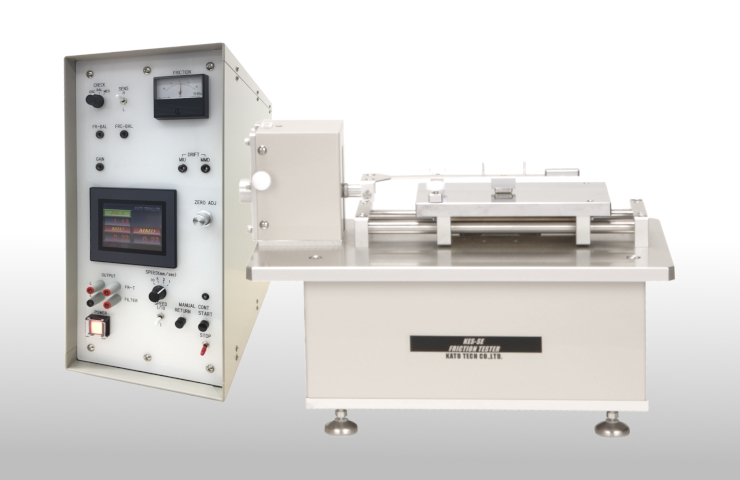


The Friction Tester is designed to evaluate the tactile performance of fabrics and other materials by simulating the “stroking” motions used by craftsmen and professionals. It quantifies frictional characteristics through measurements of friction coefficient (MIU), friction coefficient deviation (MMD), and surface roughness (SMD), providing objective data on smoothness, slip, and roughness. This instrument is also suitable for delicate materials, including hair, offering precise tactile assessment.
Application
You can use the STD-SE Friction Tester across multiple industries:
Textiles: Assess fabrics, gauze, and nonwoven materials for friction and surface roughness.
Hygiene products: Test tactile performance of materials such as diapers.
Cosmetic packaging: Analyze surface smoothness and feel of packaging materials.
Hair testing: Measure smoothness, softness, and roughness of hair.
Furniture and automotive interiors: Evaluate tactile properties of leather, synthetic leather, and seat materials.Standards
This instrument conforms to the following standards:
(1) GB/T 12602-1990 – Textile friction performance testing methods
(2) ASTM D1894-14 – Determination of static and kinetic coefficient of friction
(3) ISO 8295:1995 – Plastics, films and sheets: Determination of friction coefficient
(4) JIS L1096-1999 – General textile testing methods
Parameters
| Parameter | Specification |
|---|---|
| Device Dimensions / Weight | Main unit: W320 × D200 × H390 mm / 10 kg; Electronic amplifier: W180 × D400 × H400 mm / 12 kg |
| Power Supply | AC 100 V, max 30 W |
| Operating Environment | 20–30°C, 50–70% RH (Standard: 20°C / 65% RH) |
| Friction Measurement | Sensor: Differential transformer (ring load cell); Load: 200 gf (standard), 1000 gf (low sensitivity); Accuracy: ±0.5% FS |
| Surface Roughness Measurement | Sensor: Differential transformer; Displacement: 0.4 mm; Accuracy: ±1.0% FS |
| Sample Displacement Measurement | Sensor: Potentiometer; Travel: 30 mm (effective 20 mm); Accuracy: ±0.5% FS |
| Sensor Dimensions | Friction: 10 × 10 mm; Roughness: 0.5 mm metal wire, contact width 5 mm |
| Sample Travel Speed | 1, 2, 5, 10 mm/sec (adjustable) |
| Sample Size | 30 × 270 mm (standard) |
Features
(1) Rapid testing: Quickly measures frictional characteristics, simulating human fingertip friction signals.
(2) Comprehensive analysis: Measures friction coefficient (MIU), friction coefficient deviation (MMD), and surface roughness (SMD) simultaneously.
(3) Realistic tactile simulation: Differential transformer and wire strain sensors accurately replicate fingertip perception, closely matching human tactile evaluation.
(4) Wide applicability: Suitable for textiles, hair, leather, and cosmetic packaging materials.
(5) High precision: Ensures accurate evaluation of friction and surface roughness for sensitive tactile measurements.
Accessories
(1) Friction measurement sensor (10 × 10 mm)
(2) Surface roughness contact element (0.5 mm metal wire)
(3) Electronic amplifier
(4) Power adapter (AC 100 V)
Test Procedures
Install the sample: Secure the sample on the test platform, ensuring a flat and clean surface.
Set test parameters: Select appropriate measurement speed and sensitivity according to the material type.
Start testing: The instrument automatically measures MIU, MMD, and SMD.
Review results: Data is displayed digitally for immediate tactile evaluation.
Save data: Store results as digital files for further analysis.Maintenance Information
Keep friction and roughness sensors clean to maintain measurement accuracy.
Regularly check calibration of the differential transformer and strain sensors.
Avoid high humidity or excessive heat exposure.
Handle sensors and moving parts carefully to prevent wear or damage.
FAQ
(1) What is this product?
The STD-SE Friction Tester is an instrument that measures the friction and surface roughness of materials to provide objective tactile evaluation data.
(2) What is this product used for?
You can use it to assess fabrics, hair, leather, cosmetic packaging, and other materials for smoothness, slip, and roughness.
(3) How does this product work?
It simulates fingertip contact using differential transformer and wire strain sensors to measure friction coefficient (MIU), friction deviation (MMD), and surface roughness (SMD).
(4) Why is this product important?
It allows objective, repeatable evaluation of material tactile performance, replacing subjective manual assessment.
(5) Which industries is this product suitable for?
This instrument is suitable for textiles, hygiene products, hair testing, cosmetic packaging, furniture, automotive interiors, and any application requiring precise surface tactile evaluation.
Leave Message Get Price