Seat Belt Test Dummy
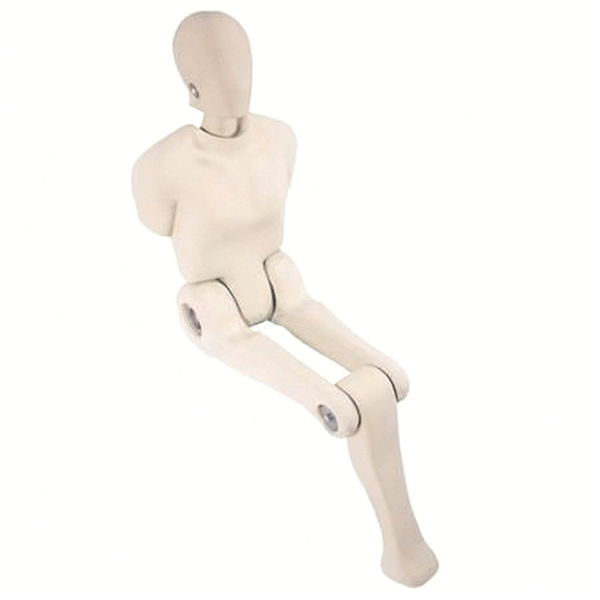


The Crash Test Dummy for Seatbelt Testing is a high-precision anthropomorphic test device designed specifically for dynamic evaluation and development of automotive seatbelt systems. It represents a 50th percentile adult male, with physical mass distribution and body dimensions accurately modeled. Constructed from metal, fiberglass, and polyurethane materials, it realistically simulates the skeletal and muscular responses of the human body under dynamic seatbelt loading conditions.
Application
You can use this dummy for:
(1) Dynamic performance verification of automotive seatbelt systems;
(2) Development, optimization, and validation of vehicle seats and occupant restraint systems;
(3) Frontal and oblique collision simulation experiments;
(4) Seatbelt design evaluation and occupant injury assessment;
(5) Regulatory compliance testing according to national and international standards.
Standards
This dummy complies with the following standards:
(1) GB 14166-2013 Motor Vehicle Occupant Restraint System Crash Test Dummy;
(2) ECE R16 Uniform Provisions for Vehicle Seatbelt and Restraint System Certification;
(3) ISO 15830 Road Vehicles – Side Impact Dummy for Restraint System Evaluation.
Parameters
Dimensional Parameters
| No. | Measurement Parameter | Dimension (mm) |
|---|---|---|
| 1 | Head Width | 160 ± 5 |
| 2 | Shoulder Width | 465 ± 5 |
| 3 | Hip Position Torso Width | 120 ± 5 |
| 4 | Hip Width | 340 ± 5 |
| 5 | Knee Center to Floor | 510 ± 10 |
| 6 | Hip Center to Floor | 990 ± 10 |
| 7 | Torso Upper Plane to Floor | 1470 ± 10 |
| 8 | Head Bolt Center to Floor | 1600 ± 10 |
| 9 | Head Top to Floor | 1750 ± 10 |
| 10 | T-Point Height | 720 ± 5 |
| 11 | P-Point Height | 320 ± 5 |
Mass Distribution
| No. | Component | Mass (kg) |
|---|---|---|
| 1 | Head Assembly | 4.0 ± 0.2 |
| 2 | Neck Assembly | 0.7 ± 0.1 |
| 3 | Torso Assembly | 29.7 ± 1.0 |
| 4 | Thigh Assembly (L/R) | 12.3 ± 0.3 |
| 5 | Lower Leg Assembly | 8.4 ± 0.3 |
| 6 | Hip Joint | 3.1 ± 0.1 |
| 7 | Knee Joint Assembly | 1.1 ± 0.1 |
| 8 | Outer Jacket + Chest Pad | 1.1 ± 0.1 |
| 9 | Total Mass (including calibration) | 75.5 ± 1.0 |
Sensor Configuration
| Installation Location | Sensor Type | Channels |
|---|---|---|
| Head | Accelerometer | 3 |
| Chest | Cable Displacement Sensor | 1 |
| Pelvis | Cable Displacement Sensor | 2 |
Features
(1) Accurately represents the mass distribution and body dimensions of a 50th percentile adult male;
(2) Modular design allows for quick replacement of the head, neck, torso, and leg assemblies;
(3) Metal and fiberglass skeleton with polyurethane covering provides high biomechanical fidelity and durability;
(4) Soft chest pad ensures realistic seatbelt loading simulation;
(5) Easy to operate and configure, enabling rapid setup and reliable data acquisition;
(6) Suitable for regulatory compliance and research applications.
Accessories
(1) Modular chest pad;
(2) Calibration weight set;
(3) Replacement thigh and lower leg assemblies;
(4) Data acquisition connection cables;
(5) Transport and mounting frame.
Test Procedures
(1) Inspect all joints, bolts, and connectors before assembling the dummy;
(2) Ensure the chest pad and outer jacket fully cover the dummy;
(3) Adjust the seating posture according to applicable standards, verifying hip, knee, and H-point alignment;
(4) Verify that chest and pelvis cable displacement sensors are connected and operational;
(5) After each test, inspect all components and recalibrate the dummy’s mass and position to ensure experimental accuracy.
Maintenance Information
(1) Store the dummy in a clean, dry environment away from direct sunlight;
(2) Regularly inspect joints, fasteners, and sensors for wear or damage;
(3) Replace damaged or worn modular components promptly;
(4) Clean the outer cover and chest pad with non-abrasive, mild cleaning agents;
(5) Calibrate sensors periodically according to manufacturer guidelines.
FAQ
(1) What is this product?
This product is a 50th percentile male crash test dummy designed specifically for dynamic testing of automotive seatbelt systems. It accurately simulates the human skeletal and muscular response under seatbelt loading.
(2) What is this product used for?
You use it to verify seatbelt performance, develop and optimize restraint systems, simulate frontal and oblique collisions, evaluate occupant injury, and conduct regulatory compliance testing such as GB 14166 and ECE R16.
(3) How does this product work?
It works by using a metal and fiberglass skeleton to replicate human bone, with polyurethane covering for muscles and skin. During dynamic seatbelt loading, chest and pelvis displacement sensors record motion, while the dummy experiences forces similar to a real human body. You can analyze these data to evaluate seatbelt performance and occupant injury risk.
(4) Why is this product important?
It provides a repeatable, safe, and precise method to assess seatbelt effectiveness and occupant protection. Without this dummy, evaluating seatbelt design under dynamic conditions would require human testing, which is unsafe and impractical.
(5) What industries is this product suitable for?
It is suitable for automotive manufacturers, safety research laboratories, regulatory agencies, and academic institutions conducting vehicle crash safety and restraint system research.
Leave Message Get Price