

Smoke Density Tester | ASTM E662 / ISO 5659-2 Compliant

The Smoke Density Tester is designed to measure the optical density of smoke generated during combustion of materials and determine the Smoke Density Rating (SDR). Originally developed by Rohm and Haas in the 1970s based on ASTM D2843, the instrument uses Billung’s law and direct flame impingement on the sample to evaluate smoke production. It is widely used for testing PVC conduits, automotive interior materials, building materials, and other solid combustibles in accordance with international standards.
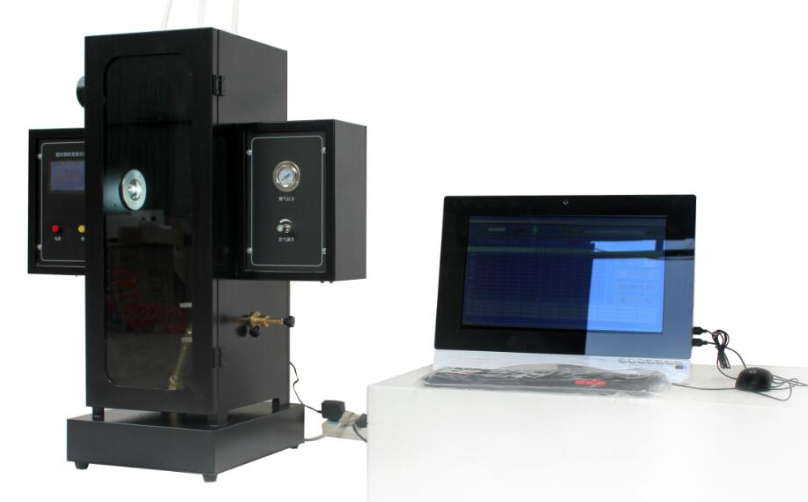
Applications
Testing smoke density for building materials and construction products
Evaluating smoke generation from textile materials and solid materials
Automotive interior material fire performance assessment
Compliance testing for aircraft and marine materials
Standards Compliant
ASTM E662 – Standard Test Method for Specific Optical Density of Smoke Generated by Solid Materials
ASTM F814 – Standard Test Method for Smoke Density of Aircraft Materials
NFPA 258 – Standard Test Method for Smoke Generation of Building Materials
Boeing BSS 7238 – Smoke Emission Test for Aircraft Materials
FAR Part 25 Appendix F Part V – Federal Aviation Regulations, Aircraft Materials Smoke Test
Aircraft Materials Fire Test Handbook Chapter 6
Airbus AITM 2.0007A / 2.0007B
IMO MSC.61(67) Annex 1 Parts 1&2 – Marine Smoke Test Standards
ISO 5659-2 – Plastics – Determination of Smoke Density
IMO FTCP Part 2
BS 6401, ABD0031
Key Features
Durable Teflon-Coated Chamber
The test chamber is lined with Teflon, resisting corrosive smoke and extending equipment lifespan.
Clear Visibility Markers
The bottom of the chamber includes an “EXIT” sign, allowing operators to easily observe sample clarity or blurriness through the observation window.
Precision Light Sensing
The tester uses an incandescent light source with a silicon photodiode and cosine correction. Color filters block UV and IR light to ensure accurate measurements.
High-Pressure Flame Impact
The main burner applies a flame at 276 KPa to the test sample, while an auxiliary burner at 138 KPa combusts any dripping material for thorough testing.
Advanced Data Display
Light transmittance values are recorded every 15 seconds, producing a transmittance curve. The SDR value is calculated automatically and displayed after the test.
Comprehensive Test Reporting
Test software compiles data from up to three sample groups, generating SDR development curves and automatically determining compliance with standards.
User-Friendly Data Management
Test results can be exported to a computer and connected to a printer for report generation, improving efficiency.
Technical Parameters
| Parameter | Specification |
|---|---|
| Burning Lamp | Length: 260 mm, Nozzle diameter: 0.13 mm, 45° angle to smoke box |
| Light Source | Incandescent lamp, 15 W, 6 V |
| Smoke Density Measurement Range | 0–100% |
| Measurement Accuracy | ±3% |
| Receiver | Silicon photovoltaic cells, 0%–100% light transmittance |
| Main Burner Working Pressure | 276 KPa (adjustable) |
| Auxiliary Burner Pressure | 138 KPa |
| Exhaust System | High-capacity fan for outdoor discharge |
| Test Chamber | Teflon-coated, corrosion-resistant |
| Data Display | Automatic SDR calculation and transmittance curve |
FAQ
1. What is a Smoke Density Tester?
It is an instrument used to evaluate the optical density of smoke produced when materials are burned, generating a Smoke Density Rating (SDR).
2. Why is smoke density testing important?
Smoke density affects visibility and safety in buildings, vehicles, and aircraft. Compliance ensures materials meet fire safety standards.
3. What materials can be tested?
PVC conduits, automotive interior materials, building materials, textiles, plastics, and aircraft components.
4. How does the test work?
A flame is applied to the sample, smoke passes through a chamber, and light transmittance is measured with a silicon photodiode to calculate SDR.
5. Which standards does it comply with?
ASTM E662, ASTM F814, NFPA 258, ISO 5659-2, Boeing BSS 7238, Airbus AITM 2.0007A/B, IMO MSC.61(67), and others.
2025-12-08 17:49