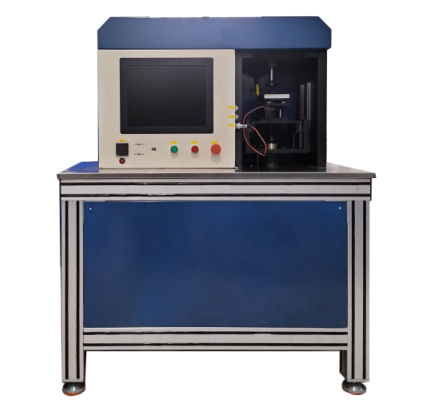
Multi-functional Friction and Wear Testing Machine


I. Equipment Introduction and Application
This equipment features two motion modes, including rotational and reciprocating test modules, which can be easily replaced to meet a wider range of testing requirements.
(1) Rotational Module
The equipment operates in a rotational mode to realize various friction contact forms and lubrication conditions. It is used to simulate friction tests between different tribological pairs, with multiple configurations such as pin-on-disc, end-face friction pair, and ball-on-disc friction pair. It can perform point, line, and surface friction simulation tests.
It is suitable for evaluating the friction and wear performance of materials such as lubricants, metals, coatings, surface coatings, plastics, rubber, and ceramics. It meets the requirements of users in petroleum and chemical industry, machinery, energy, metallurgy, aerospace, and other tribology-related fields for the development and testing of high-end oil and grease products, as well as new material development and process research.
(2) Reciprocating Module
The equipment operates in reciprocating mode, mainly used for friction and wear performance testing of materials and surface coatings.
It adopts an industrial control computer system for real-time monitoring and control of the entire test process. The test force is automatically maintained with constant loading and supports dynamic variable loading (sine wave, triangle wave, square wave, trapezoidal wave), ensuring stable and reliable loading.
It can simulate point, line, and surface contact friction forms under reciprocating motion, enabling measurement of friction force, wear volume, and other parameters under different loads, frequencies, lubrication conditions, and temperatures.
The system can be expanded with corrosion resistance functionality to simulate testing under deep-sea environmental conditions.
II. Structural Overview of the Testing Machine
The testing machine mainly consists of a drive system, load loading system, rotational module, reciprocating module, friction pair clamping mechanism, signal acquisition & processing system, and electrical control system.
2.1 Drive System
The main shaft is driven by a servo motor and servo speed control system. The rated torque of the motor is 5 N·m, with stepless speed regulation and a high-speed accuracy of 1%.
The servo motor power is 1.5 kW, directly connected to the spindle base, ensuring no torque loss. The upper part of the spindle base can be replaced with a concentric or eccentric wheel to achieve rotational or reciprocating motion.
2.2 Load Loading System
The loading system is driven by a stepper motor, transmitting motion via an arc-tooth synchronous belt, pulley system, and precision ball screw, guided by linear guide rails.
It drives the loading seat to move vertically. A linear guide, force sensor, and compression spring are installed on the upper surface of the loading seat. When moving upward, the loading seat contacts the upper specimen holder and compresses the spring, thereby generating the test load between the friction surfaces.
2.3 Reciprocating Module
This module consists of an eccentric adjustment wheel, connecting rod, main shaft rod, linear fixing device, and reciprocating friction pair assembly.
2.4 Rotational Module
This module includes a driving pulley, driven pulley, synchronous belt, rotary spindle base, and rotational friction pair assembly.
2.5 Rotational Friction Pair Mechanism
Custom friction pair configurations can be developed according to customer requirements to expand the testing capability of the machine.
2.6 Reciprocating Friction Pair Mechanism
Standard configurations include:
l Ball-on-disc (point contact)
l Pin-on-disc (line contact)
l Flat-on-flat (surface contact)
Optional expansion modules are available upon request:
l Curved surface friction module
l Cylinder liner–piston ring module
l High-temperature specimen module
III. Main Technical Specifications
No. | Technical Item | Specification |
1 | Reciprocating frequency range | 1–20 Hz |
2 | Test load | 10–2000 N |
3 | Rotational speed range | 1–2000 r/min, stepless adjustable, accuracy ±1 r/min |
4 | Rotational torque | 0–5 N·m |
5 | Reciprocating friction force measurement range | 1–50 N |
6 | Reciprocating stroke range | 0–40 mm, accuracy ±0.1 mm |
7 | Reciprocating friction modes | Ball-on-disc, pin-on-disc, cylinder-on-flat |
8 | Rotational friction modes | Ball-on-disc, pin-on-disc, end-face |
9 | Test time display & control range | 1–99,999,999 s / min / h |
10 | Lifting height | 60 mm |
11 | Test media | Air, oil, water, mud, abrasives, etc. |
12 | Temperature control range | Rotational module: RT–100°C / Reciprocating module: RT–100°C, accuracy ±1°C |
13 | Data & control functions | Allows setting frequency (speed), test time, and cycle count; real-time plotting of friction force–time, load–time, and friction coefficient–time curves; supports data storage, printing, and export functions |
IV. Operating Conditions of the Testing Machine
(1) Ambient temperature: 10°C–35°C
(2) Relative humidity: ≤80%
(3) Installed correctly on a stable foundation or workbench
(4) No corrosive media, vibration, or external interference in the surrounding environment
(5) Power supply: 220V / 16A
(6) Voltage fluctuation range: not exceeding ±10% of rated voltage
(7) The equipment must be reliably grounded
(8) Frequency fluctuation: not exceeding 2% of rated frequency
V. Our Advantages
(1) The equipment is fully intelligent and computer-controlled. Users only need to set parameters such as spindle speed, test load, friction radius (reciprocating stroke), temperature, and test duration on the software interface. With one-click start, the system automatically collects real-time test data and generates corresponding test curves. Data and curves can be stored, reviewed, printed, and exported at any time.
(2) The system also allows setting protection parameters such as rotation speed, temperature, and friction force. Once any preset limit is reached, the machine will automatically stop to protect both the equipment and test data.
(3) The loading system adopts a self-developed mechanical spring loading structure, providing stable loading force and long-term consistency, ensuring higher test accuracy.
(4) Electrical components and key parts are sourced from internationally recognized brands, ensuring high stability and long service life.
(5) All test operations can be performed through a computer-based interface, featuring flexible configuration control, multiple friction pair options, wide speed range, high-temperature simulation capability, high automation level, and easy operation and adjustment.
(6) Our company has a professional engineering design team and can provide customized solutions according to customer requirements, including high-speed, high-load, and ultra-high/low temperature testing conditions.
VI. After-Sales Service Commitment
(1) The equipment comes with a 1-year warranty after successful acceptance.
(2) Free real-time operation training is provided.
(3) Free technical guidance and consultation services are available according to customer needs.
(4) Each equipment unit is assigned dedicated personnel for tracking support. A customer file is maintained, and maintenance reminders are provided upon due dates.
(5) The company guarantees a 1-hour response time after receiving a service call. If on-site service is required, engineers will arrive within 24 hours to ensure timely resolution and meet customer operational requirements.
Leave Message Get Price