Double-Head Abrasion Tester
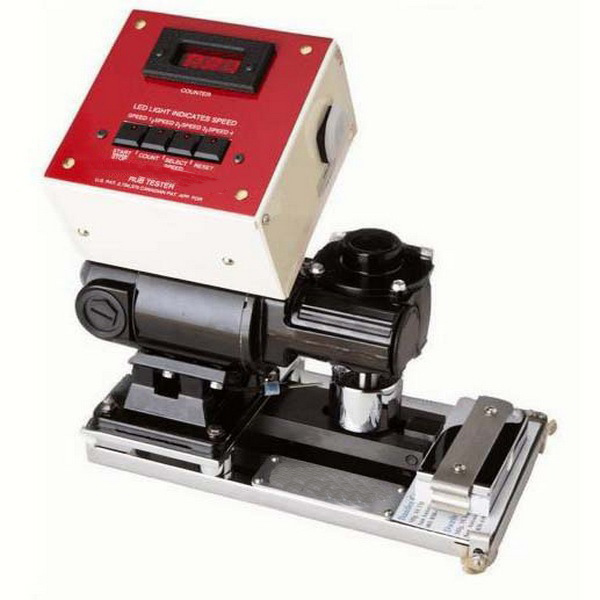


The Double-Head Abrasion Tester is a motor-driven wear testing instrument designed to evaluate the abrasion resistance of paper, cardboard, and printed materials. Equipped with dual electric brushes and adjustable weights, it can perform dry abrasion, wet abrasion, color transfer, and specialized friction tests to assess ink durability and adhesion. The device offers multiple speed settings and preset counting functions, complying with ASTM D-5264 standards, making it suitable for research, quality control, and standardized laboratory testing.
Applications
Testing ink abrasion resistance on printed materials
Evaluating surface wear performance of paper and cardboard
Performing dry abrasion, wet abrasion, and transfer friction tests
Supporting product development and production quality control
Conducting standardized testing in teaching and research laboratories
Standards
ASTM D-5264-92: Standard Test Method for Abrasion Resistance of Printed Matter
GB/T 7705-2008: National Standard for Offset Decorative Printed Matter
Technical Specifications
| Item | Parameter |
|---|---|
| Power Supply | 220V / 50-60Hz / Single Phase / 2A |
| Dimensions | 15 × 15 × 12 inches |
| Weight | Gross 42 lbs |
| Speed Settings |
Speed 1: 21
rpm Speed 2: 42 rpm Speed 3: 85 rpm Speed 4: 106 rpm |
| Count Range | 0–999 cycles (presettable) |
| Slider Weights |
Standard: 2 lbs (0.9
kg), 4 lbs (1.8 kg) Optional: 20 N weight |
| Display | LCD |
| Functions | Dry abrasion, wet abrasion, wet smear or transfer, functional friction tests |
| Automatic Features | Auto power-off, end-of-test notification |
Features
Four adjustable speeds to accommodate various abrasion testing requirements
Dual-head design allows simultaneous testing of two samples, improving efficiency
Supports dry, wet, and specialized friction tests, providing versatile testing options
Built-in preset counting ensures accurate and repeatable results
Supports optional weights for flexible load adjustment
LCD display offers intuitive operation and easy data reading
High-speed mode (106 rpm) enables fast wear testing
Accessories & Consumables
| Accessory / Consumable | Description |
|---|---|
| Slider Weights | Standard 2 lbs and 4 lbs; optional 20 N weight; custom weights available |
| Safety Cover | Protects operators from rotating components |
| Power Cord | Standard 220V |
| User Manual | Operation and maintenance guide |
| Tools | Adjustment and installation tools |
Testing Principle
The Double-Head Abrasion Tester simulates actual wear and color transfer by driving friction sliders to reciprocate across the sample surface using a motor. The interaction between the sliders and the surface generates friction, allowing you to evaluate abrasion resistance and ink adhesion under different speeds, weights, and cycle counts.
Operation Instructions
Secure the sample on the test table, ensuring a flat surface.
Select dry or wet abrasion mode according to your testing needs and install the appropriate weights.
Set the desired test speed (21, 42, 85, or 106 rpm) and number of cycles.
Start the instrument and observe the process. After testing, turn off the power.
Exercise caution to avoid contact with rotating parts and high-pressure sliders.
Experimental Procedure
Place and secure the test sample on the test platform.
Install slider weights and select the test mode (dry or wet abrasion).
Choose the appropriate speed and cycle count, then start the test.
After completion, record surface wear, including color loss, scratches, or smudging.
Evaluate the abrasion resistance of ink or paper and, if necessary, repeat the test to verify data consistency.
FAQ
1.What is this product?
You are using a Double-Head Abrasion Tester, a device for evaluating wear resistance of paper, cardboard, and printed materials.
2.What is this product used for?
You can assess ink durability, adhesion, and surface wear performance under dry, wet, or transfer friction conditions.
3.Why is this product important?
It allows you to simulate real-world wear conditions in a controlled laboratory environment, ensuring material and print quality.
4.What industries is this product suitable for?
You can use it in printing, packaging, paper production, research laboratories, and quality control in manufacturing.
5.What types of this product are available?
You can choose standard dual-head models with adjustable speeds and optional slider weights to match different testing requirements.
Leave Message Get Price