Mechanical Scratch Tester
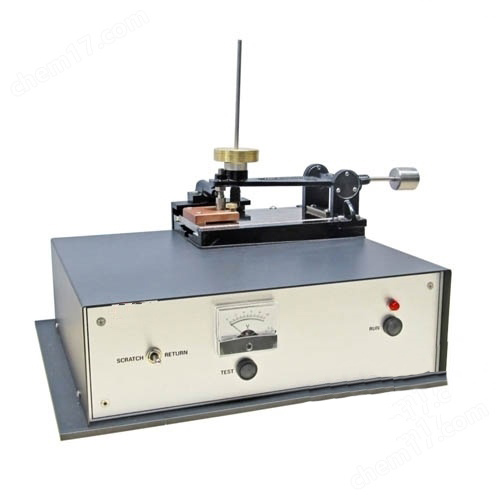


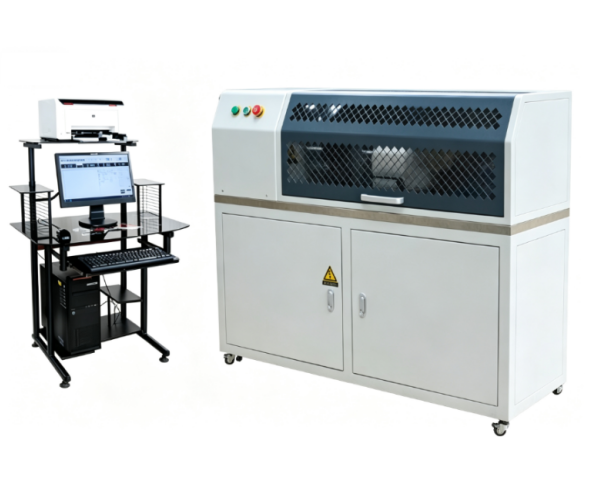
The Mechanical Scratch Tester is a mechanically driven instrument designed for evaluating coating hardness based on scratch resistance performance. During testing, the coated panel is clamped and moved at a controlled constant speed while a spherical stylus or alternative scratching tool is pressed against the surface under a defined load. By applying either fixed or variable loads, the system can generate different levels of coating damage ranging from visible marks to complete film failure. An integrated voltmeter detects electrical contact between the stylus and the metallic substrate, enabling clear determination of coating breakthrough. The tester is suitable for standard metal panels up to 100 × 150 × 1.6 mm with a coating thickness of up to 0.3 mm.
Application
Primary test purposes
Coating scratch resistance evaluation
Coating hardness assessment based on mechanical damage behavior
Determination of coating failure load
Detection of coating breakthrough on conductive substrates
Typical tested materials
Painted metal panels
Industrial coatings
Automotive coatings
Protective and functional coatings on metal substrates
Laboratory standard test panels
Standards
(1) GB/T 23989-2009 – Determination of scratch resistance of coatings
(2) GB/T 5210-2006 – Paints and varnishes – Pull-off adhesion test
(3) GB/T 1768-2006 – Determination of abrasion resistance of paint films
(4) ISO 1518-1 – Paints and varnishes – Scratch test – Part 1: Determination of scratch resistance
(5) ISO 20502 – Coating materials – Scratch test
(6) ASTM C1624 – Standard test method for adhesion and scratch resistance of ceramic and hard coatings
(7) DIN EN 1071-3 – Advanced technical ceramics – Mechanical properties of ceramic coatings – Part 3: Scratch testing
Parameters
| Parameter | Specification |
|---|---|
| Stylus moving speed | 35 mm/s |
| Maximum panel size | 100 × 150 × 1.6 mm |
| Maximum coating thickness | 0.3 mm |
| Applicable standard setting | ISO 1518-1 |
| Standard test load | 20 N |
| Power supply | 230 VAC, 50 Hz |
Features
Mechanical drive system enclosed by a protective cover for stable and safe operation.
Constant sliding speed of approximately 3–4 cm/s.
Rigid, well-balanced stylus arm that minimizes vibration and instability during scratching.
Equipped with a 1 mm tungsten carbide ball stylus fixed at 90° to the test panel.
Stylus can be easily removed for inspection or replacement.
Tungsten carbide tip provides long service life without frequent replacement.
Adjustable loading system with selectable weights from 100 g to 2 kg (0–20 N).
Optional additional weight up to 10 kg available for testing harder coatings.
Compatible with standard metal panels up to 150 × 100 mm and thickness up to 1.65 mm.
Optional transparent plastic safety cover to prevent accidental contact during operation.
Accessories
(1) 1 mm tungsten carbide ball stylus
(2) Standard weight set (100 g to 2 kg)
(3) Optional additional weight kit (up to 10 kg)
(4) Optional transparent protective cover
Test Procedures
Specimen preparation
Mount a standard coated metal panel (up to 100 × 150 × 1.6 mm) into the clamping fixture.
Ensure the panel is flat, clean, and firmly secured.
Load setting
Select the required weight according to the test standard or evaluation objective.
Place the weight above the stylus to apply the desired normal force.
Scratch execution
Start the instrument to move the panel at a constant speed of 35 mm/s.
The tungsten carbide stylus scratches the coating along a straight path.
Breakthrough detection
Monitor the voltmeter: when electrical contact is detected between stylus and metal substrate, coating failure is confirmed.
Result evaluation
Record the applied load at which visible damage or breakthrough occurs.
Compare results with standard requirements or reference panels.
Maintenance Information
Clean the tungsten carbide stylus after each test.
Inspect the stylus tip regularly; replace if worn or damaged.
Keep moving rails and mechanical parts free from dust and debris.
Ensure protective cover is installed during operation.
Avoid exceeding the maximum recommended load for routine testing.
FAQ
1. What is the core advantage of this product?
Its main advantage is stable mechanical movement combined with precise load application, enabling repeatable and objective evaluation of coating scratch resistance.
2. Are the test results reliable?
Yes. The constant-speed mechanical drive, rigid stylus arm, and electrical breakthrough detection minimize operator influence and improve result consistency.
3. Which international/industry standards does it comply with?
It supports testing in accordance with ISO 1518-1. ISO 20502. ASTM C1624. DIN EN 1071-3. and relevant GB standards including GB/T 23989. GB/T 5210. and GB/T 1768.
4. Why is this product important?
Scratch resistance is a key indicator of coating durability and adhesion. This tester provides quantitative evidence of coating performance under mechanical stress, which is critical for product quality control and material selection.
5. Which fields is this product suitable for?
Coatings and paints industry
Automotive coating evaluation
Metal surface treatment industry
Research and development laboratories
Third-party testing and certification institutions
Leave Message Get Price