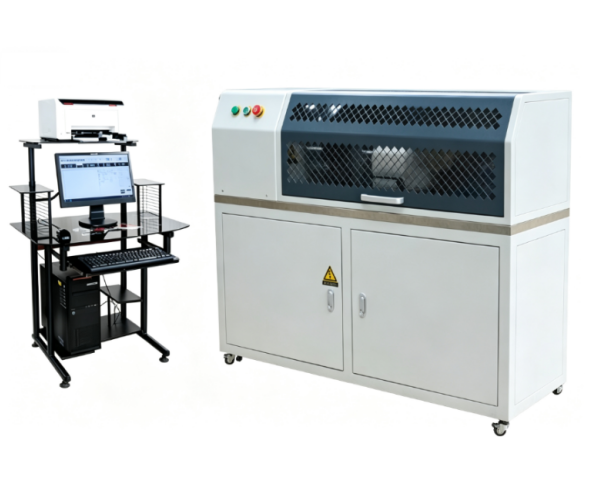
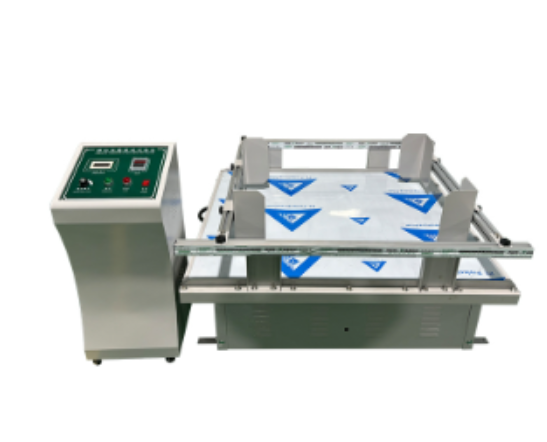
Surface Scratch Resistance Testing Machine



The Surface Scratch Resistance Testing Machine is a PLC-controlled instrument designed for evaluating the scratch resistance of solid insulating materials used in household appliances and information technology equipment. By applying a standardized hardened steel stylus under a controlled load, speed, and angle, the system produces repeatable scratch patterns to verify whether accessible insulating parts or printed circuit boards possess sufficient mechanical strength to resist penetration by sharp tools. The equipment integrates programmable motion control, precise load application, and a rotatable specimen tray, enabling compliance with international electrical safety standards while ensuring stable and traceable test results.
Application
Primary test objects
Accessible solid insulating parts of household appliances
Components of similar electrical products
Printed circuit boards (PCBs)
Plastic and polymer insulating materials used in electrical enclosures
Typical application scenarios
Safety verification of electrical appliance insulation
Mechanical durability assessment of insulating surfaces
Conformity testing for electrical safety certification
Laboratory type testing and routine production inspection
Standards
(1) GB 4706.1-2005 Safety of household and similar electrical appliances – Part 1: General requirements, Clause 21.2
(2) GB 4943.1-2011 Information technology equipment – Safety – Part 1: General requirements, Clause 2.10.8.4
(3) IEC 60335-1:2004 Household and similar electrical appliances – Safety – Part 1: General requirements, Clause 21.2
(4) IEC 60950-1:2005 Information technology equipment – Safety – Part 1: General requirements, Clause 2.10.8.4
Parameters
| Parameter | Specification |
|---|---|
| Power supply | 220 V AC, 50 Hz |
| Test station | Single station |
| Control system | PLC control, 7-inch color touch screen, stepper motor drive |
| Stylus tip radius | R0.25 ± 0.02 mm |
| Stylus apex angle | 40° |
| Scratch speed | 20 ± 5 mm/s (presettable) |
| Scratch force | 10 ± 0.5 N |
| Scratch spacing | 0–50 mm (presettable) |
| Scratch angle | 80–85° (fixture fixed) |
| Specimen tray | Rotatable by 90°, multiple mounting holes |
Features
Standard-compliant stylus geometry with polished rounded tip.
Precise motion control using stepper motors and programmable parameters.
Stable load application to maintain constant 10 N test force.
90° rotatable specimen tray suitable for different sample sizes and orientations.
Flexible starting-point selection (center-based or arbitrary positioning).
Automatic cycle operation with return-to-origin function after completion.
Accessories
(1) Scratch stylus × 1
(2) Hex key set × 1
(3) Specimen pressure plates × 4
Test Procedures
1. Specimen installation
Center the specimen on the test platform.
For large samples, secure using clamping plates.
For thin samples (< 2 mm), place the flat side of the pressure plate directly on the specimen.
2. Parameter setting
Start point selection (choose one method):
Center mode: Scratches are symmetrical about the rotary center.
Arbitrary start point: Manually move the stylus to the desired position and confirm as the start point.
Vertical position setting:
Lower the stylus manually until it is lifted by the specimen surface.
Record this position and input it as the “downward position” in the control interface.
Motion parameters:
Preset vertical, horizontal, and forward speeds (horizontal speed: 20 ± 5 mm/s).
Set scratch length ensuring that after 90° rotation the scratches remain within the specimen and do not intersect.
Set scratch spacing (minimum 5 mm between lines and 5 mm from specimen edge).
Set number of scratches and select 90° rotation if required.
3. Test operation sequence
Press Return to Origin, then Start.
The stylus moves: Origin → selected start point → descends to test position → performs scratch → lifts → returns to start point → advances spacing → repeats cycle → stops automatically and returns to origin.
Maintenance Information
Clean the stylus after each test to avoid residue buildup.
Inspect the stylus tip regularly; replace if worn or damaged.
Keep the guide rails clean and lightly lubricated.
Avoid exceeding specified load and speed ranges.
Store the equipment in a dry, dust-free environment.
FAQ
1. What is the core advantage of this product?
Its main advantage is precise, programmable, and repeatable scratch application that fully aligns with IEC and GB safety requirements for electrical insulation testing.
2. Are the test results reliable?
Yes. The machine uses fixed stylus geometry, controlled load, constant speed, and automated motion paths, which minimize operator variability and ensure consistent results.
3. Which international/industry standards does it comply with?
It complies with IEC 60335-1. IEC 60950-1. GB 4706.1. and GB 4943.1 relevant clauses on scratch resistance of insulating materials.
4. Why is this product important?
Scratch resistance of accessible insulating parts is critical to prevent electrical hazards. This tester provides objective evidence that materials can withstand mechanical damage without losing insulation integrity.
5. Which fields is this product suitable for?
Household appliance manufacturers
IT and electronics industry
PCB manufacturers
Electrical safety testing laboratories
Certification and third-party testing organizations
Leave Message Get Price