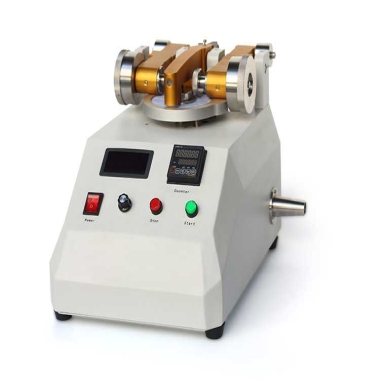
Taber Type Abrasion Tester


Application
The Taber Type Abrasion Tester is designed to evaluate the surface wear resistance of a wide variety of products, including mobile phones, keyboards, and other electronic accessories. It is also suitable for testing injection-molded plastics, silk-screen printed surfaces, coatings, wires, electrical appliances, leather, and other consumer or industrial products. The tester simulates real-life mechanical wear using erasers, cotton, and other friction media, helping manufacturers and quality control departments assess durability and performance.
Applicable Standards
The tester complies with major international and industry standards:
ISO 9352 – Plastics: Determination of resistance to wear by abrasive wheels
ISO 5470 – Rubber- or plastics-coated fabrics: Determination of abrasion resistance
ISO 7784 – Paints and varnishes: Scratch and abrasion testing
ASTM D1044 – Resistance of transparent plastics to surface abrasion
ASTM D3884 – Abrasion resistance of textile fabrics (rotary platform method)
ASTM D4060 – Taber Abraser method for wear testing of coatings
GB/T 5137.1 – Coating wear resistance
QB/T 2726 – Abrasion testing of coated materials
DIN 53109 – Abrasion testing of rubber and plastics
Features
LCD operation panel for real-time speed display and cycle count
Adjustable spinning speed: 30–75 rpm
Preset number of wear cycles: 1–999,999
Rear arm with balance weights to achieve precise pressure (125 g standard)
Adjustable vacuum arm height for efficient debris removal and improved test accuracy
Supports multiple friction media (eraser, cotton, etc.) for versatile testing
Technical Specifications
| Parameter | Specification |
|---|---|
| Spinning Speed | 30–75 r/min (adjustable, digital) |
| Sample Surface Diameter | 100 mm |
| Sample Table Diameter | 113 mm |
| Number of Turns | 1–999,999 |
| Air Pressure | 250 g |
| Wheel Pressure Range | 125 g, 250 g, 500 g, 750 g, 1000 g, 1250 g |
| Counterweights | 250 g, 500 g, 750 g, 1000 g |
| Vacuum Arm Height | Adjustable |
| Power Supply | 220 V, 50 Hz |
| Machine Size | 220 × 380 × 300 mm |
| Weight | 20 kg |
Advantages
High-precision testing with adjustable pressure and cycle count
Realistic simulation of mechanical wear on a variety of materials
Easy-to-use interface with LCD display and digital speed adjustment
Efficient debris removal via adjustable vacuum arm
Compliant with multiple international standards for abrasion testing
Suitable for both research laboratories and production quality control
FAQ
1. What is the Taber Type Abrasion Tester?
The Taber Type Abrasion Tester is a high-precision wear testing instrument used to evaluate the abrasion resistance of materials, coatings, and surface treatments. By applying rotating wheels or friction media to the sample, it simulates real-life surface wear, providing reliable data for product durability and quality control.
2. What materials can be tested?
This tester can evaluate a wide range of materials, including plastics, electronic product housings (such as mobile phones, keyboards, and computer mice), coated surfaces, textiles, leather, rubber, wiring, and other industrial or consumer product surfaces. It accommodates samples of various shapes and sizes and supports both dry and liquid-immersed testing conditions.
3. Why is using the Taber Abrasion Tester important?
Surface abrasion resistance directly affects product lifespan and user experience. Standardized wear testing allows companies to:
Detect potential material or process issues early
Ensure compliance with international standards and customer requirements
Improve product competitiveness in the market
Reduce warranty claims and returns
4. How does the instrument work?
During testing, the sample is fixed on a rotating platform while friction wheels or abrasive media move across its surface. The speed, number of cycles, applied pressure, and type of friction medium (such as erasers or cotton) can be adjusted to simulate different wear conditions. A vacuum system efficiently removes debris to maintain testing accuracy.
5. How are test results evaluated?
Test results are typically quantified by the degree of surface wear or the number of abrasion cycles endured. Users can assess material or coating durability and obtain precise measurements through weight loss or standard gray scale evaluation, providing data for R&D, quality control, and production improvement.
6. Which industries is this instrument suitable for?
It is widely used in plastics, electronics, automotive components, furniture, coatings, textiles, leather, packaging, and industrial materials. Whether for new product development, batch quality control, or third-party testing laboratories, the instrument provides reliable abrasion performance data.
7. Which international standards does the tester support?
The instrument complies with multiple ISO, ASTM, GB, and DIN standards, including ISO 9352, ISO 5470, ISO 7784, ASTM D1044, ASTM D3884, ASTM D4060, GB/T 5137.1, QB/T 2726, and DIN 53109, ensuring internationally recognized and comparable test results.
Leave Message Get Price