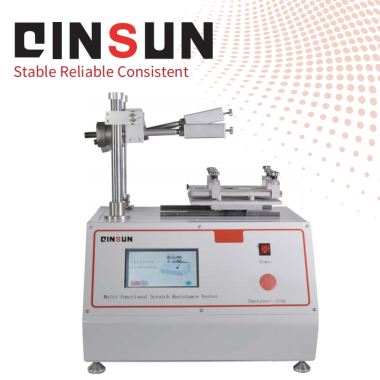
Reciprocating Wear Tester


Application
The Reciprocating Wear Tester is designed to evaluate the wear, scratch, and rub resistance of various materials. It is suitable for testing coatings, plastics, automotive interiors, fabrics, electronics, decorative materials, and other products with flat or contoured surfaces. The instrument can simulate real-life abrasion conditions using different friction media and adjustable loads, stroke lengths, and speeds, making it ideal for quality control, new product development, performance verification, and material property measurement. It helps manufacturers maintain consistent product performance and reproducibility of wear data.
Standards
The Reciprocating Wear Tester complies with multiple international and industry standards for abrasion and scratch resistance testing, including:
ASTM F2496 – Scratch hardness and adhesion testing for prints/coatings
ISO 1518-1 & ISO 1518-2 – Scratch resistance determination for paints and varnishes (constant and variable loading)
GME 60248 – Scratch resistance for automotive interiors and textiles
D44 1221 – Abrasion resistance for fluff surface materials
D14 1055-2004 & D42 1775-03-2001 – Wear resistance for organic coatings and plastic parts
Technical Parameters
| Parameter | Specification |
|---|---|
| Working Stations | 2 independent stations |
| Stroke Length | 0–150 mm (adjustable) |
| Test Arm Height | Up to 130 mm (adjustable) |
| Number of Reciprocating Motions | Up to 999,999 cycles |
| Test Speed | 1–200 cycles/min |
| Load | Optional / Standard 400 g |
| Friction Heads | Interchangeable (CS-10, H-18, semicircular R18, flat) |
| Abrasion Media | Various abrasives (sandpaper, brushes) |
| Control Panel | Intelligent touch panel with LCD display |
| Power Supply | 220V |
| Weight | 85 kg |
| Dimensions | 600 × 500 × 700 mm |
Advantages
Dual-Station Efficiency: Simultaneous testing on two independent workstations accelerates workflow
Versatile Applications: Suitable for coatings, plastics, automotive interiors, fabrics, and electronic components
Precision Control: Adjustable stroke, speed, and load ensure tailored testing
User-Friendly Interface: LCD screen with real-time parameter display and programmable settings
Modular Design: Interchangeable friction heads and weights accommodate diverse testing requirements
Lever-Balanced Accuracy: Maintains consistent surface load via counterweight-equipped test arms
Adjustable Height: Abrasive/load rack adapts to samples of varying thicknesses
Comprehensive Kit: Includes abrasives, sandpaper, stainless steel fixings, and spare parts
FAQ
1. What is the Reciprocating Wear Tester?
It is a testing instrument that simulates abrasion, scratch, and rub resistance on materials using a reciprocating motion under controlled load and speed.
2. What is the purpose of this tester?
It evaluates the durability and surface resistance of coatings, plastics, fabrics, automotive interiors, and other products, ensuring consistent quality and performance.
3. Why is the Reciprocating Wear Tester important?
Surface wear affects product quality perception and longevity. This tester helps manufacturers verify product durability, comply with standards, and optimize material selection and production processes.
4. What can this tester measure?
It measures wear resistance, scratch resistance, rub resistance, and the effect of different friction media on the sample surface.
5. How does the Reciprocating Wear Tester work?
The sample is fixed on a horizontal platform while a friction head moves back and forth under a specified load. Lever-balanced test arms ensure consistent surface pressure, while adjustable stroke, speed, and interchangeable friction heads allow tailored testing for different materials. The intelligent control panel allows programmable cycles and real-time monitoring.
Leave Message Get Price