Taber abraser(Abrader)


Application:
The Taber Abraser is ideal for testing abrasion resistance of metals, paints, coatings, plastics, textiles, leathers, rubbers, automotive interiors, furniture surfaces, flooring materials, electronic components, labels, varnishes, decorative panels, and a wide range of consumer and industrial products. It is widely used in quality control, material research, product development, and durability testing for products including luggage, carpets, clothing, glass, tiles, resins, anodized surfaces, and more.
Standards:
ISO 9352: Plastics – Determination of resistance to wear by abrasive wheels
ISO 5470: Rubber- or plastics-coated fabrics – Determination of abrasion resistance
ASTM D1044: Test method for resistance of transparent plastics to surface abrasion
ASTM D3884: Standard guide for abrasion resistance of textile fabrics (rotary platform, double-head method)
JIS K6902: Testing method for laminated thermosetting high-pressure decorative sheets
Technical Parameters:
| Item | Parameter |
|---|---|
| Rotating speed | 60–72 rpm (adjustable) |
| Testbed | External diameter 108 mm, Inner diameter 8 mm, Thickness 3 mm |
| Grinding wheel | Diameter 2" |
| Grinding wheel spacing (center) | 63.5 mm |
| Loading | 250 g, 500 g, 750 g, 1000 g |
| Power | 1φ, AC 220 V, 50 Hz |
Product Advantages:
Logic circuit control ensures simple and reliable operation.
Suction port height is adjustable for different material thicknesses.
Multiple weight options and interchangeable wear wheels allow testing of a wide variety of materials.
LCD counter provides precise rotation measurement up to 999,999 cycles.
Compact and durable design suitable for lab and production environments.
FAQ
1. What is a Taber Abraser?
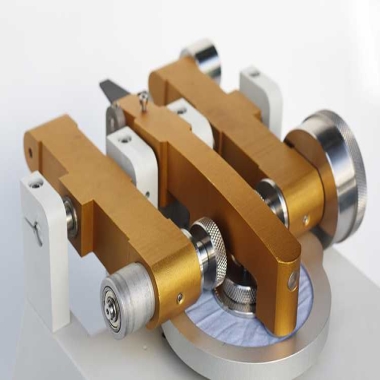
The Taber Abraser is a laboratory testing instrument designed to evaluate the abrasion resistance, wear performance, and surface durability of various materials including plastics, coatings, textiles, metals, rubber, and leather. It uses rotating abrasive wheels to simulate real-world wear conditions in a controlled environment.
2. What is the purpose of a Taber Abraser?
The primary purpose of a Taber Abraser is to assess how materials and products withstand friction, wear, and surface degradation over time. This helps manufacturers and researchers evaluate product durability, improve material formulations, and ensure compliance with industry standards.
3. Why is the Taber Abraser important?
The Taber Abraser is important because it provides reliable, repeatable, and standardized testing of material wear. It helps reduce product failures, extends the life of materials, and ensures quality control for consumer and industrial products. It is widely used in automotive, electronics, textiles, and packaging industries.
4. What test items can the Taber Abraser measure?
The Taber Abraser can measure abrasion resistance, surface wear, color fading due to friction, coating durability, and mechanical degradation. It can simulate real-life wear scenarios for luggage, flooring, automotive interiors, printed materials, labels, paints, and varnishes.
5. How does the Taber Abraser work?
The Taber Abraser works by rotating a test specimen on a turntable while friction wheels, attached to articulated arms with adjustable weights, are pressed against the specimen surface. The rotation and applied load simulate repeated wear. Debris is collected using a suction device, and the number of rotations is tracked with a digital counter to ensure precise and repeatable testing.
Leave Message Get Price