Application of Melt Flow Rate Tester


A plastics compounding manufacturer specializes in the production of polyethylene (PE), polypropylene (PP), and engineering plastic masterbatches. The company supplies materials to packaging, automotive, and home appliance industries.
With increasing orders and tighter quality requirements from downstream clients, the customer needed a more reliable method to evaluate polymer melt flow performance during incoming material inspection and finished product quality control.
Customer Requirements
During project communication, the customer highlighted the following needs:
(1) Accurate measurement of melt flow rate (MFR/MFI) for multiple polymer types
(2) Wide temperature range to cover engineering plastics
(3) Stable load system compliant with GB/T 3682.1-2018
(4) High temperature control precision for repeatable results
(5) Reliable operation suitable for daily production testing
(6) Compact structure suitable for laboratory benches
Solution Provided
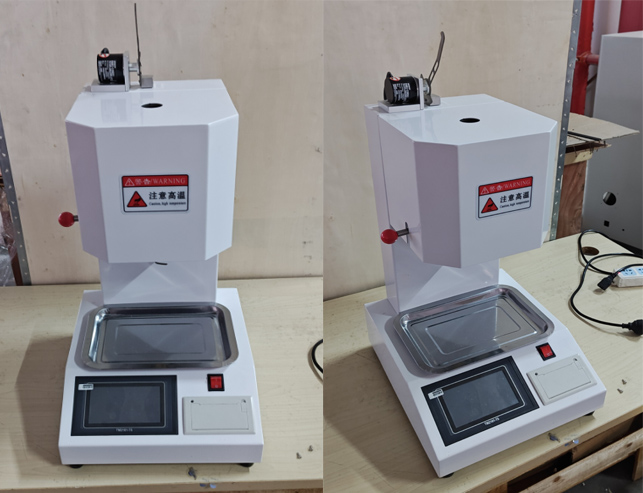
Based on the application scenario, we supplied the Melt Flow Rate Tester, designed strictly in accordance with GB/T 3682.1-2018.
The instrument enables precise determination of melt flow properties of thermoplastic polymers at elevated temperatures and is suitable for both quality control and R&D environments.
Materials tested by the customer include
(1) Polyethylene (PE)
(2) Polypropylene (PP)
(3) ABS resin
(4) Polycarbonate (PC)
(5) Nylon (PA)
Key Advantages for the Customer
High-Precision Extrusion Structure
The instrument adopts a standard-compliant extrusion system:
Die diameter: Φ2.095 ± 0.005 mm
Barrel diameter: Φ9.550 ± 0.007 mm
Precision piston design
This ensures excellent test repeatability and full compliance with standard requirements.
Eight-Level Standard Load System
The tester provides eight standard test loads ranging from 0.325 kg to 21.600 kg, covering common polymer testing conditions.
Customer benefits
(1) Flexible testing for different materials
(2) Compliance with standard load requirements
(3) High load accuracy (≤0.5% error)
(4) Easy weight combination and operation
Wide Temperature Range with High Stability
Temperature range: 50–400 °C
Control accuracy: ±0.1 °C
This allows the customer to test both commodity plastics and high-temperature engineering plastics with consistent results.
Reliable Operation for Production Labs
The compact structure (250 × 350 × 600 mm) fits well in the customer’s QC laboratory. The instrument operates stably under typical factory environmental conditions, supporting routine batch testing.
Customer Results
After implementation, the customer reported the following improvements:
Incoming material screening became more reliable
Batch-to-batch consistency of products improved
Test repeatability met internal QC requirements
Operators found the instrument easy to use
Daily testing efficiency increased
The customer has since integrated the tester into their standard quality control workflow.
Leave Message Get Price