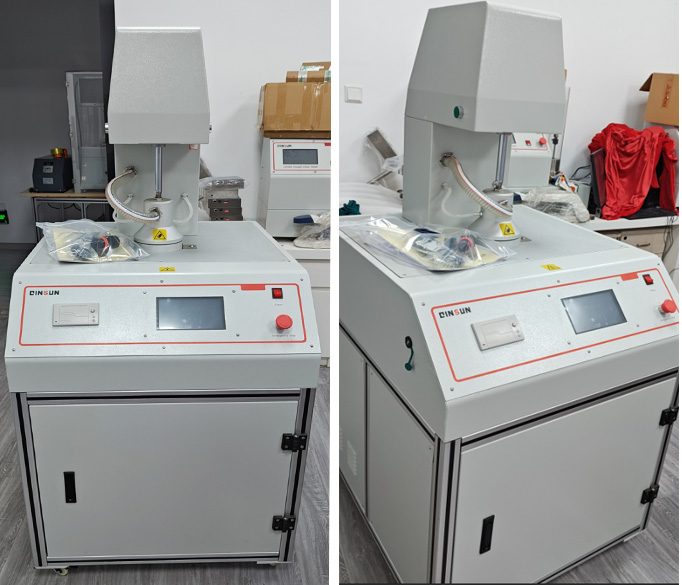
Application of Particulate Filtration Efficiency Tester G506


A medical device testing center is responsible for routine inspection, type testing, and supervisory sampling of daily protective masks, medical masks, and medical protective masks. Its testing scope includes critical performance indicators such as Particulate Filtration Efficiency (PFE) and Bacterial Filtration Efficiency (BFE).
All test activities must strictly comply with relevant national and industry standards, including GB 32610-2016, GB 2626-2006, GB 19083-2010, YY 0469-2011, and YY 0969-2013.
Challenges Faced by the Customer
With the increase in mask varieties and inspection volume, the customer encountered several issues with existing testing equipment:
(1) Insufficient aerosol generation stability, resulting in large concentration fluctuations and reduced repeatability of filtration efficiency results;
(2) Separate systems required for oil and non-oil particle testing, leading to complex operation and low testing efficiency;
(3) Manual data calculation and recording increased the risk of errors and limited data traceability;
(4) Potential particle leakage during testing posed occupational safety risks to laboratory personnel;
(5) Inadequate monitoring of environmental temperature and humidity, making it difficult to fully meet standard-specified test conditions.
Implemented Solution
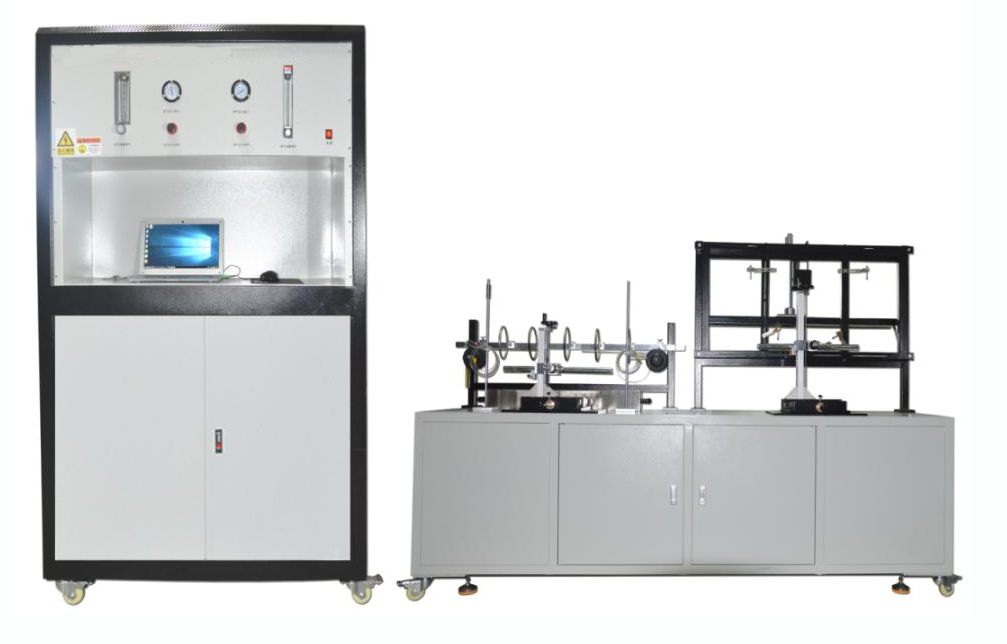
To improve testing accuracy, efficiency, and safety, the testing center introduced a Particulate Filtration Efficiency Tester to establish a standardized and integrated PFE testing system for medical and daily protective masks.
Based on the definition of filtration efficiency in GB 2626-2006, the system evaluates the percentage of particulate matter removed by mask filter media under specified test conditions. By using highly penetrative particles, the tester accurately reflects the true filtration performance of mask materials under worst-case conditions.
Product Advantages in Application
(1) Stable Aerosol Generation
A cold aerosol generator is used to continuously produce uniform and stable aerosol particles, ensuring compliance with standard requirements for test condition consistency.
(2) Integrated Oil and Non-Oil Particle Testing
The system integrates both a salt aerosol generator and an oil aerosol generator, allowing oil-based and non-oil-based particle filtration tests to be conducted on a single platform.
(3) High Measurement Accuracy
Equipped with a high-precision PM2.5 sensor and a laser particle counter, the system accurately measures upstream and downstream aerosol concentrations, providing reliable data for filtration efficiency calculations.
(4) Enhanced Operational Safety
A full particle leakage prevention design, combined with an electrostatic charge neutralization device, effectively reduces particle escape during testing and improves operator safety.
(5) Environmental Condition Monitoring
Built-in temperature and humidity sensors provide real-time monitoring to ensure compliance with standard test conditions (25 °C ± 5 °C, 30 %RH ± 10 %RH).
(6) High Level of Automation
The entire test process is controlled by a computer system. Aerosol concentration measurement, filtration efficiency calculation, and data acquisition are performed automatically. Test data can be stored, queried, exported, and printed for traceability and audit purposes.
Application Results
After implementation, the customer achieved the following improvements:
(1) Significantly improved repeatability and stability of particulate filtration efficiency test results;
(2) Reduced test preparation and operation time, increasing overall laboratory throughput;
(3) Standardized digital data management, facilitating review, auditing, and historical traceability;
(4) Improved laboratory safety performance in accordance with occupational health requirements.
Customer Feedback
“The particulate filtration efficiency tester demonstrates excellent aerosol stability, automation, and safety performance. It supports both oil and non-oil particle testing and fully complies with current national and industry standards. The system operates reliably and has significantly improved the efficiency and data reliability of our mask testing work.”
Leave Message Get Price