Chemical Mechanical Polisher
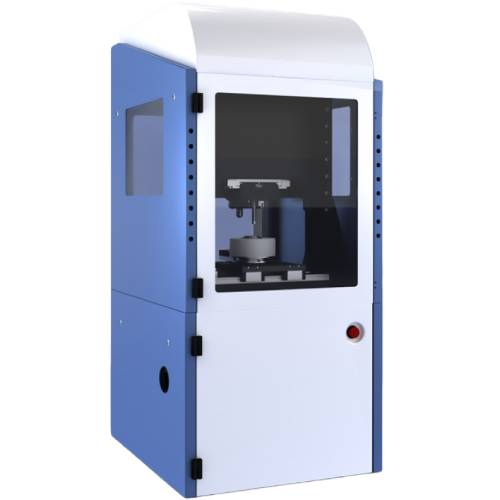


Chemical Mechanical Polisher is a precision polishing platform designed for process research and product development. It integrates chemical mechanical polishing with closed-loop load control, a wide speed range, automated slurry delivery, and real-time signal monitoring. By combining polishing capability with an inline three-dimensional surface profiler, this system enables detailed investigation of surface topography, friction, and wear evolution during the polishing process, supporting accurate optimization of polishing parameters.
Application
The Chemical Mechanical Polisher is widely used in laboratory and pilot-scale environments for polishing process optimization and material behavior studies, including:
Semiconductor wafer polishing (Si, GaN and related substrates)
Optical component surface finishing
Substrate and thin material planarization
Aerospace material surface preparation
Research on friction, wear, and material removal mechanisms
Typical test objects include semiconductor wafers, optical substrates, bonded pads, and development samples with diameters from 0.5 inch to 4.25 inches.
Standards
The system is primarily intended for research and development applications. It supports experimental setups and evaluation methods commonly referenced in:
(1) Semiconductor CMP process research practices
(2) Optical surface finishing and planarization studies
(3) Tribology and wear mechanism investigation methods
Specific test standards depend on user-defined processes and research objectives.
Parameters
| Item | Description |
|---|---|
| Load Control | Closed-loop loading force control with high-precision force sensor |
| Torque Measurement | High-resolution online torque measurement |
| Wafer Holder | Self-leveling fixture with active rotation and horizontal oscillation |
| Sample Size Range | 0.5 inch to 4.25 inches |
| Platform | Fully automated XY platform with quick-change capability |
| Speed Control | Wide adjustable speed range via programmable control |
| Slurry Delivery | Automatic slurry delivery system |
| Inline Sensors | Torque, temperature, and acoustic emission |
| Surface Measurement | Integrated inline three-dimensional optical profiler |
Features
Real-time measurement of friction coefficient during polishing
Precise control of loading force and rotational speed through closed-loop feedback
Integrated three-dimensional optical surface profiler for inline morphology analysis
Compatibility with multiple wafer and sample sizes
Online monitoring of torque, temperature, and acoustic emission signals for accurate endpoint detection
Accessories
(1) Self-leveling wafer fixture
(2) Quick-change wafer and pad holders
(3) Automatic slurry delivery system
(4) Inline torque sensor
(5) Acoustic emission sensor
(6) Online temperature monitoring module
(7) Integrated 3D optical profiler
Test Procedures
Mount the wafer or substrate using the appropriate quick-change fixture and ensure proper self-leveling.
Select a predefined test program or create a custom polishing program, setting load force, speed, and slurry flow.
Start the polishing process; the system automatically controls force and motion while delivering slurry.
Monitor real-time signals such as torque, temperature, and acoustic emission during polishing.
Use inline three-dimensional surface measurement to evaluate surface morphology and polishing progress.
Stop the test automatically or manually based on endpoint criteria or signal thresholds.
Maintenance Information
Clean wafer holders, polishing pads, and slurry delivery components after each test to prevent residue buildup.
Periodically verify calibration of force, torque, temperature, and acoustic emission sensors.
Inspect mechanical motion components and the XY platform to ensure smooth and accurate operation.
Keep optical components of the inline profiler clean to maintain measurement accuracy.
FAQ
1. What is the main purpose of the Chemical Mechanical Polisher?
The Chemical Mechanical Polisher is designed for process and product development rather than routine mass production. It provides a flexible platform that supports a wide range of polishing conditions, allowing detailed investigation of how chemical reactions, mechanical forces, and motion parameters influence surface quality. By combining closed-loop load control, programmable speed, and automated slurry delivery, the system enables precise adjustment of polishing parameters. The addition of inline signal monitoring and three-dimensional surface measurement allows users to directly correlate polishing conditions with surface morphology, friction, and wear behavior.
2. How does the system control and monitor the polishing process?
The system uses high-precision force sensors to achieve closed-loop control of the applied load, ensuring stable and repeatable polishing conditions. During operation, high-resolution online torque measurement quantifies interfacial interactions between the pad and the wafer. Temperature is monitored near the polishing interface to support studies of material removal mechanisms. Acoustic emission signals can also be collected to detect debris formation or surface defects, providing reliable endpoint detection and deeper insight into the polishing process.
3. What types of samples can be processed with this system?
The Chemical Mechanical Polisher is compatible with a wide range of wafer and substrate sizes from 0.5 inch to 4.25 inches. The self-leveling fixture supports active rotation and horizontal oscillation, enabling uniform polishing across different sample geometries. It is suitable for semiconductor materials such as silicon and gallium nitride, as well as optical components and research samples used in aerospace and advanced materials studies.
4. What role does the inline three-dimensional surface profiler play?
The integrated three-dimensional optical profiler allows surface morphology to be measured directly during or after polishing without removing the sample from the system. This enables direct observation of how surface topography evolves as polishing parameters change. By combining morphology data with torque, temperature, and acoustic emission signals, the system provides comprehensive information on surface, friction, and wear behavior, supporting accurate process optimization.
Leave Message Get Price