Advanced 3D Optical Surface Profilometer
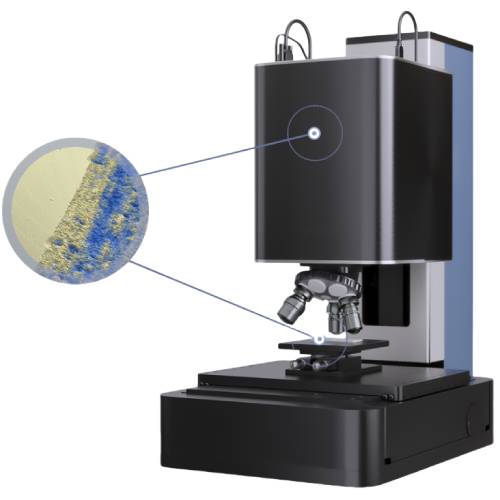


The Advanced 3D Optical Surface Profilometer is a high-end three-dimensional surface measurement system designed for accurate and efficient characterization of surface topography. With high-speed scanning, ultra-high vertical resolution, and multiple integrated optical modes, it provides versatile solutions for surface analysis across a wide range of materials and applications. The system combines advanced optical technologies on a single platform to achieve reliable, repeatable, and high-resolution 3D surface measurements.
Application
The Advanced 3D Optical Surface Profilometer is suitable for comprehensive surface characterization of materials with different optical properties, surface roughness levels, and geometries.
Typical application scenarios and tested products include:
Aerospace components: functional coatings, precision parts, surface defect inspection
Automotive materials: coated parts, metal surfaces, wear-related surface analysis
Biomedical materials: surface morphology of bio-compatible materials and coatings
Optical and glass products: lenses, glass panels, transparent and reflective surfaces
Semiconductor and display industry: thin films, substrates, protective coatings
Polymer and coating materials: surface roughness, defects, and thickness analysis
Pharmaceutical products: coated tablets and functional surfaces
Standards
The system is suitable for surface topography measurement and analysis in accordance with widely used international standards, including but not limited to:
(1) ISO 25178 – Geometrical Product Specifications (GPS): Surface texture – Areal
(2) ISO 4287 – Surface texture: Profile method – Terms, definitions and parameters
(3) ISO 16610 – Filtration of surface texture data
(4) ISO 5436 – Measurement of surface roughness standards
Parameters
| Parameter | Specification |
|---|---|
| Camera speed | Up to 200 FPS |
| Vertical (Z) resolution | Sub-nanometer, independent of objective magnification or scan range |
| Imaging modes | Confocal, White Light Interferometry, Bright Field, Dark Field, Zoom |
| XY stage | Fully automatic motorized XY stage |
| Sample alignment | Adjustable tilt stage |
| Scanning capability | Large-area scanning with automatic stitching |
Features
Multi-mode optical measurement integrated on a single platform
High-speed imaging enabled by dedicated high-speed cameras
Sub-nanometer vertical resolution for precise height measurement
Open system architecture for flexible sample handling
Automatic XY stage and tilt adjustment for accurate positioning
Support for large-area scanning and automatic image stitching
High image quality achieved through optimized optical paths
Accessories
(1) Motorized automatic XY stage
(2) Adjustable tilt sample stage
(3) Multi-wavelength LED illumination module
(4) Film thickness measurement module (spectral reflectance based)
(5) Atomic Force Microscope (AFM) module
(6) Dedicated analysis and reporting software
Test Procedures
Place the sample securely on the stage and adjust the tilt if required.
Select the appropriate imaging mode based on sample material and surface condition (confocal, white light interferometry, bright field, dark field, or zoom).
Set scanning parameters such as scan area, resolution, and speed.
Perform automatic surface scanning using the motorized XY stage.
Acquire three-dimensional surface data and, if required, enable automatic stitching for large-area samples.
Analyze surface morphology, roughness, defects, or thickness using the integrated software and generate measurement reports.
Maintenance Information
Keep optical components clean and free from dust to maintain image quality.
Periodically inspect the illumination system and camera performance.
Ensure the XY stage and tilt platform operate smoothly and are properly calibrated.
Store the system in a clean, vibration-free environment when not in use.
Perform routine software updates and system checks according to recommended schedules.
FAQ
1. What imaging modes are integrated into the Advanced 3D Optical Surface Profilometer?
The Advanced 3D Optical Surface Profilometer integrates multiple imaging modes on a single platform, including confocal microscopy, white light interferometry, bright field imaging, dark field imaging, and zoom imaging. This multi-mode configuration allows the system to adapt to different surface conditions, such as smooth, rough, transparent, or low-reflectivity surfaces. By selecting the appropriate mode, accurate three-dimensional surface data can be obtained without changing instruments, improving efficiency and measurement consistency.
2. How does the system achieve high-speed and high-resolution measurement at the same time?
The system combines a high-speed camera with optimized optical paths for each imaging mode. Each optical technique uses a dedicated high-speed camera, rather than sharing a single camera and optical path. This design significantly improves image quality while maintaining scanning speeds of up to 200 FPS. In addition, the sub-nanometer Z-resolution is independent of objective magnification or scan distance, ensuring stable and repeatable height measurements even during fast scanning.
3. What advantages does spinning disk confocal technology offer compared to traditional confocal systems?
The spinning disk confocal technology uses densely distributed pinholes arranged in a spiral pattern across the disk. This design allows the entire field of view to be scanned simultaneously, rather than relying on a single pinhole with mechanical movement of mirrors or the XY stage. As a result, surface scanning is much faster while maintaining high XY resolution. Scattered light is physically blocked, reducing noise and improving image clarity, especially for transparent layers, steep slopes, and low-reflectivity surfaces.
4. Can the system measure large samples or large surface areas?
Yes. The Advanced 3D Optical Surface Profilometer is equipped with a fully automatic, high-precision XY stage that enables scanning of large samples. The system supports automatic image stitching, allowing multiple scanned areas to be combined into a single, continuous three-dimensional surface map. This capability is particularly useful for large components or samples where full-surface characterization is required.
Leave Message Get Price