Syringe Sliding Performance Tester
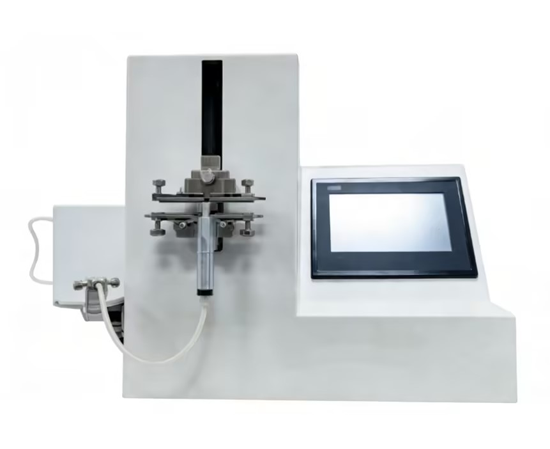


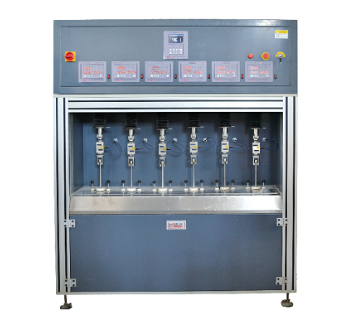
This Syringe Sliding Performance Tester serves as a high-efficiency testing device for evaluating the performance of products manufactured by state-inspected producers. It comprises a programmable controller, touchscreen, force sensor, transmission mechanism, and onboard printer, featuring Chinese and English menu displays.
The Syringe Sliding Performance Tester enables human-machine interaction for parameter configuration and automatic test mode operation. Additionally, it incorporates machine-printed input for production units and batch numbers, ensuring standardized and regulated test results. Information security is safeguarded through a three-level password system, guaranteeing reliable data protection. Test control functions include: nominal capacity, core rod displacement, print settings, testing, upward/downward movement, timing, calibration, and verification.
Integrated onboard printing displays real-time test loads and sliding performance data (initial force, average force, maximum thrust). The system automatically evaluates results; non-compliant items trigger an audible alarm and prompt the printer to output test data and outcomes for analysis.
Application
(1) Syringe quality inspection
Used by syringe manufacturers for routine production testing and batch quality verification.
(2) Medical device laboratory testing
Applied to evaluate syringe plunger movement performance and mechanical consistency.
(3) Incoming material inspection
Used by medical device companies to verify purchased syringe components or finished products.
(4) Research and development
Supports comparison of syringe designs, materials, lubrication processes, and structural improvements.
(5) Regulatory compliance testing
Provides test data for verification according to applicable syringe performance requirements.
Standards
(1)GB 15810-2019 Sterile Single-Use Syringes
(2)ISO 7886-1:2017 Sterile Single-Use Syringes
Parameters
Parameter | Specification |
Operation Interface | Simplified Chinese / English |
Test Range | 0.1N~100N, error ≤ ±0.1N |
Test Speed | 100mm/min, error range: ±1mm/min (software-adjustable) |
Nominal Capacity | 0.1ml~200ml, all specifications can be input arbitrarily |
Net Weight | 15kg |
Dimension | 430×290×400 (mm) |
Power Supply Voltage | AC90V~240V/50Hz (self-adaptive wide voltage) |
Total Machine Power | 70W |
Programmable Controller | PLC + ARM |
Touch Screen | 7-inch, K600+ core, dot-matrix 65-color, 800*480 resolution |
Sensor | High-precision force sensor |
Force Measuring Mechanism | Built-in |
Printer | Built-in dot-matrix printer |
Features
(1) PLC + ARM control ensures stable and reliable operation.
(2) 7-inch touch screen with bilingual interface for easy operation.
(3) Automatic test mode with human-machine interactive parameter setting.
(4) Three-level password protection ensures data security.
(5) Real-time display of initial force, average force, and maximum thrust.
(6) Automatic pass/fail judgment with audible alarm.
(7) Built-in printer for immediate test report output.
(8) Supports batch number and manufacturer information input for traceability.
(9) Wide voltage power supply suitable for different regions.
(10) Compact structure suitable for laboratory environments.
FAQ
(1) What is this product?
It is a dedicated instrument used to measure the sliding performance of medical syringes.
(2) What is this product used for?
You use it to evaluate plunger movement force and smoothness of disposable syringes.
(3) Why is syringe sliding force testing important for manufacturers?
It ensures syringe usability, patient safety, and compliance with medical device standards. Consistent sliding performance affects user operation experience and product reliability. Testing helps manufacturers identify variations caused by materials, assembly processes, lubrication conditions, or production changes.
(4) What industries is this product suitable for?
It is suitable for medical device manufacturing, pharmaceutical packaging, quality inspection agencies, and research laboratories.
(5) What types of this product are available?
Models are typically available with different force ranges, automation levels, and optional computer or data management functions.
(6) How should the test parameters be selected?
Test speed, capacity setting, and evaluation criteria should follow the applicable product standard or internal quality requirements. Laboratories should confirm conditions before testing to ensure comparable results.
(7) What should be considered when purchasing this type of tester?
Selection should focus on measurement range, control accuracy, data recording functions, standard compliance, and after-sales support. For specific application requirements, please contact QINSUN engineers for professional guidance.
Leave Message Get Price