Multifunctional Rapid Thermal Conductivity Tester
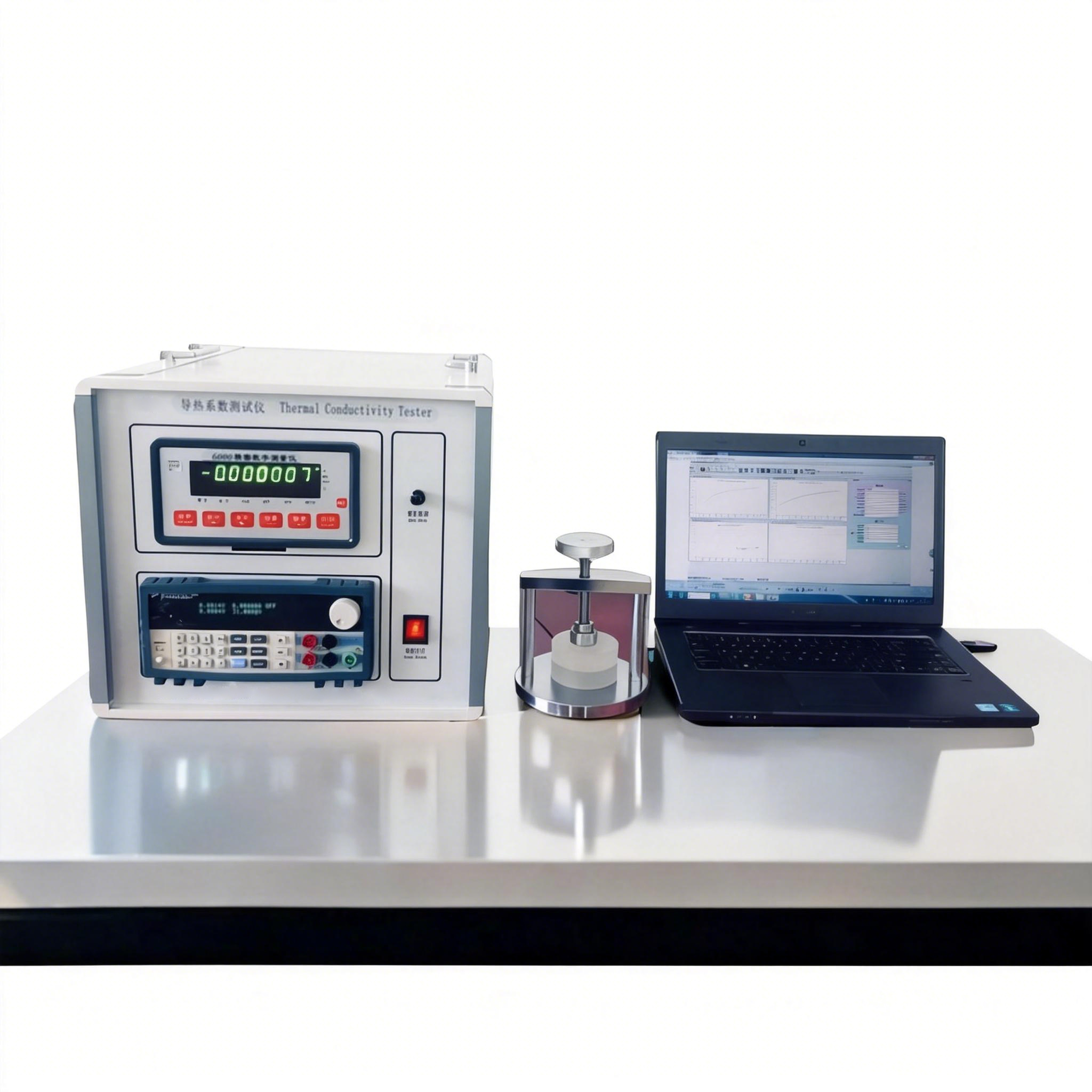


Multifunctional Rapid Thermal Conductivity Tester is a multifunctional thermal property testing system based on the Transient Plane Source (TPS) method, also known as the Hot Disk technique. The instrument directly measures heat transfer behavior using a flat disk-shaped sensor, enabling fast and accurate determination of thermal conductivity and related thermal parameters. Compared with traditional steady-state methods, this technique effectively eliminates the influence of contact thermal resistance and requires minimal sample preparation. With wide applicability, short testing time, and reliable mathematical models for different material types, the system has become a widely adopted solution for thermal characterization of solids, powders, liquids, pastes, thin films, insulation materials, and anisotropic materials.
Application
The Multifunctional Rapid Thermal Conductivity Tester is suitable for thermal property evaluation across a wide range of materials and industrial or research applications, including but not limited to:
Metals and alloys (bulk samples, high thermal conductivity materials)
Graphite and thermally conductive fillers
Thermal interface materials such as thermal grease, silicone gel, and silicone rubber
Ceramics and inorganic materials
Geotechnical materials including soil, rock, and geological samples
Polymers and composite materials
Paper, textiles, foams, and concrete
Insulation and thermal barrier materials
Thin materials and films (thickness 0.01–1 mm)
Anisotropic materials with directional thermal properties
The system can measure thermal conductivity, thermal diffusivity, specific heat capacity, volumetric heat capacity, thermal effusivity, and thermal resistance for solid, powder, liquid, paste, coating, and layered materials.
Standards
The instrument is designed and operated in accordance with the following international and national standards:
ISO 22007-2:2008 / ISO 22007-2:2015:Plastics — Determination of thermal conductivity and thermal diffusivity — Part 2: Transient plane heat source (hot disc) method
GB/T 32064-2015:Determination of thermal conductivity and thermal diffusivity — Transient plane heat source (TPS) method
Parameters
| Item | Specification |
|---|---|
| Thermal conductivity range | 0.001 – 500 W/(m·K) |
| Thermal conductivity resolution | 0.0001 W/(m·K) |
| Thermal diffusivity range | 0.1 – 100 m²/s |
| Thermal effusivity range | 0.1 – 30 W/(m²·K) |
| Specific heat capacity range | 0.1 – 5 kJ/(kg·°C) |
| Thermal resistance range | 0.5 – 0.000005 mm²·K/W |
| Temperature measurement accuracy | ≤ 0.001 °C |
| Relative measurement error | ≤ 3% |
| Repeatability error | ≤ 3% |
| Test time | 1 – 120 s |
| Sample environment temperature | Standard: room temperature |
| Optional temperature range | –40 to 150 °C / –40 to 250 °C |
| Power supply | AC 220 V ±10%, 50/60 Hz |
| Total system power | < 500 W |
| Standard probe | Φ15 mm, –40 to 150 °C |
Features
Direct measurement of heat transfer behavior, significantly reducing testing time
Minimal influence from contact thermal resistance compared with steady-state methods
No special sample preparation required for solid materials with relatively flat surfaces
Wide measurement range suitable for both high and low thermal conductivity materials
Flexible testing schemes and mathematical models for different material types
Effective suppression of natural convection effects during measurement
Fast testing speed with stable and repeatable results
Fully automatic testing software for data analysis and report generation
Accessories
Hot Disk sensor (standard Φ15 mm probe)
Optional probes: Φ30 mm, Φ15 mm, Φ7.5 mm, Φ4.0 mm (–40 to 250 °C)
Solid sample clamping fixture
Powder, paste, and liquid sample testing cell
Dedicated thin-sample testing configuration
Optional temperature control chamber (–40 to 250 °C)
Optional vacuum testing configuration
Test Procedures
Select an appropriate probe and testing mode according to material type and thermal range.
Place the Hot Disk sensor between two solid samples or insert it into the dedicated sample holder for powders, liquids, or pastes.
Ensure proper contact between the probe and sample surface without special surface treatment.
Set test parameters such as power, time, and temperature conditions in the software.
Start the test; the system automatically records transient temperature response.
The software calculates thermal conductivity and related parameters using the corresponding mathematical model.
Review results and export test reports upon completion.
Maintenance Information
Keep the Hot Disk probe clean and free from mechanical damage during handling and storage
Avoid excessive bending or pulling of probe leads
Periodically verify system performance using reference materials
Ensure stable power supply and appropriate environmental conditions during operation
Store probes and accessories in protective containers when not in use
FAQ
1. What makes the thermal conductivity tester different from steady-state testing methods?
The uses the Transient Plane Source (TPS) method, which directly measures heat transfer over a short time period. Unlike steady-state methods, this approach is not significantly affected by contact thermal resistance and does not require long equilibrium times. As a result, testing can be completed much faster while maintaining reliable accuracy. The method is also suitable for a wide range of materials with minimal sample preparation, making it more flexible for laboratory and industrial use.
2. What types of materials can be tested using the system?
The system supports a broad range of materials, including metals, alloys, ceramics, polymers, graphite, thermal interface materials, insulation materials, rocks, soils, paper, textiles, foams, concrete, thin films, and anisotropic materials. It can test solids, powders, liquids, pastes, coatings, and layered structures using dedicated probes and sample holders. Different testing schemes and mathematical models are applied to ensure reliable results for each material type.
3. Does the test require special sample preparation?
For most solid materials, no special preparation is required beyond ensuring a relatively flat contact surface. Powder, paste, and liquid samples can be tested using dedicated sample cells. Thin materials and extreme thermal conductivity ranges are handled using specific testing configurations and calculation models.
4. What thermal parameters can be obtained from one measurement?
The system can determine thermal conductivity, thermal diffusivity, specific heat capacity, volumetric heat capacity, thermal effusivity, and thermal resistance from a single test.
Leave Message Get Price