Walk-in Constant Temperature and Humidity Test Chamber
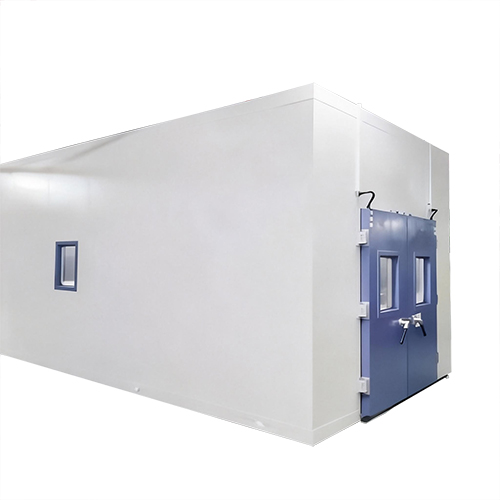


The Walk-in Constant Temperature and Humidity Test Chamber is a high-precision, large-scale environmental testing solution designed to simulate a wide range of temperature and humidity conditions. Whether you need to conduct accelerated aging tests or evaluate product reliability under extreme climates, this chamber provides a stable and controllable environment. Its modular "sandwich" panel construction allows for flexible sizing to accommodate bulky specimens, such as automotive sub-assemblies or large batches of electronic components, ensuring that your performance analysis and quality assessments are based on highly accurate environmental data.
Applications
The Walk-in Constant Temperature and Humidity Test Chamber is suitable for conducting accelerated humidity and heat testing, cyclic humidity and heat testing, and constant humidity and heat testing on large components, semi-finished products, electronic and electrical equipment, precision instruments, lithium batteries, chemical products, automotive parts, and pharmaceuticals. It can also be used for constant temperature and humidity storage in warehouses and production under workshop conditions, enabling analysis and evaluation of product performance and behavior under simulated environmental conditions during testing.
Standards
GB/T2423.3 Environmental Testing of Electronic and Electrical Products Ca: High Temperature Test Method
GB10589-89 Technical Conditions for Low Temperature Testing
GB/T2423.4-93.507.2 Alternating Humidity and Heat Test
GB/T2423.3-93 Constant Temperature and Humidity Test Method
GB5170.5.-96 Requirements for “Verification Methods for Basic Parameters of Environmental Test Equipment for Electrical and Electronic Products”
Requirements of GJB150. IEC, and other standards
Features
1. Mechanical Structure: Primarily composed of an electrical control system, insulated chamber system, air circulation system, heating system, humidification and water circuit system, refrigeration and dehumidification system, etc.
2. Utilizes modular insulated chamber panels, allowing for arbitrary expansion of internal volume. Easy to assemble and disassemble, with dimensions customizable by the customer.
3. The interior features SUS#304 stainless steel panels, while the exterior utilizes Baosteel A3 powder-coated steel for an aesthetically pleasing finish. Insulation layers employ PU foam or rock wool.
4. The control system incorporates imported single-point or programmable controllers with a user-friendly interface, allowing flexible parameter settings for convenient operation.
5. Refrigeration units incorporate imported European/American compressors with eco-friendly refrigerants. A dual-circuit low-temperature system design employs separate compressors for different temperature zones, extending equipment lifespan.
6. Large observation windows in interior doors facilitate monitoring of test samples.
7. The left side of the unit features a 50mm diameter test port for connecting external power or signal cables (port size and quantity are optional).
8. Utilizes imported fan motors + high/low-temperature resistant aluminum alloy circulation fans. High-quality centrifugal fans ensure powerful air circulation, eliminating dead zones and achieving uniform temperature distribution throughout the test chamber.
9. Equipped with advanced safety and protection devices: earth leakage circuit breaker, over-temperature protector, phase failure protector, water shortage protector, low-water protection, short-circuit protection, current overload protection, along with audible/visual alarms and SMS alerts.
Parameters
| Item | Specification |
|---|---|
| Test Area Dimensions | The specific dimensions shall be determined by the customer according to actual usage! |
| External Dimensions | Subject to the quotation. |
| Operating Temperature Range | SBH: +85°C (100°C, 120°C) ~ 0°C (A: 0°C, B: -20°C) |
| Relative Humidity Range | 30% ~ 98%RH- Temperature Deviation: ≤±2°C- Humidity Deviation: +2/-3%RH- Temperature Fluctuation: ≤±0.5°C |
| Heating Time | ≤40min |
| Cooling Time | 30min ~ 180min (varies by model) |
| Material | Exterior: A3 steel plate with spray coatingInterior: SUS#304 stainless steelInsulation: PU foam and insulation board |
| Temperature & Humidity Control System | Equipped with imported fully/ semi-hermetic compressors from the US/Europe, R134a/R404a refrigerant, axial flow fans (side/top discharge), high-performance heaters, steam humidification, and ADP critical dew point cooling dehumidification. Air-cooled or water-cooled dual-system refrigeration. |
| Controller | Programmable type uses Yongheng self-developed touch screen or Korean TH500 controller.Display accuracy: Temperature 0.1°C, Humidity 0.1%RHControl mode: Program/constant value, microcomputer PID controlInput signal: Platinum resistance PT100 |
| Observation Window | Multi-layer hollow electroplated heated explosion-proof glass |
| Other Accessories | Test holes, lighting, feet, shelf racks (or as specified by customer) |
| Safety Devices | Over-temperature protection, leakage protection, water shortage protection, humidification system protection, compressor over-pressure/overload/over-current protection, fan over-speed protection, phase sequence protection |
| Power Supply | AC380V (1±10%) V, 50±0.5HZ, 3-phase 4-wire + protective earth |
| Optional Accessories | Temperature & humidity recorder, USB & 485 communication, SMS alarm, choice of controller/compressor brand, dual refrigeration system, etc. |
| Extendable Products | Walk-in environmental test chamber, high-low temperature test room, high-temperature aging room, constant temperature & humidity workshop/room, dust-free room, purification room, etc. |
| Special Notes | Custom dimensions are available to meet customer requirements. |
Test Procedures
Pre-use Preparation: 3 Key Checks
Before powering on the equipment, thorough preparation is crucial to avoid malfunctions and testing errors!
1. Equipment Status Check
First, check the appearance: For deformation or scratches on the enclosure, and whether the sealing strips are aged. Next, check the power supply: Confirm that the main power supply voltage (generally 380V) matches the control box power supply, and that the grounding is secure (use a multimeter to measure grounding resistance <4Ω). Finally, calibrate the sensors: Check that the temperature and humidity probes are clean and calibrated within their expiration date (annual calibration is recommended).
2. Environmental Condition Confirmation
Allow at least 50cm of space around the equipment, avoiding direct sunlight and proximity to heat/cold sources; the ground must be level to prevent tilting of the equipment from affecting humidity uniformity; the recommended temperature range for the testing area is 5℃~40℃, and the humidity ≤85%RH to avoid overpressure operation of the equipment in extreme environments.
3. Sample Pretreatment
Unsealed samples should be placed in an environment of 23±2℃ and 50±5%RH for 24 hours beforehand to reduce the impact of initial humidity fluctuations. Flammable and explosive samples (such as lithium batteries) are strictly prohibited from being placed in the sample; please confirm the testing standard requirements.
Power-On Operation: Correct Sequence Avoids Pitfalls
The equipment has a fixed startup sequence; incorrect sequence may damage the compressor or affect test accuracy!
1. Main Power → Control Box Power
First, turn on the main power switch outside the test chamber. After the equipment indicator light illuminates, turn on the "main power switch" inside the control box. The system will automatically perform a self-check (approximately 30 seconds). Observe whether the display shows "Self-check Complete".
2. Preheating and System Initialization
If rapid cooling is required before testing, it is recommended to first run the equipment in "cooling pre-cooling" mode (generally pre-cooling to below the target temperature of -10℃). If a high-temperature environment is required, directly enter the "heating pre-heating" process. During this process, the circulating fan can be turned on to accelerate heating/cooling.
Parameter Settings: Precise Control is Key
Incorrect temperature and humidity parameter settings render test results useless!
1. Temperature and Humidity Range
Common model temperature range: -70℃~+150℃, humidity 30%~98%RH (fluctuation ±2℃/±5%RH). Note when setting: When the temperature difference between the target temperature and room temperature is >50℃, it is recommended to increase or decrease the temperature in stages (e.g., from 25℃→-30℃, first to 0℃ and then to -30℃) to avoid overloading the equipment.
2. Operating Mode Selection
Select "Constant Mode" (e.g., maintain 25℃/60%RH for 24 hours) or "Cycling Mode" (e.g., cycle once per hour from 0℃ to 30℃) according to test requirements. The cycle time is recommended to be ≥1 hour to prevent damage to the sample from sudden temperature changes.
Sample Placement: 3 Golden Rules
Improper sample placement can lead to localized temperature and humidity deviations, affecting test accuracy!
1. Spacing and Orientation
Leave at least 20cm gaps between samples to avoid stacking and obstruction; for equipment with plugs, keep the plugs away from the air outlet to prevent overheating; if the sample has a heat sink, it is recommended to place it vertically to ensure air circulation.
2. Fixing and Protection
Metal samples can be fixed with anti-static tape; fragile parts (such as glass and ceramics) should be cushioned with foam; liquid samples should be sealed and fixed with a bracket to prevent spillage and contamination of the equipment.
Operation Monitoring: 3 Steps for Troubleshooting
Observe the data in real time during equipment operation and address any problems promptly!
1. Temperature and Humidity Fluctuations
If the fluctuation is >±3℃/±8%RH, check for blocked air outlets (clean the filter) or excessive sample accumulation (reposition).
2. Abnormal Alarm Handling
When encountering "over-temperature" or "over-humidity" alarms, first press the "reset" button to turn off the alarm, then check if the heating/cooling system is malfunctioning (check if the compressor is running and if there are any abnormal noises).
FAQ
Q1: What is the benefit of a "Cascade Refrigeration System" in a walk-in chamber?
A: When you require temperatures below -40℃, a single-stage system becomes inefficient. A cascade system uses two separate cooling cycles with different refrigerants, allowing the unit to reach ultra-low temperatures reliably without over-stressing the compressors.
Q2: How do I prevent condensation from forming on my samples during a test?
A: Condensation usually occurs when the air temperature rises faster than the sample temperature. You should program a gradual ramp-up or use the "drying" function if available. Always ensure the chamber reaches ambient temperature before removing samples.
Q3: Can I test active (heat-dissipating) specimens in this chamber?
A: Yes, but you must account for the "Heat Load." If your sample generates significant heat (e.g., a running engine or large battery), you must specify this total wattage during the design phase so the refrigeration system can be oversized to compensate.
Q4: Why is deionized or distilled water mandatory for the humidity system?
A: Standard tap water contains calcium and magnesium. When boiled for steam, these minerals form "white powder" or scale, which can coat the test samples, clog the sensors, and burn out the humidification heater.
Leave Message Get Price