Walk-in High-Temperature Aging Chamber
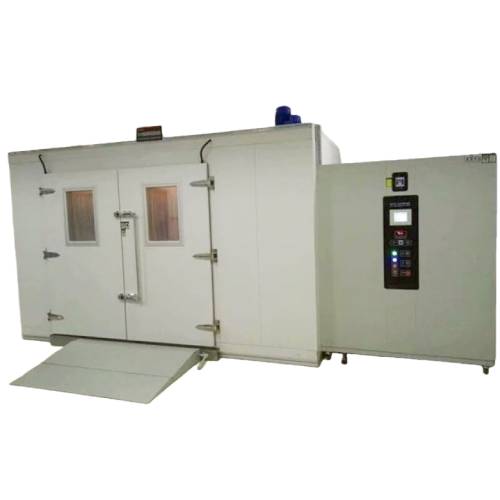


The Walk-in High-Temperature Aging Chamber is designed for large-scale high-temperature aging tests, providing a controlled environment to simulate long-term thermal stress on materials, components, and products. You can use this chamber to evaluate product durability, thermal stability, and performance reliability under elevated temperatures. Its robust safety features and user-friendly operation make it suitable for continuous industrial testing and research applications.
Applications
Walk-in High-Temperature Aging Chambers are typically assembled on-site using insulated panels (double-sided color steel sheets with insulation material in between). Chamber dimensions are customized to client specifications. The complete walk-in high/low temperature and humidity test chamber features comprehensive safety protection devices and provides troubleshooting methods, with safety ratings surpassing other brands. Protection Devices: Fuse-less switches, fuses, over-temperature protection, dry-run protection, low-water protection, liquid level protection, compressor overpressure, overheat, and overcurrent protection. Comprehensive protection includes compressor overload/overheat protection, phase loss protection, and a fault alarm system.
Standards
GJB150.3 (ML-STD-810D) High Temperature Test Method
GJB150.4 (MIL-STD-810D) Low Temperature Test Method
GJB360.8-87 (MIL-STD-202f) High Temperature Life Test
GB/T5170.2-96 Temperature Test Equipment
GB2423.1-89 (IEC68-2-1) Basic Environmental Test Procedures for Electrical and Electronic Products Test A: Low Temperature Test Method
GB2423.2-89 (IEC68-2-2) Basic Environmental Test Procedures for Electrical and Electronic Products - Test B: High Temperature Test Method
GB5170. 2. 3. 5. 6-95 “Calibration Methods for Basic Parameters of Environmental Test Equipment for Electrical and Electronic Products - Low Temperature, High Temperature, Constant Humidity and Heat, Alternating Humidity and Heat Test Equipment” Requirements
Features
1. Simple maintenance and user-friendly operation are key advantages of our products.
2. The independent frame design ensures the refrigeration system and air distribution system operate separately.
3. Maintenance and repairs can be performed during unit operation, resulting in low annual failure rates and simplified, rapid servicing.
Parameters
| Item | Specifications |
|---|---|
| Dimensions | 200 cm (W) × 200 cm (H) × 200 cm (D); customizable per customer requirements, with external dimensions subject to actual size |
| Temperature Range | Optional ranges: 0°C~20°C / -40°C~60°C / -70°C~+85°C / 100°C (lower temperature ranges are higher in cost; choose based on product needs) |
| Temperature Fluctuation | ±0.5°C (defined as half the difference between the highest and lowest measured temperatures at the center point) |
| Temperature Uniformity | ±2.0°C (defined as the arithmetic mean of the differences between highest and lowest measured temperatures per test) |
| Heating Time | From room temperature (+10°C) to +85°C: <60 minutes, non-linear no-load heating rate ≈3°C/min |
| Cooling Time | - From +10°C to 0°C: <30 minutes, non-linear no-load cooling rate ≈1°C/min- From +10°C to -20°C: <45 minutes, non-linear no-load cooling rate ≈1°C/min- From +10°C to -40°C: <60 minutes, non-linear no-load cooling rate ≈1°C/min |
| Operating Noise | A-weighted sound level ≤60 dB(A), measured in anechoic chamber at 25°C ambient temperature, using A-weighting, averaged over 8 test points (each at 1m from noise source and 1m above ground) |
Accessories
Temperature and humidity sensors
LED display control panel with PID auto-tuning
Stainless steel air circulation ducts and heating elements
Safety devices: fuses, overload protection, leakage detection
Adjustable shelving for test samples
Test Procedures
1. Pre-Operation Preparation
Train personnel on safety procedures, emergency stop methods, and chamber operation.
Verify grounding and electrical system integrity; ensure voltage is within specifications (~380V).
Ensure adequate ventilation and unobstructed exhaust system.
Wear appropriate personal protective equipment (PPE) including heat-resistant gloves, safety shoes, and protective eyewear.
2. Sample Placement
Arrange test samples to avoid overcrowding and ensure uniform airflow.
Ensure sample weight and volume do not exceed chamber limits.
3. Operation
Set desired temperature and duration according to test protocol.
Start the chamber and monitor temperature via PID control system.
Check for abnormal readings or fluctuations; adjust settings as necessary.
4. Monitoring During Test
Continuously monitor internal temperature and airflow.
Inspect for leaks or abnormal fumes if using gas or electric heating.
Restrict access to authorized personnel only.
FAQ
1. What is the maximum temperature range achievable?
You can select a range from 0℃ to +100℃, depending on your specific requirements and chamber configuration.
2. Can the chamber maintain uniform temperature throughout?
Yes, the PID-controlled air circulation and heating system ensure temperature uniformity within ±2℃.
3. How is safety ensured during high-temperature tests?
The chamber is equipped with over-temperature protection, dry-burn prevention, liquid level monitoring, leakage protection, and comprehensive fault alarms.
4. Can the chamber be customized in size?
Yes, dimensions can be tailored to meet your testing needs, accommodating various product sizes.
5. Is continuous operation possible?
Yes, the independent refrigeration and airflow systems allow maintenance during operation, ensuring low failure rates.
6. What is the noise level during operation?
Noise is ≤60 dB(A), measured at 1 meter above ground in a low-echo environment.
Leave Message Get Price