Dying Rubbing Fastness Tester(Model: G238BBC)
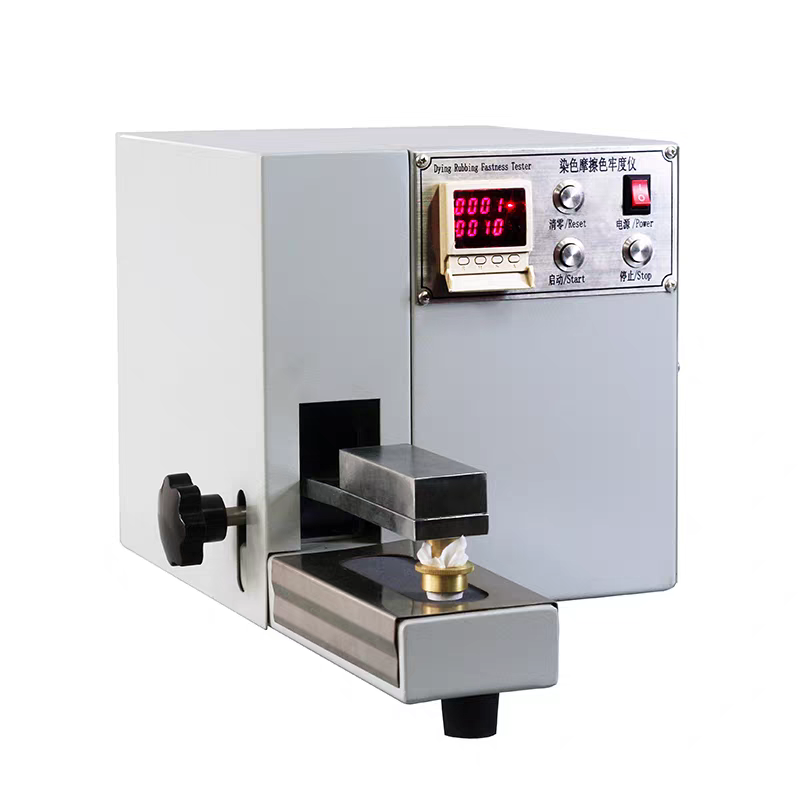


The Dying Rubbing Fastness Tester is a laboratory instrument used to determine the resistance of dyed textiles to dry and wet rubbing. The test is performed by a standard-weight rubbing head executing reciprocating linear motion at a specified speed and stroke length. After completion of the preset number of cycles, the motor automatically stops, ensuring consistent and repeatable test results.
Application
The Dying Rubbing Fastness Tester is suitable for evaluating dry and wet rubbing fastness of various textile materials, including:
Cotton, wool, linen, and silk fabrics
Knitted fabrics
Printed and dyed textiles
The instrument is used in textile manufacturing, printing and dyeing industries, quality inspection laboratories, and research institutions.
Standards
ISO 105-X12 Textiles — Tests for Colour Fastness — Part X12: Colour Fastness to Rubbing
ISO 105-D02 Textiles — Tests for Colour Fastness — Part D02: Colour Fastness to Rubbing Using Organic Solvents
AATCC 8 Colorfastness to Crocking
AATCC 165 Colorfastness to Crocking: Screen Printing Inks
BS 1006 D02 Methods of Test for Colour Fastness of Textiles and Leather — Colour Fastness to Rubbing
BS 4655 Specification for Colour Fastness to Rubbing of Textile Materials
GB/T 420 Textiles — Tests for Colour Fastness — Colour Fastness to Rubbing
GB/T 3920-2008 Textiles — Tests for Colour Fastness — Colour Fastness to Rubbing
Parameters
| Parameter | Specification |
|---|---|
| Rubbing head diameter | Φ16 mm ± 0.1 mm |
| Rubbing head load | 9 N ± 0.2 N |
| Stroke length | 104 mm ± 3 mm |
| Reciprocating speed | 60 ± 3 cycles/min |
| Test table cushion thickness | 0.25 mm water-resistant fine sandpaper |
| Number of cycles | 1–999,900 (adjustable) |
| Power supply | AC 220 V ±10%, 50 Hz |
| Power consumption | 20 W |
| Machine dimensions (L×W×H) | 430 × 280 × 260 mm |
| Packing box dimensions | 460 × 300 × 300 mm |
Features
Standard-weight rubbing head ensures test repeatability and consistency
Adjustable stroke length and test cycles to meet different standard requirements
Motor-driven operation with automatic stop after preset cycles
Stable mechanical structure suitable for long-term laboratory use
Compatible with multiple international textile color fastness standards
Accessories
Main instrument × 1
Standard rubbing head × 1
Test table cushion × 1
Operation manual × 1
Certificate of conformity × 1
Test Procedures
Fix the textile specimen securely on the test table.
Select dry or wet rubbing mode according to the test standard.
Set the required number of rubbing cycles on the control interface.
Start the test; the rubbing head performs reciprocating motion under standard load.
After completion, remove the specimen and evaluate rubbing fastness using the appropriate gray scale.
Maintenance Information
Keep the rubbing head and test table clean and free of fiber residue.
Periodically inspect the rubbing head load and stroke accuracy.
Replace worn sandpaper cushions as required by the test standard.
Disconnect power when the instrument is not in use for extended periods.
FAQ
(1) What is this product?
It is a laboratory instrument used to evaluate the dry and wet rubbing color fastness of dyed textile materials.
(2) What is this product used for?
It is used to assess color transfer resistance when textiles are subjected to rubbing under controlled conditions.
(3) Why is this product important?
Rubbing fastness is a key quality indicator for dyed textiles and directly affects product durability and consumer acceptance.
(4) What industries is this product suitable for?
It is suitable for textile manufacturing, printing and dyeing industries, quality inspection laboratories, and research institutions.
(5) What types of this product are available?
This product series includes laboratory rubbing fastness testers designed for dry and wet rubbing tests in accordance with international standards.
Leave Message Get Price