Vehicle-Level High/Low Temperature and Humidity Test Chamber
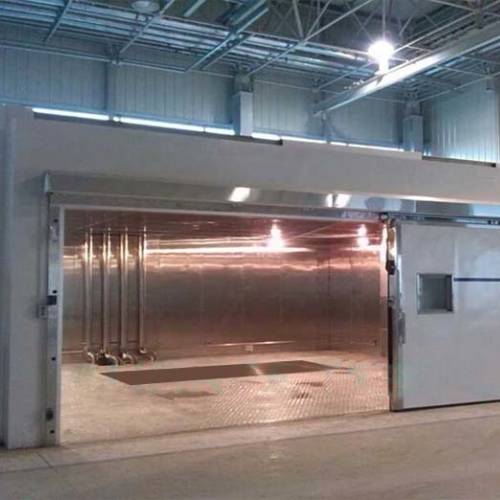


The Vehicle-Level High/Low Temperature and Humidity Test Chamber is a large-scale environmental simulation chamber designed to replicate extreme temperature and humidity conditions for full vehicles and automotive components. You can use it to verify the performance reliability of engines, air conditioning systems, electrical components, coatings, and rubber parts under high and low temperature, as well as humid environments. This chamber is essential for automotive research, development, and quality control.
Applications
1. Automotive R&D Testing
Cold Start Test: Verifies engine starting performance at low temperatures (e.g., -40°C), requiring ≤3 successful starts with a start time ≤15 seconds.
Thermal Equilibrium Test: Simulates high-temperature (+60°C) and high-humidity environments to evaluate the stability of air conditioning systems and cooling components.
Material Reliability: Assesses the aging resistance of body coatings and rubber seals under temperature-humidity cycling conditions.
2. Other Applications
Extendable for environmental reliability testing in aerospace, large home appliances, and other industries, supporting composite environment simulation including low atmospheric pressure (1 kPa to atmospheric pressure).
Standards
GB/T 2423.1 Environmental Testing of Electrical and Electronic Products - Part 2: Test Methods - Test A: Low Temperature
GB/T 2423.2 Environmental Testing of Electrical and Electronic Products - Part 2: Test Methods - Test B: High Temperature
GB/T 2423.3 Environmental Testing - Part 2: Test Methods - Test Cab: Constant Humidity and Heat Test
GJB 150.3A Laboratory Environmental Test Methods for Military Equipment - Part 3: High Temperature Test
GJB 150.4A Laboratory Environmental Test Methods for Military Equipment - Part 4: Low Temperature Test
Features
1.Large-Scale Vehicle Testing:
Supports full-size vehicles and engine operation under extreme temperature and humidity conditions.
2.Precise Environmental Control:
Temperature fluctuation ≤±0.5℃, temperature uniformity ≤2℃, and humidity deviation ±5% RH ensures reliable and repeatable results.
3.Cold Start and Heat Balance Simulation:
Allows testing of automotive engines, air conditioning systems, and auxiliary components under simulated real-world conditions.
4.Durability and Reliability Assessment:
Facilitates accelerated aging of coatings, rubber seals, and electrical components under extreme environmental cycles.
5.Flexible Application:
Can be adapted to composite environmental simulations including low-pressure conditions for aerospace or industrial applications.
Parameters
| Item | Specifications |
|---|---|
| Refrigeration System | Capable of maintaining stable internal temperature at -16°C while one 5-ton vehicle (or two 2.5-ton vehicles, total engine displacement 4.0T, maximum power 300kW) is running at 50% rated engine speed.Internal effective dimensions: 10 m × 5 m × 4 m (D × W × H) |
| Temperature Range | -45°C ~ 90°C |
| Temperature Fluctuation | ≤±0.5°C |
| Temperature Uniformity | ≤2°C |
| Humidity Range | 20% ~ 98% RH |
| Humidity Deviation | ±5% |
Accessories
Programmable touchscreen control system
Humidity and temperature sensors
Data acquisition and monitoring software
Vehicle support platforms or wheel locking fixtures
Safety interlocks and alarm systems
Test Procedures
1. 1.Equipment Preparation
Verify chamber structure, power supply, and safety interlocks.
Check water supply and humidity system operation.
Position vehicle(s) securely using support platforms or fixtures.
2. 2.Parameter Configuration
Set desired temperature and humidity ranges.
Program cyclic test schedules for hot, cold, and humid conditions.
Activate data acquisition and monitoring systems.
3.3. Test Execution
Start environmental simulation.
Monitor temperature, humidity, and engine behavior if performing cold start tests.
Record all data automatically via software.
4.4. Test Completion
Gradually return chamber to ambient conditions.
Remove vehicles safely and analyze test data for component reliability and performance.
FAQ
1. Can full-size vehicles operate inside the chamber?
Yes, it supports one vehicle up to 5 tons or two vehicles of 2.5 tons each. Engine operation under low temperatures is possible.
2. How accurately does the chamber control temperature and humidity?
Temperature fluctuation is ≤±0.5℃, uniformity ≤2℃, and humidity deviation ±5% RH for precise testing.
3. Can cold start tests be performed?
Yes, engines can be started at temperatures as low as -18℃, maintaining up to 50% of rated engine speed.
4. Is the chamber suitable for composite environmental simulations?
Yes, it can simulate extreme temperatures, high humidity, and optionally low-pressure environments for aerospace or industrial testing.
5. How is vehicle safety ensured during testing?
Vehicles are secured using wheel fixtures or platforms, and the chamber includes interlocks, alarms, and emergency shutdown systems.
Leave Message Get Price