Vehicle Environmental Performance Test Chamber
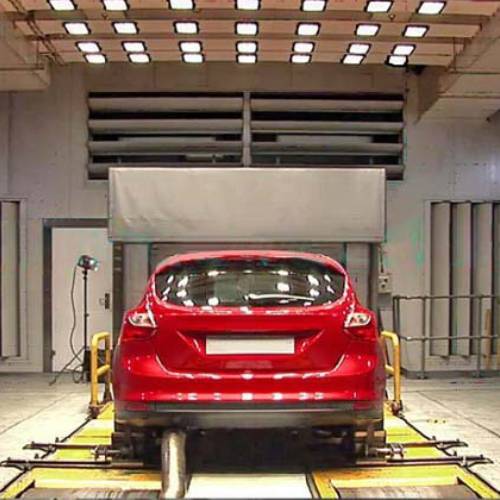


Full Vehicle Environmental Performance Test Chamber is a specialized facility designed for comprehensive testing of gasoline and electric vehicles under controlled environmental conditions. It evaluates vehicle HVAC systems, defrost/defogging performance, thermal management, and overall environmental behavior. The chamber is compatible with chassis dynamometers (roller type) for integrated vehicle testing, providing accurate data for research, development, and performance analysis.
The Vehicle Environmental Performance Test Chamber provides a controlled environment for evaluating complete vehicle performance under different climate conditions. With full-vehicle testing capability, chassis dynamometer compatibility, and comprehensive environmental control, it supports automotive manufacturers and laboratories in improving vehicle reliability, energy efficiency, and passenger comfort.
Application
The Vehicle Environmental Performance Test Chamber is widely used for comprehensive vehicle performance evaluation:
(1) HVAC system testing — Evaluation of vehicle air conditioning, heating, ventilation, defrosting, and demisting performance under different climate conditions.
(2) Thermal management research — Testing battery thermal management, powertrain temperature control, and passenger compartment thermal comfort for electric and conventional vehicles.
(3) Vehicle energy efficiency testing — Combined with chassis dynamometers to analyze fuel consumption, energy usage, and climate control impact during driving cycles.
(4) Interior air quality evaluation — Testing cabin VOC emissions, pollutant concentration, and temperature-related air quality performance.
(5) Cold and hot environment testing — Verification of vehicle starting performance and operating reliability under extreme temperature conditions.
(6) Automotive research and development — Supporting vehicle manufacturers, testing institutions, and research laboratories in environmental performance validation.
Standards
The chamber conforms to multiple national and international standards, including:
(1) GB 18352.6-2016 – Limits and measurement methods for light vehicle pollutants
(2) GB/T 27630-2011 – Guidelines for passenger car interior air quality assessment
(3) QC/T 658-2009 – Road test methods for automotive air conditioning system performance
(4) GB/T 12535-2021 – Vehicle starting performance test methods
(5) GB/T 12542-2020 – Road test methods for vehicle thermal balance capabilities
(6) GB/T 2423 – Environmental testing methods for high/low temperature, humidity, and thermal cycling
(7) ISO 12219-1 – Road vehicles – Interior air – Test methods for volatile organic compounds in complete vehicles
(8) DIN 75220 – Sunlight simulation aging tests for automotive components
(9) SAE J1711 – Recommended procedures for hybrid vehicle fuel economy and emission measurements
(10) PV 3938 – Evaluation methods for automotive interior odor
Parameters
| Item | Specification |
|---|---|
| Internal dimensions (L×W×H) | 16.300 × 8.300 × 5.200 mm |
| Heat exchanger clearance height | ≥3.500 mm |
| Floor insulation | 150 mm polyurethane |
| Chamber floor | Stainless steel tread plate, solid layer thickness ≥3 mm, pattern height 2 mm |
| Floor load capacity | 1.200 kg/wheel; axle load ≥2.000 kg |
| Chassis dynamometer support | Thermally insulated, designed for full dynamometer weight |
| Vehicle access door | 1 set, net 3.000×3.000 mm, two-leaf, heated glass observation windows 300×300 mm |
| Personnel access door | 1 set, net 900×1.900 mm, heated explosion-proof glass observation window 300×300 mm |
| Control observation window | 2 sets (optional), 2.000×1.000 mm, insulated, anti-frost heated surface |
| Lighting | Main illumination ≥500 lux over full temperature range; emergency light operational ≥1 hour at -40°C |
| Power outlets | 4×220 VAC/10A, 2×220 VAC/16A, 2×380 VAC/32A (with standard triangle plugs) |
| Cable feed-throughs | 4 sets, diameter 100 mm, max 16 cables per hole |
| Personnel airlock | 1 set, 1.500×1.500×2.100 mm, internal opening, external lockable |
| Chamber pressure | Micro-positive pressure 0–50 Pa via pressure balance valves |
Features
Large-scale chamber capable of accommodating full-size vehicles
Supports integration with roller-type chassis dynamometers
Comprehensive environmental control: temperature, humidity, solar irradiation, and airflow
Heated, insulated, and observation-capable doors for vehicle and personnel access
Safety features: emergency lighting, pressure balance, CO/NOx monitoring, automatic alarm and shutdown
High load capacity floor suitable for vehicle weight and axle distribution
Multiple power supply options for testing electrical and HVAC systems
Precise instrumentation and calibration for temperature, humidity, and solar radiation simulation
Accessories
(1) Observation windows with heated glass
(2) Personnel access door with anti-explosion heated glass
(3) Control system for environmental parameters
(4) Emergency lighting and power outlets
(5) Roller-type chassis dynamometer interface and support blocks
Maintenance Information
Regular cleaning of chamber walls, doors, and observation windows to prevent contamination
Periodic calibration of temperature, humidity, and solar simulation systems
Inspection of power outlets, lighting, and emergency systems
Verification of airlock operation and pressure balance valves
Scheduled maintenance of roller dynamometer interface and support structures
FAQ
1. What is the purpose of the Full Vehicle Environmental Performance Test Chamber?
The Full Vehicle Environmental Performance Test Chamber is designed to evaluate complete gasoline and electric vehicles under controlled environmental conditions. It allows comprehensive testing of HVAC systems, defrosting/defogging efficiency, thermal management, in-cabin air quality, and overall vehicle environmental behavior. By integrating with roller-type chassis dynamometers, it can simulate real-world driving conditions while providing precise measurements of fuel consumption, emissions, and climate control performance. This chamber is essential for vehicle research, development, and performance analysis.
2. What applications is this chamber suitable for?
The chamber supports a wide range of applications, including thermal comfort assessment for driver and passenger compartments, HVAC system performance evaluation, defrosting and demisting efficiency testing, and in-cabin air quality analysis. It also enables road simulation and performance analysis when coupled with a chassis dynamometer, allowing measurement of energy efficiency, fuel consumption, and climate control performance. In addition, it provides controlled environments for emission and VOC concentration testing, supporting research and regulatory compliance in both gasoline and electric vehicles.
3. Which standards does the Full Vehicle Environmental Performance Test Chamber comply with?
The chamber conforms to multiple national and international standards, including GB 18352.6-2016 for light vehicle pollutant limits, GB/T 27630-2011 for passenger car interior air quality, QC/T 658-2009 for automotive air conditioning performance, GB/T 12535-2021 for vehicle starting performance, and ISO 12219-1 for interior VOC testing. It also supports thermal cycling and environmental testing according to GB/T 2423. as well as sunlight simulation tests per DIN 75220 and hybrid vehicle fuel economy evaluation using SAE J1711. Compliance ensures reliable, repeatable, and standardized test results.
4. What are the main technical features of this chamber?
The chamber is large enough to accommodate full-size vehicles and supports integration with roller-type chassis dynamometers. It provides comprehensive environmental control including temperature, humidity, airflow, and solar irradiation. The doors are heated, insulated, and include observation windows for vehicle and personnel access. Safety systems include emergency lighting, micro-positive chamber pressure, CO/NOx monitoring, and automatic alarms with shutdown. The floor has high load capacity suitable for vehicle weight and axle distribution. Precise instrumentation ensures accurate calibration of environmental parameters.
5. How are tests conducted inside the chamber?
Before testing, the chamber is cleaned and ventilated to minimize background pollutants. Vehicles are positioned centrally with uniform airflow across surfaces. Power supply connections and sensor installations (temperature, emissions, fuel consumption) are verified. The automated control system then maintains set temperature, humidity, airflow, and solar irradiation, while performing thermal cycling tests or road simulation with roller dynamometers. Vehicle performance metrics such as AC cooling rate, defrost time, cold start, and emission levels are recorded. Safety protocols continuously monitor emissions and chamber pressure, triggering alarms and shutdown if parameters exceed limits.
6. What maintenance is required for the Full Vehicle Environmental Performance Test Chamber?
Regular maintenance includes cleaning chamber walls, doors, and observation windows to prevent contamination. Temperature, humidity, and solar simulation systems must be periodically calibrated to ensure accurate environmental control. Power outlets, lighting, emergency systems, airlocks, and pressure balance valves should be inspected routinely. The roller dynamometer interface and support structures also require scheduled inspection and maintenance to ensure stable operation. Proper upkeep ensures consistent, accurate testing conditions and prolongs the service life of the chamber.
7.What factors should be considered when selecting this test chamber?
Selection should consider vehicle size, required temperature range, test standards, dynamometer compatibility, power requirements, and future testing needs. QINSUN engineers can provide suitable configuration suggestions.
Leave Message Get Price