High-Temperature Curing Chamber
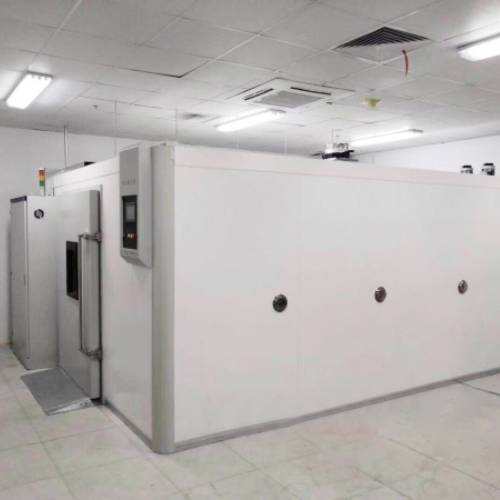


The High-Temperature Curing Chamber, also known as a drying or baking curing room, is a high-performance industrial solution designed for large-scale thermal processing. It utilizes an advanced forced-air hot vent circulation system to ensure uniform temperature distribution across the entire workspace. Whether you are performing surface curing, moisture removal, or thermal stress testing, this chamber provides a stable, high-capacity environment to accelerate the drying and hardening processes for various industrial materials and products.
Applications
High-Temperature Curing Chamber, also known as a drying and curing room, is an advanced hot air circulation system designed for curing large electrical components, motors, coatings, chemical products, and surfaces, as well as for drying moisture from food and various other products. It ensures uniform temperature distribution throughout the working chamber.
Standards
(1) GB 50052: Code for design of power supply and distribution systems.
(2) GB 50054: Code for design of low-voltage electrical installations.
(3) GB 50169: Code for construction and acceptance of grounding devices in electrical installations.
(4) GB 50243: Code for acceptance of construction quality of ventilation and air conditioning works.
(5) IEC 60068-2-2: Environmental testing - Part 2-2: Tests - Test B: Dry heat.
(6) ISO 9001: Quality management systems (Production compliance).
Features
1. Mechanical Structure: Primarily composed of an electrical control system, insulated chamber system, air circulation system, heating system, humidification and water circuit system, refrigeration and dehumidification system, etc.
2. Utilizes modular insulated chamber panels, allowing for arbitrary expansion of internal volume. Easy to assemble and disassemble, with dimensions customizable by the customer.
3. The interior features SUS#304 stainless steel panels, while the exterior utilizes Baosteel A3 powder-coated steel for an aesthetically pleasing finish. Insulation layers employ PU foam or rock wool.
4. The control system incorporates imported single-point or programmable controllers with a user-friendly interface, allowing flexible parameter settings for convenient operation.
5. Refrigeration units incorporate imported European/American compressors with eco-friendly refrigerants. A dual-circuit low-temperature system design employs separate compressors for different temperature zones, extending equipment lifespan.
6. Large observation windows in interior doors facilitate monitoring of test samples.
7. The left side of the unit features a 50mm diameter test port for connecting external power or signal cables (port size and quantity are optional).
8. Utilizes imported fan motors + high/low-temperature resistant aluminum alloy circulation fans. High-quality centrifugal fans ensure powerful air circulation, eliminating dead zones and achieving uniform temperature distribution throughout the test chamber.
9. Equipped with advanced safety and protection devices: earth leakage circuit breaker, over-temperature protector, phase failure protector, water shortage protector, low-water protection, short-circuit protection, current overload protection, along with audible/visual alarms and SMS alerts.
Parameters
| Item | Specification |
|---|---|
| Insulation Material | PU or rock wool (choose one); thickness: 5cm, 7.5cm, 10cm, 15cm (choose one) |
| Temperature Range | RT ~ +60°C ~ +85°C (up to ~300°C) |
| Temperature Fluctuation | ±1°C |
| Heating Rate | Average 3~5°C/min; Instrument resolution: 0.1°C |
| Operating Mode | Temperature adjustable, constant operation (programmable operation available with programmable controller) |
| Heating Power | Determined by the size of the aging chamber |
| Power Supply | 380V; 50 Hz; If using 220V power supply, a minimum current of 120A is required for installation |
Structure and Material Specifications
The main system utilizes insulated sandwich panels, with combustion performance compliant with Class A1 or B2 standards of the “Classification of Combustion Performance for Building Materials.”
1. Wall Materials: All five sides of the chamber are assembled using double-sided color-coated steel insulated panels (computer color or snow white), fixed with aluminum support beams and aluminum profile edging. The floor remains untreated (insulation available upon customer request). High-temperature resistant silicone sealant is applied at joints to ensure effective chamber sealing. Aging test vehicles can be placed inside as required.
2. Single Door Opening: W800×2000mm (Double or single door available upon request).
3. Observation Window: 400×600mm tempered glass installed on the main door, enabling real-time monitoring of internal conditions during aging (or customized as required).
4. Heater Placement: Located within the ceiling air circulation duct, surrounded by fireproof insulation material. Utilizes PID temperature control modules. Upon reaching the required product temperature, the system automatically adjusts heater power based on indoor temperature fluctuations, complementing the insulation properties of the thermal panels to maintain precise and stable temperature at the set value.
Air Conditioning and Dehumidification System
The ventilation system complies with the “Code for Acceptance of Construction Quality of Ventilation and Air Conditioning Engineering” GB50243-2002 standard.
1. The hot air circulation system adopts a European-style design with left/right air outlets and a central return air duct, utilizing high-capacity fans for forced air circulation.
2. The ventilation system comprises separate exhaust and circulation systems, operating independently.
3. The exhaust system removes excess heat from the chamber when the internal temperature exceeds the product's required temperature.
4. The exhaust system employs a duct-and-fan integrated design concept. The circulation fan continuously drives convective air movement within the chamber; ensuring uniform indoor temperature distribution.
5. The heater is installed at the top of the aging chamber. Utilizing PID control, once the temperature reaches the product's required level, it dynamically adjusts the electric heating output power based on indoor and outdoor temperatures, significantly enhancing indoor temperature precision.
6. Enhanced quiet operation better ensures a favorable office environment and working conditions for operators.
Measurement and Control System
1. Temperature Measurement: PT-100.
2. Control Instrument: Imported or Taiwanese brand high-precision digital temperature controller with PID regulation, accuracy 0.1°C.
3. Control Output: Solid-state relay (SSR) output.
4. Electrical Control Cabinet: One set, featuring imported components from LG, Omron, etc., for primary electrical components.
5. Moisture extraction time is programmable, enabling more efficient removal of excess humidity from the chamber.
Test Procedures
1. Control System Integration with Aging Function Design. Design a functional control cabinet where aging duration, temperature, and various operation switches can be managed from a single control panel. The cabinet panel features an aesthetically pleasing design and intuitive operation.
2. Fully automatic control with partial anomaly self-handling capabilities, enabling automated and simplified operation:
a. Power supply to circulation fans, electric heaters, etc., is cut off; the test chamber cools down automatically and continues aging. When the total time elapses, a yellow warning light illuminates to indicate aging completion.
b. Over-temperature protection control for products. When temperature exceeds the product's upper limit, power supply to the product is automatically cut off to prevent overheating and performance degradation. Simultaneously, a buzzer sounds and a red warning light illuminates. Power supply automatically resumes when temperature returns to normal.
3. Multiple safety protections for reliability:
a. Dry-burn protection for electric heaters: Automatic power cutoff with alarm activation during fan failure or excessive duct temperatures.
b. Interlocked heater-fan operation: Heaters cannot activate independently if the fan fails to start.
c. High-temperature resistant wiring (non-combustible at 300°C) for heater connections.
d. Indoor installation of 60W explosion-proof lighting extends bulb lifespan and prevents bulb explosions.
e. Chamber body constructed with flame-retardant insulation material for superior thermal performance and high safety factor.
f. Over-temperature audible/visual alarm function: During aging, excessive temperatures trigger a red light and buzzer alarm.
FAQ
Q1: How do I choose between PU foam and Rock Wool insulation for my curing room?
A: You should choose PU foam for applications up to 85℃ where superior thermal efficiency and structural rigidity are required. For high-temperature curing (above 100℃ and up to 300℃), Rock Wool is mandatory due to its non-combustible properties and high thermal resistance.
Q2: Can the chamber handle volatile gases released during the curing of coatings?
A: Yes, however, you must specify the concentration of volatiles. For such applications, we equip the chamber with a high-volume independent exhaust system to ensure that the concentration of flammable vapors remains well below the Lower Explosive Limit (LEL).
Q3: What happens if the internal temperature exceeds the set safety limit?
A: The chamber is equipped with an independent over-temperature protector. If the temperature exceeds your pre-set safety ceiling, the system will trigger a red light and buzzer, and immediately cut off the main heating power to prevent damage to the equipment and your product.
Leave Message Get Price