Vehicle Sunlight Simulation Test Chamber
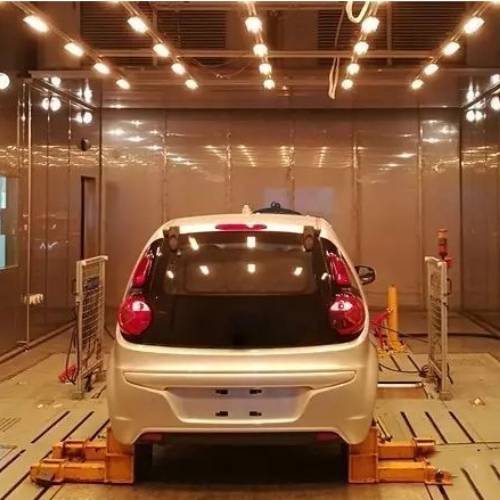


The Vehicle Sunlight Simulation Test Chamber is a high-precision environmental testing system designed to reproduce intense solar radiation and extreme climatic conditions in a controlled laboratory setting. By combining a full-spectrum infrared lighting system with accurate temperature and humidity regulation, the chamber enables comprehensive evaluation of whole vehicles or large automotive assemblies under prolonged sunlight exposure.
This system helps manufacturers and researchers assess material durability, thermal behavior, and functional reliability under peak solar loads, ensuring product performance and safety in real-world high-temperature environments.
Applications
The chamber is specifically developed for vehicle-level sunlight exposure testing, supporting both complete vehicles and large-scale components:
(1) Material Aging Evaluation
Analyze changes in shape, color, gloss, texture, and mechanical strength after solar irradiation.
(2) Thermal Performance Testing
Evaluate thermal expansion behavior and heat distribution across vehicle structures.
(3) Vehicle Functional Testing
Assess vehicle starting capability, motor performance, and system stability under high-temperature solar conditions.
(4) Air Conditioning System Testing
Verify cooling performance and cabin comfort under simulated sunlight exposure.
(5) Electric Vehicle Testing
Suitable for EV performance validation, especially for vehicles with motor power ≤150 kW.
Standards
GB/T 12535-2007 Test Methods for Starting Performance of Automobiles
GB 11556-2009 Defrosting and Demisting Test
GB/T 18297-2001 (Reference) Motor Performance Test
GB/T 2423.24-1995 Solar Radiation Test
GB/T 2423.3-2006 Test Method for Constant Humidity and Heat
GB/T 12782-2007 Requirements and Test Methods for Automotive Heating Performance
QC/T 658-2000 Test Method for Automotive Air Conditioning System Performance
Features
1. This vehicle-level solar simulation test chamber is designed for performance testing of electric vehicles with motor power ≤150kW, providing environmental simulation conditions ranging from -20°C to +60°C.
2. Functionality and volume can be customized according to different vehicle models and testing standards.
Parameters
| Category | Specifications |
|---|---|
Temperature Control Range | -20°C ~ +60°C |
| Humidity Range | Relative humidity: 30% ~ 95%, no condensation in the low-temperature test chamber• Without illumination: 30% ~ 95% RH• With illumination: 30% ~ 80% RH |
| Condition Control | a. Cooling Time• 25°C ~ -20°C: ≤ 85 min (no load)• 60°C ~ 25°C: ≤ 40 min (no load)b. Heating Time• -20°C ~ 25°C: ≤ 50 min (no load)• 25°C ~ 60°C: ≤ 50 min (no load)c. Temperature Fluctuation• ≤ ±0.5°C (no load)d. Temperature Uniformity• ≤ ±1.5°C (no load)e. Temperature Deviation• ≤ ±2.0°C (with load, measured at vehicle front air inlet, roof, left and right sides) |
| Illumination System | a. Infrared Radiation Lamps• Working ambient temperature: -20°C ~ 60°C• Maximum radiation intensity: 1200±25W/m², uniformity: ±10%• Adjustment range: 30% ~ 100%b. Simulated Lamps• Uses two-terminal linear medium-wave infrared simulation lamps• Service life: ≥ 5000h (radiation intensity remains stable during this period)c. Illumination Adjustment• Automatically and manually adjustable via temperature control on the vehicle surfaced. Projection Area & Movement• Projection area: 5000mm × 2500mm (L×W)• Vertical movement distance: Minimum 2200mm, maximum 3000mm (distance from the lower surface of the lamp to the chamber bottom) |
Accessories
1.Solar Simulation Array: Vertically adjustable lamp rack with medium-wave IR lamps.
2.Humidity Control System: Includes a high-pressure water spray and dehumidification unit.
3.Sensor Package: High-precision temperature and humidity sensors, plus pyranometers for radiation monitoring.
4.Vehicle Interface Port: Sealed pass-throughs for vehicle exhaust and data cables.
5.Safety System: Over-temperature protection, emergency stop, and smoke detection alarms.
FAQ
1. What safety measures are in place for testing electric vehicles (EVs)?
For EVs, the chamber can be equipped with specialized venting systems to handle potential battery off-gassing and integrated fire suppression systems. The control system also monitors vehicle surface temperature to prevent thermal runaway during high-radiation tests.
2. Is it possible to perform tests that involve driving the vehicle inside the chamber?
The standard chamber is designed for static environmental testing. However, for motor and AC performance tests, the chamber can be integrated with a chassis dynamometer (roller) to simulate driving loads while under solar radiation.
3. What does sunlight simulation include?
It replicates solar radiation intensity, thermal loading, and environmental conditions such as temperature and humidity.
4. Can the system test complete vehicles?
Yes, it is specifically designed for full-vehicle testing, not just individual components.
5. Is customization available?
Yes, chamber dimensions, lighting systems, and performance parameters can be tailored to specific testing requirements.
6. How is measurement accuracy ensured?
Each system undergoes strict factory inspection and performance verification before delivery, ensuring accurate, stable, and reliable test results for all measurements.
Leave Message Get Price