50th Percentile FAA Crash Test Dummy
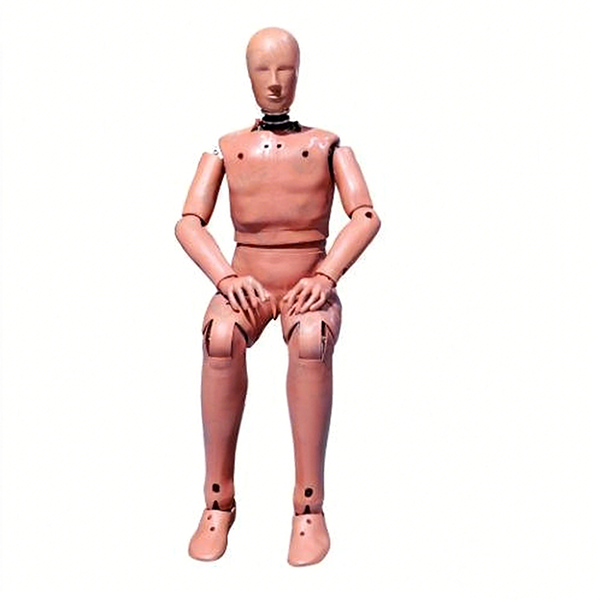


The 50th Percentile FAA Crash Test Dummy is a professional, anthropomorphic test device designed for emergency landing and dynamic aircraft seat testing. You can use this dummy to assess aircraft seat restraints and occupant injury under simulated emergency conditions. Developed from standard 50th percentile male anthropometric data, it retains Hybrid III biomechanical response characteristics while adapting the pelvis, thigh, and torso structures to meet FAA 14 CFR requirements.
Application
You can use this dummy for:
(1) Aircraft seat dynamic safety and emergency landing tests.
(2) Evaluation of seat restraint systems and occupant protection measures.
(3) Research on injury mechanisms under rapid deceleration and impact conditions.
(4) High-repetition aerospace crash testing and laboratory research.
(5) Supplemental automotive crash research for seat and restraint system validation.
The dummy supports testing of various aircraft seat models, restraint configurations, and emergency scenarios.
Standards
This dummy complies with multiple international standards, including:
(1) FAA 14 CFR Parts 23 / 25 – Airworthiness Standards for Transport and Normal Category Aircraft
(2) ISO 9790 / ISO/TR 9790 – Road Vehicles: Side Impact Dummy Evaluation Methods
(3) FMVSS 208 – Occupant Crash Protection
(4) FMVSS 213 – Child Restraint Systems (modified for aircraft seats)
(5) ECE R21 – Uniform Regulations for Seat and Restraint Certification
Parameters
Key Dimensions
| No. | Name | Dimension (mm) |
|---|---|---|
| A | Seated Height | 909.3 ±8 |
| B | Shoulder Pivot Height | 533.4 ±8 |
| C | H-Point Height (Ref.) | 121.9 ±8 |
| D | H-Point to Seatback (Ref.) | 94.0 ±8 |
| E | Shoulder Pivot to Back Plane | 88.9 ±5.1 |
| F | Thigh Thickness | 147.3 ±7.6 |
| G | Elbow to Wrist Pivot | 297.2 ±7.6 |
| H | Head Back to Back Plane | 43.2 ±2.5 |
| I | Shoulder to Elbow | 337.8 ±7.6 |
| J | Elbow to Seat Plane | 226.1 ±10 |
| K | Knee Front to Back Plane | 591.8 ±12.7 |
| L | Foot to Seat Plane | 442.0 ±12.7 |
| M | Knee Pivot to Floor | 492.8 ±7.6 |
| N | Hip to Popliteal Distance | 464.8 ±12.7 |
| O | Chest Thickness (unclothed) | 221.0 ±7.6 |
| P | Foot Length | 259.1 ±7.6 |
| V | Shoulder Width | 429.3 ±7.6 |
| W | Hip Width | 363.2 ±7.6 |
| R | Foot Width | 99.1 ±7.6 |
| Y | Chest Circumference | 1028 ±15 |
| Z | Waist Circumference | 876 ±15 |
| AA | Chest Circumference Reference | 431.8 ±2.5 |
| BB | Waist Circumference Reference | 228.6 ±2.5 |
Mass Distribution
| Component | Mass (kg) |
|---|---|
| Head Assembly | 4.54 ±0.05 |
| Neck Assembly | 1.54 ±0.05 |
| Upper Torso with Chest | 17.19 ±0.36 |
| Lower Torso | 17.69 ±0.14 |
| Thighs (L/R) | 7.42 ±0.09 |
| Lower Legs (L/R, including feet) | 5.44 ±0.14 |
| Upper Arms (L/R) | 2.00 ±0.05 |
| Lower Arms/Hands (L/R) | 2.27 ±0.09 |
| Total Dummy Weight | 75.39 ±1.13 |
Sensor Configuration
| Location | Sensor Type | Channels |
|---|---|---|
| Head | Accelerometer | 3 |
| Upper Neck | 6-channel Force Sensor | 1 |
| Chest | Accelerometer | 3 |
| Chest | Displacement Sensor | 1 |
| Pelvis | Accelerometer | 3 |
| Thigh | Force Sensor | 2 |
| Knee | Displacement Sensor | 2 |
| Upper Tibia | 4-channel Force Sensor | 2 |
| Lower Tibia | 4-channel Force Sensor | 2 |
| Foot | Accelerometer (with mounting block) | 2 |
Features
(1) Modular design allows you to replace components quickly for maintenance and upgrades.
(2) Modified lumbar, pelvis, and thigh structure supports FAA seat certification and torso flexion tests.
(3) Retains Hybrid III biomechanical response, ensuring compatibility with automotive crash data.
(4) Suitable for high-repetition aerospace crash experiments and research.
(5) Anthropomorphic shape and biomechanical response closely simulate a 50th percentile adult male.
Accessories
(1) Modular replacement parts (head, torso, limbs)
(2) Sensor calibration kits
(3) Mounting and alignment blocks
(4) Data acquisition interface connectors and cables
(5) Protective transport case
Test Procedures
(1) Inspect all joints, sensors, and modular components before installation.
(2) Mount the dummy on the test fixture according to FAA 14 CFR and ISO/TR 9790 standards.
(3) Connect all data acquisition channels securely.
(4) Perform sensor zero and sensitivity calibration.
(5) Conduct the dynamic test, following all safety protocols.
(6) After testing, inspect the dummy structure, sensors, and components for damage.
Maintenance Information
(1) Clean dummy components with a non-abrasive cloth after each test.
(2) Store in a dry, temperature-controlled environment.
(3) Check for sensor drift, connector integrity, and mechanical wear before each test.
(4) Replace damaged modular parts promptly to maintain biomechanical accuracy.
(5) Perform full system recalibration monthly or after major repairs.
FAQ
(1) What is this product?
This is a 50th percentile male FAA crash test dummy, specifically designed to simulate an average adult male during emergency aircraft landings and dynamic tests. You can consider it a highly anthropomorphic, instrumented surrogate for a real human, with modular components and sensors that capture biomechanical responses.
(2) What is this product used for?
You use it to evaluate aircraft seat safety and restraint systems, measure occupant injury potential under sudden deceleration, and conduct FAA 14 CFR-compliant dynamic tests. It also supports research in injury mechanisms, seat certification, and high-repetition aerospace crash testing, allowing you to test various seat models and restraint configurations without endangering human subjects.
(3) How does this product work?
The dummy simulates human inertial motion and torso flexion by combining modified pelvis, thigh, and torso structures with Hybrid III biomechanical response characteristics. You can record acceleration, force, displacement, and angle data from multiple sensors embedded in the head, neck, chest, pelvis, and limbs. These measurements allow you to calculate critical injury metrics, such as chest compression, pelvis loads, and head accelerations, providing a detailed evaluation of seat and restraint system performance.
(4) Why is this product important?
It allows you to conduct repeatable, precise, and safe testing of aircraft seats and occupant protection systems. Without it, evaluating emergency landing conditions would require significant risk to human subjects. By using this dummy, you ensure compliance with FAA regulations, support research into human injury biomechanics, and improve aircraft occupant safety through data-driven design and testing.
(5) Which industries is this product suitable for?
This dummy is suitable for the aviation and aerospace industries, including aircraft manufacturers, seat and restraint system developers, certification labs, and research institutions. You can also use it for supplemental automotive crash research, particularly in seat safety studies that benefit from human-like biomechanical response data.
Leave Message Get Price