Automotive Wire Repeated Bending Test Machine
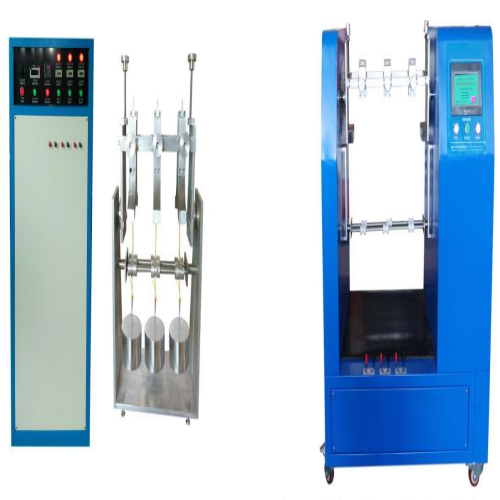


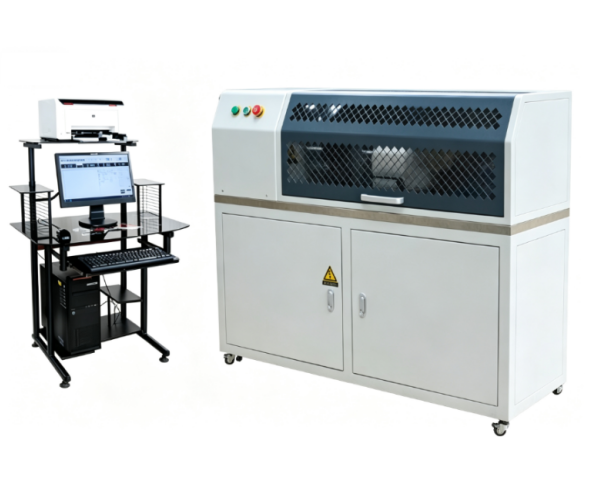
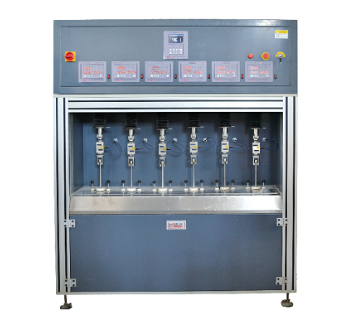
The Automotive Wire Repeated Bending Test Machine is designed to evaluate the mechanical durability of automotive wires under cyclic bending conditions. It simulates the repeated flexing that wires experience during harness installation and operation, particularly in restricted routing spaces. The system can be optionally integrated with a low-temperature chamber to assess wire performance under extreme environmental conditions. The test ensures insulation integrity, conductor continuity, and overall wire reliability, which are critical for automotive safety and quality assurance.
Application
Automotive wire harness testing: Evaluating insulation and conductor performance under repeated bending.
Low-temperature bending assessment: Combined with a temperature chamber, simulates wire performance in cold climates.
R&D and quality control: Helps manufacturers select durable wire materials and designs.
Electrical continuity verification: Detects wire breakage or conductor failure during cyclic bending.
Material testing: Applicable to various insulation types, including PVC, XLPE, TPE, and composite coatings.
Typical test samples include automotive power cables, signal wires, control wiring, and harness bundles up to 1.5mm².
Standards
The machine complies with international and industry standards for wire bending and durability testing:
(1) ISO 14572:2011 — Road vehicles: Low voltage primary cables, cyclic bending test
(2) SAE J1128 — Automotive low-voltage cable standard
(3) DIN 72551 — Electrical wiring and harnesses for vehicles
(4) IEC 60227 / IEC 60228 — Insulated cables and conductors
(5) GB/T 12706 — Power cables for industrial and automotive applications
(6) QC/T 29106 — Automotive wire performance test guidelines
These standards ensure repeatable, reliable, and globally recognized testing procedures.
Parameters
| Item | Specification |
|---|---|
| Test angle | Clockwise 0–180° (programmable), Counterclockwise 0–180° (programmable) |
| Bending speed | 10–60 ±1 cycles/min |
| Counter range | 1–999,999 (presettable) |
| Test stations | 3 independent stations |
| Load weights | 2.5 N, 3.75 N, 5 N, 7.5 N (selectable) |
| Automatic stop | Upon wire breakage, data retention |
| Test voltage | DC 24V |
| Power supply | AC 220V ±10%, DC 24V/5A (switching power supply) |
| Machine weight | 50 kg |
| Sample diameters & clamp R angles | 0.5mm² wire Ø1.5 mm, R
= 3.75 0.75mm² wire Ø1.8 mm, R = 4.5 1.0mm² wire Ø2.0 mm, R = 5.0 1.5mm² wire Ø2.2 mm, R = 5.5 Optional R angles: 7.2 / 9.6 / 12.6 / 18 / 22.2 / 44.25 / 51 / 74.25 |
Features
Programmable Bending Angle: Clockwise and counterclockwise angles can be set independently for precise simulation of wire flexing.
Adjustable Speed: 10–60 cycles per minute to simulate various operational conditions.
Multiple Test Stations: Three simultaneous test positions improve testing efficiency.
Automatic Stop on Failure: Detects wire breakage or insulation failure and retains test data.
Wide Clamp Compatibility: Multiple clamp radii to accommodate different wire diameters.
Optional Environmental Testing: Compatible with low-temperature chambers for extreme condition testing.
Stable and Durable Construction: Ensures long-term accuracy and minimal maintenance.
User-Friendly Interface: Simple controls and counter display allow easy monitoring and data recording.
Accessories
(1) Set of load weights (2.5N, 3.75N, 5N, 7.5N)
(2) Clamp sets for various wire diameters and R angles
(3) Counter module for cycle tracking
(4) Optional low-temperature chamber interface
(5) Touchscreen/PLC control system
(6) User manual and calibration certificate
Maintenance Information
Clean clamps and moving parts after each test to prevent wear debris accumulation.
Periodically inspect load weights and bearings for damage or misalignment.
Verify counter accuracy and reset if needed before starting a new test.
Lubricate mechanical components per the maintenance schedule to ensure smooth operation.
Check electrical connections and power supply stability.
Inspect low-temperature chamber interface (if used) for proper thermal insulation and control.
FAQ
(1) What failures can be detected by this wire bending tester?
The machine can evaluate failures caused by repeated mechanical stress, including conductor breakage, insulation cracking, and loss of electrical continuity. It helps engineers identify weak wire designs before mass production and improve harness reliability for automotive applications.
(2) Can this tester evaluate wires under cold temperature conditions?
Yes. The system can be combined with an optional low-temperature chamber to simulate cold environments. This allows evaluation of insulation flexibility and conductor durability under conditions where automotive wires may experience increased brittleness.
(3) Why is it important?
Ensures automotive wire harnesses remain safe and functional under repeated mechanical stress.
(4) Which industries use this product?
Automotive manufacturing, wire production, harness assembly, R&D, and quality control labs.
(5) What types are available?
Standard cyclic bending model, low-temperature integrated model, multi-station configurable models.
(6) What factors should be considered when selecting this bending tester?
Users should consider wire diameter, bending radius, test cycles, environmental conditions, and applicable standards. Selecting the correct fixture and loading method ensures test results accurately represent actual vehicle operating conditions.
(7) Can QINSUN provide solutions for different automotive wire durability requirements?
Yes. QINSUN engineers can assist with equipment selection, fixture configuration, and customized testing solutions according to wire specifications, standards, and application scenarios. More testing solutions and application cases can be provided based on customer requirements.
Leave Message Get Price