Seam Fatigue Tester
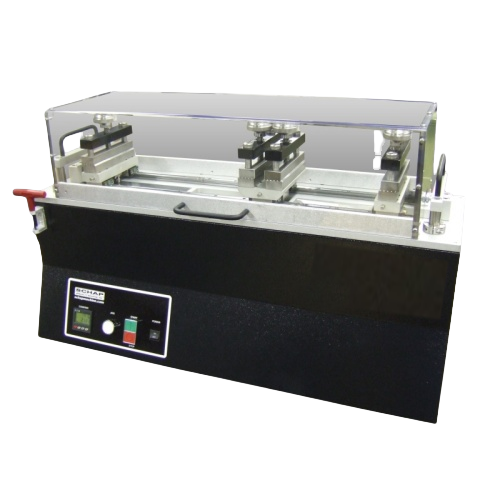


The Seam Fatigue Tester is designed to evaluate the fatigue strength of seams in automotive seat surface materials, including leather, synthetic leather, and textiles. The strength and fatigue resistance of stitched seams directly affect the service life of automotive seats. This tester allows accurate prediction of seat durability and provides guidance for improving seam longevity through systematic testing of material seam strength and fatigue life.
Application
The Seam Fatigue Tester is suitable for:
Fatigue testing of automotive seat surface materials
Evaluation of seam tensile strength, needle-hole elongation, and durability
Predictive analysis of seat service life
Quality control and R&D testing of stitched seat materials
Typical Test Products Include:
Automotive leather seats and synthetic leather seat covers
Textile seat covers and fabric-based seat materials
Upholstery materials with stitched seams
Standards
The Seam Fatigue Tester is compliant with:
(1) Toyota TSL 5101G (3.7)
(2) GMW 3405 – General Motors standard for seam fatigue
(3) Nissan M-0154
(4) Ford Motor Co. BN 106-02
(5) TSL 5100G Section 4.22
Parameters
| Parameter | Unit | Value |
|---|---|---|
| Number of test stations | – | 2 |
| Sample load | kg | 3 |
| Testing speed | cycles/min | 30 |
| Counter | digits | ≥4 (standard test cycles 2,500) |
| Stroke | mm | 140 |
| Adjustable test spacing | mm | 120 / 124 / 140 |
| Clamp width | mm | 50 |
| Overall dimensions (L×W×H) | inches | 13 × 31 × 17 |
| Weight | kg / lb | 50 / 110 |
Features
Mechanical components constructed from corrosion-resistant aluminum and stainless steel
Durable powder coating and anodized surface treatment
Precision ball and needle bearings
Programmable controller with automatic stop function
Adjustable step motion and test speed
Height-adjustable weight frame
Adjustable clamp spacing to accommodate different sample sizes
Openable protective cover to safeguard operators’ hands during testing
Accessories
(1) Sample clamps for textile and leather materials
(2) Height gauge for precise clamp spacing adjustment
(3) Counter for cycle tracking
(4) Safety guard for operator protection
Test Procedures
Install the height gauge between the pair of sample clamps at the first test station.
Align the stitched sample and secure it in the clamps, then remove the height gauge.
Repeat for the second test station.
Input the desired number of test cycles into the counter.
Start the test; the machine cycles the clamps automatically.
Upon reaching the preset cycle count, the machine stops automatically.
Evaluate the tested sample visually for seam fatigue and durability.
Maintenance Information
Clean clamps and sample holders after each test to remove debris.
Inspect mechanical bearings and lubricate periodically according to manufacturer guidelines.
Check controller and counter functionality regularly.
Ensure the protective guard is functioning properly.
Store the instrument in a dry environment to prevent corrosion.
FAQ
1. What is this product?
It is a Seam Fatigue Tester for evaluating the fatigue resistance of stitched seams in automotive seat materials.
2. What is it used for?
It tests the durability, tensile strength, and elongation of seams under repeated cyclic loading.
3. Why is this product important?
Seam integrity is critical for seat safety and longevity; this tester ensures compliance with international standards and predicts service life.
4. Which industries is it suitable for?
Automotive seating, leather and synthetic leather manufacturing, textile upholstery, and R&D laboratories.
5. What are similar products?
Automotive seat dynamic and static testing machines
Upholstery seam strength testers
Textile fatigue and tensile testing equipment
Leave Message Get Price