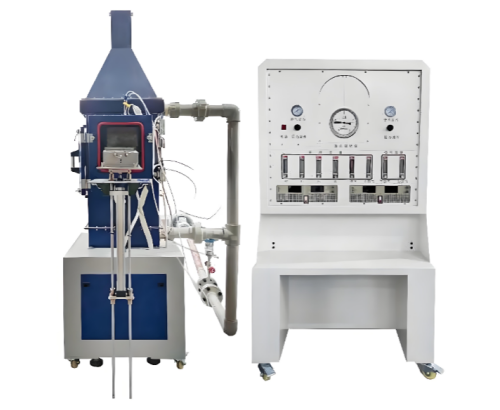
Test System for oil thread leak test of HEPA filter



The Oil Thread Leak Test System is designed for quality control of HEPA and ULPA filters according to ISO 29463-4 (EN 1822-4). The system provides a visual method to verify the absence of filter leaks using the oil thread (DOP) test. It is particularly suitable for filter elements that cannot be scanned due to geometric constraints, such as V-shaped arrangements.
Applications
(1) Integral visual leak testing of HEPA and ULPA filters.
(2) Quality control during production of small to medium HEPA/ULPA filter elements.
(3) Verification of filter integrity when the scan method is not fully applicable.
(4) Testing of filters up to H13/H14 efficiency classes.
Standards
(1) ISO 29463-4 (EN 1822-4) – Leak testing of high-efficiency air filters.
(2) ISO 16890-2 – Air filters for general ventilation – Part 2.
(3) ISO 16890-3 – Air filters for general ventilation – Part 3.
(4) ISO 16890-4 – Air filters for general ventilation – Part 4.
(5) EN 779 – Particulate air filters for general ventilation.
(6) ASHRAE 52.2 – Method of testing general ventilation air-cleaning devices.
(7) ISO 10121-3 – Test methods for air filters.
Features
(1) Cost-effective solution for leak testing of HEPA filters (H13/H14).
(2) Easy manual operation with short setup time.
(3) Constant test conditions due to pre-adjustable parameters.
(4) Efficient testing of multiple filters using pre-set conditions.
(5) Flexible and configurable filter holder accommodating various dimensions.
(6) Visual detection of leaks via rising oil threads using DEHS aerosol.
Principle
The filter element is mounted horizontally on the test bench with the upstream side facing down and fixed pneumatically. A flow of polydisperse DEHS aerosol is applied to the upstream side. Any leakage is made visible as rising oil threads on the downstream (upper) side of the filter, allowing rapid visual inspection of integrity.
Technical Data
| Parameter | Unit | Value |
|---|---|---|
| Test flow rate | L/min | 50 … 600 |
| Test specimen dimensions (W × H × D) | mm | min. 305 × 305 × 30 / max. 915 × 800 × 300 |
| Operating medium (aerosol substance) | – | DEHS |
| Compressed air supply | bar | 6 |
| Power supply | – | 230 VAC, 1 A |
| System dimensions (W × H × D) | mm | 1200 × 610 × 910 |
| Weight | kg | approx. 100 |
Test Procedure
(1) Mount the filter element horizontally on the test bench and secure with pneumatic clamps.
(2) Activate the DEHS aerosol generator to introduce a polydisperse aerosol flow upstream.
(3) Observe the downstream side of the filter for rising oil threads.
(4) Record any visible leaks for quality documentation.
Maintenance Information
(1) Clean the aerosol generator and test chamber regularly.
(2) Inspect the pneumatic fixing device and filter holders for wear.
(3) Check compressed air supply and ensure proper pressure.
(4) Replace DEHS liquid as needed and verify aerosol flow uniformity.
FAQ
(1) What is this product?
– A visual leak test system for HEPA and ULPA filters using the oil thread method.
(2) What is it used for?
– To verify filter integrity and detect leaks in production or R&D processes.
(3) What types of filters can be tested?
– HEPA/ULPA filters up to H13/H14, including geometrically complex designs.
(4) How is it operated?
– Install the filter, apply DEHS aerosol upstream, and observe for visible oil threads downstream.
Leave Message Get Price