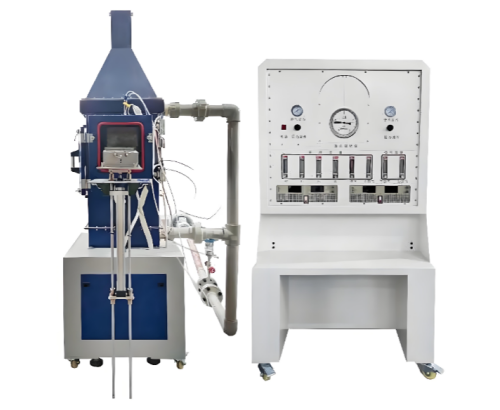
Test system for testing particle separation of air filters for passenger compartments
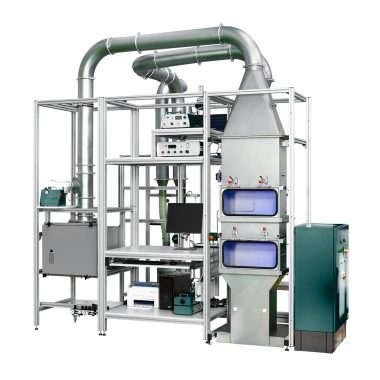


The Test System for particle separation of air filters for passenger compartments is designed to evaluate the particle filtration performance of cabin air filters according to DIN 71460-1 and ISO/TS 11155-1. The system provides precise measurement of differential pressure drop, gravimetric and fractional filtration efficiency, and dust holding capacity. It allows standardized and reproducible testing for R&D, quality assurance, and production control of air filters for automotive passenger compartments. The system can be combined with adsorption test systems (PAF 112) for comprehensive filter evaluation including gas adsorption.
Application
(1) Measurement of differential pressure across cabin air filters.
(2) Analysis of fractional separation efficiency for particle filtration.
(3) Dust loading tests to determine filter capacity and performance over time.
(4) Combined particle filtration and gas adsorption tests (with PAF 112 integration).
(5) Custom testing protocols for R&D or internal company standards.
(6) Quality control during production and final inspection of passenger compartment air filters.
Standards
(1) ISO 11155-1 — Cabin air filter particle separation testing.
(2) DIN 71460-1 — Particle filtration for vehicle passenger compartments.
(3) ISO 11155-2 — Gas adsorption testing of cabin air filters (optional with PAF 112 integration).
(4) DIN 71460-2 — Gas adsorption testing of cabin air filters (optional with PAF 112 integration).
Features
(1) Standard-compliant testing for both filter media and complete filter elements.
(2) Modular system design for flexible instrumentation and integration with gas adsorption systems.
(3) High degree of automation for repeatable and traceable testing.
(4) Adjustable flow rate and differential pressure ranges to simulate real operating conditions.
(5) Integrated aerosol generation and conditioning for precise particle distribution.
(6) Comprehensive sensor suite for differential pressure, absolute pressure, temperature, and relative humidity.
Parameters
| Parameter | Unit | Value |
|---|---|---|
| Test flow rate | m³/h | 70 – 700 (higher flow rates available on request) |
| Measuring range, differential pressure | Pa | 0 – 1000 |
| Compressed air supply | bar | 6 |
| Power supply | – | – |
| Test specimen dimensions | mm | max. 300 × 600 |
| Aerosol generation technology | – | Dust disperser SAG 410/L, Atomizer ATM 220 |
| Aerosol conditioning technology | – | Electrical Aerosol Neutralizer EAN 581 |
| Aerosol measurement technology | – | Aerosol spectrometer |
| Sensors | – | Differential pressure, absolute pressure, temperature, relative humidity |
| System dimensions (W × H × D) | mm | 4600 × 3400 × 1200 |
Test Procedures
(1) Mount the filter element or media sample securely in the test adapter.
(2) Set the desired flow rate and differential pressure according to the standard or test requirements.
(3) Activate aerosol generation and conditioning units to introduce test particles.
(4) Start automated test sequence and monitor differential pressure and particle filtration efficiency.
(5) Conduct dust loading tests by continuously exposing the filter to aerosols.
(6) Record fractional efficiency and differential pressure data throughout the test.
(7) Generate automated test reports for quality control, documentation, or R&D analysis.
Maintenance Information
(1) Regular cleaning of aerosol generator, test section, and sampling ducts.
(2) Calibration of sensors and aerosol measurement instruments periodically.
(3) Inspect filter adapters and seals to ensure no leaks during testing.
(4) Check airflow control units and compressed air supply for stable operation.
(5) Update control software and verify automated sequences prior to testing campaigns.
FAQ
(1) What is this product?
– A test system for particle separation of cabin air filters, measuring differential pressure, efficiency, and dust holding capacity.
(2) What is it used for?
– To evaluate particle filtration performance of passenger compartment air filters in compliance with DIN 71460-1 and ISO/TS 11155-1.
(3) What types of this product exist?
– Configurations for standard cabin air filters, pleated panel filters, and compact integrated filter assemblies.
(4) What industry problems does it solve?
– Ensures reliable filter performance, supports quality control, and verifies compliance with international standards.
(5) How is it operated?
– Mount the filter in the adapter, set flow and pressure, run automated particle exposure tests, and analyze fractional efficiency and differential pressure results.
Leave Message Get Price