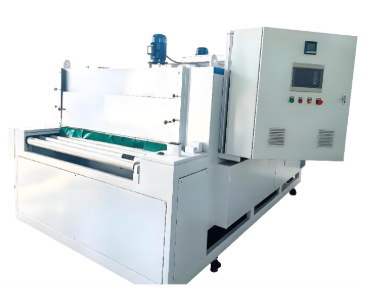
Filter media test rig according to ISO 16890
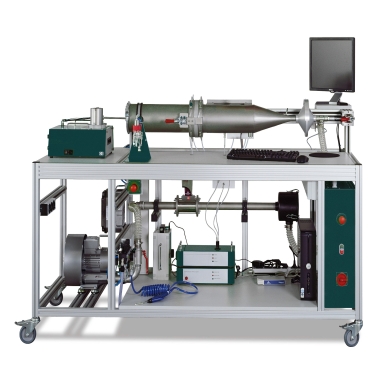


The Filter Media Test Rig is a laboratory system designed for the characterization of filter media and small filter elements. It allows testing of differential pressure, gravimetric efficiency, fractional efficiency, and dust holding capacity in a reliable and reproducible manner. The system is suitable for development, optimization, and quality assurance of filter media, supporting a wide range of industrial, automotive, HVAC, and cleanroom applications.
Application
(1) Testing general ventilation air filters according to ISO 16890, EN 779, and ASHRAE 52.2.
(2) High-efficiency filters (EPA, HEPA, ULPA) according to ISO 29463.
(3) Cabin air filters for passenger compartments according to DIN 71460-1 / ISO/TS 11155-1.
(4) Engine and compressor inlet air cleaning filters according to ISO 5011.
(5) Development and optimization of new filter media according to internal R&D standards.
(6) Quality assurance during production of flat and pleated filter media.
(7) Final inspection or incoming inspection of filter media for industrial, automotive, and cleanroom applications.
Standards
(1) ISO 16890-2 — General ventilation air filters.
(2) ISO 16890-3 — Performance testing of air filters.
(3) ISO 29463-3 — High-efficiency air filters (HEPA/ULPA).
(4) ASHRAE 52.2 — Method of testing air-cleaning devices.
(5) EN 779 — Particulate air filters for general ventilation.
(6) ISO 5011 — Air filters for internal combustion engines and industrial machinery.
(7) DIN 71460-1 — Cabin air filters for road vehicles.
Features
(1) Supports various aerosols including solid and liquid particles (DEHS, paraffin oil, NaCl, PSL, etc.).
(2) Flexible design allows rapid modifications and future enhancements.
(3) Variable volume flow range suitable for small and medium-scale filter testing.
(4) Optimized component integration ensures high measurement reproducibility.
(5) User-friendly Win-based software for data acquisition, test control, and reporting.
(6) Compact, modular filter holder with support grid prevents deformation at high flow rates.
(7) Single optical particle counter can measure upstream, downstream, and purge with a sample switching unit.
Parameters
| Parameter | Unit | Value |
|---|---|---|
| Test flow rate | m³/h | 0.4 – 40 or 2 – 64 |
| Test aerosol | – | Customer-specific (DEHS, paraffin oil, NaCl, PSL, etc.) |
| Test specimen dimensions | – | Diameter ≤ 150 mm |
| Operating medium (gas/air) | – | Conditioned room air suitable for standard tests |
| Compressed air supply | bar | 6 |
| Power supply | – | 400 VAC, 16 A |
| Environmental condition, temperature | °C | 0 – 50 |
| Environmental condition, relative humidity | % | 0 – 100 |
| System dimensions (W×H×D) | mm | 2100 × 1400 × 850 |
| Weight | kg | approx. 300 |
Test Procedures
(1) Mount the filter media or small filter element in the test holder.
(2) Select the appropriate aerosol for the test (DEHS, paraffin oil, NaCl, PSL, etc.).
(3) Set test parameters including flow rate, particle size range, and test duration.
(4) Start the automated or semi-automated test sequence via the control software.
(5) Monitor differential pressure, fractional efficiency, gravimetric efficiency, and dust loading in real time.
(6) Remove the filter media to determine mass or perform additional measurements if needed.
(7) Generate automated test reports documenting performance metrics.
Maintenance Information
(1) Clean the aerosol generation and distribution system regularly.
(2) Calibrate particle counters and sensors periodically.
(3) Inspect filter holders and support grids for wear or deformation.
(4) Perform routine software updates and verify automated test sequences.
(5) Check compressed air supply and system integrity.
FAQ
(1) What is this product?
– A laboratory test rig for characterizing filter media and small filter elements, including differential pressure, fractional efficiency, and dust holding capacity.
(2) What is it used for?
– To evaluate and optimize filter media for HVAC, cleanroom, industrial, automotive, and high-efficiency applications.
(3) What types of this product exist?
– Configurations for cleanable filters, general ventilation filters, HEPA/ULPA filters, engine intake filters, and cabin air filters.
(4) What industry problems does it solve?
– Provides standardized, reproducible testing for media optimization and quality assurance.
– Supports R&D and production inspections.
– Reduces manual labor through automation.
(5) How is it operated?
– Place the filter in the holder, select test aerosol, configure test parameters, start automated testing, monitor results, and generate performance reports.
Leave Message Get Price