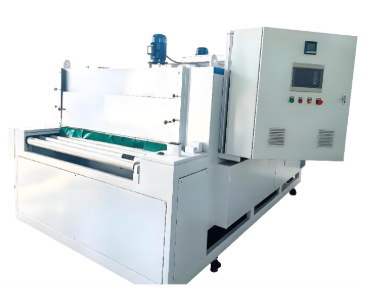
Filter Media Test System
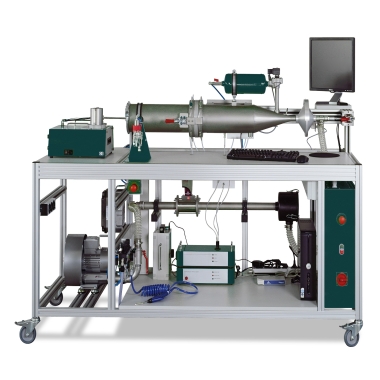


The Filter Media Test System is a precision laboratory test rig designed for characterizing cleanable and conventional filter media. It evaluates differential pressure, gravimetric and particle size-dependent separation efficiency, and dust loading capacity. The system supports testing in accordance with VDI 3926-2 and ASTM D6830-02 and can be adapted for ISO 16890, EN 779, DIN 71460-1, ISO/TS 11155-1, and ISO 5011. Its compact, lightweight design allows for flexible laboratory use and rapid R&D or quality assurance testing of filter materials.
Application
(1) Cleanable filter media testing according to VDI 3926-2 (e.g., bag filters, panel filters, cartridge filters).
(2) Evaluation of fractional separation efficiency, dust loading capacity, and differential pressure drop of filter sheets, pleated media, and composite filter materials.
(3) Small-scale testing of cabin air filters, engine air intake filters, HVAC filters, and industrial process filters (ISO 16890, EN 779, ISO 11155-1).
(4) Development and optimization of new filter media formulations for HEPA, ULPA, and general ventilation filters.
(5) Quality assurance and batch testing during production of industrial, automotive, and HVAC filter media.
(6) Comparative testing of imported and domestic filter media for research or certification purposes.
Standards
(1) VDI 3926-2 — Testing of cleanable filter media.
(2) ISO 12103-1 — Standard test dust for filter evaluation.
(3) ISO 5011 — Test of air filters for internal combustion engines and industrial machinery.
(4) ASTM D6830-02 — Standard test methods for filter media characterization.
Features
(1) Standardized filter testing using alumina oxide (e.g., Pural NF).
(2) Automated testing sequences up to 14 hours without operator intervention.
(3) Supports various aerosols, including solid and droplet aerosols.
(4) Flexible, modular design enabling rapid modifications and future upgrades.
(5) Operator-friendly control software for easy setup, monitoring, and data acquisition.
(6) Compact and lightweight, suitable for laboratory-scale R&D.
Parameters
| Parameter | Unit | Value |
|---|---|---|
| Test flow rate | m³/h | 2 – 64 |
| Measuring range, differential pressure | Pa | – |
| Duration of pressure pulse | ms | 50 – 150 |
| Pressure tank capacity | bar | 2 – 6 |
| Test specimen dimensions | mm | Diameter ≤ 150 |
| Power supply | – | 3 × 400 VAC, 16 A |
| Operating medium (aerosol substance) | – | Pural-NF, Pural-SB, DEHS |
| Sensors | – | Temperature, relative humidity |
| System dimensions (W×H×D) | mm | 2800 × 1500 × 800 |
| Weight | kg | approx. 120 |
Test Procedures
(1) Install the filter media specimen in the test chamber.
(2) Select the appropriate aerosol type (solid or droplet).
(3) Set test parameters including flow rate, pressure pulse duration, and test duration.
(4) Start the automated test sequence using the control software.
(5) Monitor differential pressure, fractional efficiency, and dust loading in real time.
(6) Collect and analyze test data for media performance evaluation.
(7) Generate automated test reports documenting efficiency, pressure drop, and dust holding capacity.
Maintenance Information
(1) Regularly clean the aerosol generation and distribution system.
(2) Periodically calibrate sensors for temperature, humidity, and aerosol concentration.
(3) Inspect and maintain pressure tanks and flow control valves.
(4) Perform routine software updates and verify automated test sequences.
(5) Check for wear or contamination in the filter holder and test chamber.
FAQ
(1) What is this product?
– A laboratory test system for characterizing cleanable and conventional filter media, including efficiency, pressure drop, and dust loading.
(2) What is it used for?
– To measure filtration efficiency, differential pressure, particle size-dependent efficiency, and dust holding capacity of filter media.
(3) What types of this product exist?
– Configurations for cleanable filters (VDI 3926-2), cabin filters, engine air filters, HVAC filters, and general laboratory filter media testing.
(4) What industry problems does it solve?
– Supports R&D and quality assurance of filter media.
– Provides standardized and reproducible testing for material optimization.
– Reduces operator workload with automated testing sequences.
(5) How is it operated?
– Place the filter media in the test chamber, select aerosol type, set test parameters, start automated testing, monitor performance, and generate reports.
Leave Message Get Price