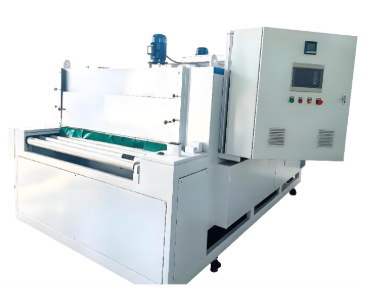
Robot HEPA/ULPA Filter Scanning System
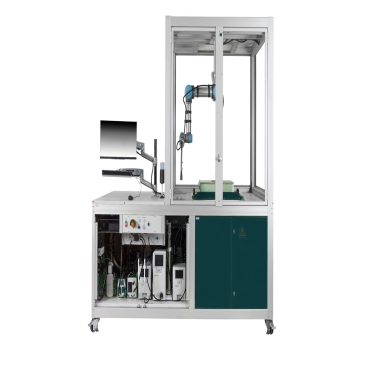


The Robot HEPA/ULPA Filter Scanning System is an automated test system designed to measure both integral and local particle filtration efficiency, as well as leak detection, of 2-dimensional and 3-dimensional HEPA and ULPA filter elements. The modular design allows the use of different test aerosols, including DEHS, paraffin oil, and PSL. Optical particle counters (OPC) are used by default, while SMPS measurements or DMA-classified aerosol tests combined with condensation particle counters (CPC) are also supported. The system is suitable for panel filters and cartridges at moderate flow rates and can be scaled for higher flows upon request.
Application
(1) Product development and R&D of HEPA and ULPA filters.
(2) Quality control during filter production.
(3) Scanning of panel filters and filter cartridges for leak detection.
(4) 3-dimensional scanning of V-bank and compact filters.
(5) Integral efficiency testing for production control.
(6) Local efficiency and MPPS (Most Penetrating Particle Size) determination for filter development.
Standards
(1) ISO 29463-4 — High-efficiency filters (HEPA and ULPA) — Part 4: Determination of leakage by scan method.
(2) ISO 29463-5 — High-efficiency filters (HEPA and ULPA) — Part 5: Determination of fractional efficiency and efficiency curves.
Parameters
| Parameter | Unit | Value |
|---|---|---|
| Test flow rate | m³/h | 1 – 300 |
| Differential pressure measuring range | Pa | 50 – 5000 |
| Scan speed | mm/s | 5 – 100 |
| Test specimen dimensions (W×H×D) | mm | Panel filter: 50–500 × 30–500 × 7–280; Filter cartridges: 40–350 × 40–350 × 45–600 |
| Operating medium (aerosol substance) | – | DEHS, paraffin oil, PSL |
| Compressed air supply | bar | max. 6.0 |
| Power supply | – | 3 × 400 VAC, 32 A |
| Aerosol measurement instruments | – | OPC, CPC, SMPS |
| System dimensions (W×H×D) | mm | 4000 × 4000 × 3000 |
Features
(1) First commercial solution for automatic 3-dimensional filter scanning.
(2) Operator-defined filter dimensions within the robot’s working range.
(3) Programmable robot for fast implementation of new scanning concepts.
(4) Multi-functional setup enabling integral efficiency tests using hood assemblies.
(5) Stepwise scanning with classified aerosols for reliable MPPS curve determination.
(6) Supports multiple aerosol types (DEHS, paraffin oil, PSL) and measurement instruments (OPC, CPC, SMPS).
(7) Modular and scalable design suitable for moderate to high flow rates.
Maintenance Information
(1) Periodically clean the robot scanning area and aerosol delivery lines.
(2) Calibrate particle counters (OPC, CPC) and SMPS instruments regularly.
(3) Check compressed air supply and aerosol generator performance.
(4) Inspect robot joints and scanning mechanisms for wear and proper alignment.
(5) Perform routine software updates and verify automated test sequences.
FAQ
(1) What is this product?
– An automated robotic system for HEPA and ULPA filter efficiency and leak testing, supporting integral and local measurements.
(2) What is it used for?
– To measure particle filtration efficiency, detect leaks, and evaluate local efficiency and MPPS curves of panel and cartridge filters.
(3) What types of this product exist?
– Configurations for panel filters, cartridges, and 3-dimensional V-bank filters, supporting moderate to high flow rates and multiple aerosol types.
(4) What industry problems does it solve?
– Enables precise quality control and R&D of HEPA/ULPA filters.
– Detects local leaks and evaluates filter efficiency at high resolution.
– Automates labor-intensive scanning processes for reproducible results.
(5) How is it operated?
– Place the filter in the scanning area, select aerosol type and measurement instrument, define dimensions and scanning parameters, run the automated test sequence, and retrieve reports with efficiency and leak data.
Leave Message Get Price