Gas Turbine Filter Test System
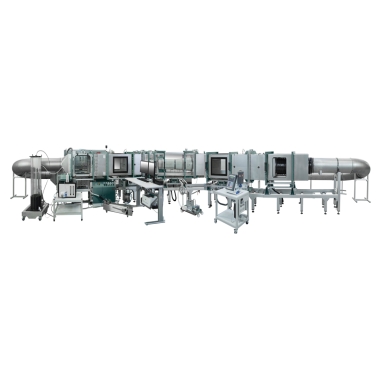


The Gas Turbine Filter Test System is a specialized test bench designed for evaluating air intake filter systems used in rotary machinery, in accordance with ISO 29461. It extends the capabilities of general air filter test systems (ISO 16890) to accommodate filters of various shapes, including cartridges, cassette filters, filter bags, and plane filter media. The system enables precise measurement of filter performance under controlled air conditions, including temperature, humidity, and aerosol exposure. Key performance indicators include differential pressure curves, dust holding capacity, gravimetric efficiency, fractional efficiency, salt removal efficiency, and water endurance.
Application
(1) Testing gas turbine intake filter systems according to ISO 29461-2 and ISO/AWI 29461-4.
(2) Evaluation of general air filters according to ISO 16890, EN 779, and ASHRAE 52.2.
(3) Assessment of differential pressure versus airflow for various filter types.
(4) Measurement of dust loading capacity and gravimetric efficiency for filter media.
(5) Fractional efficiency testing using DEHS, salt (NaCl/KCl), and other aerosols.
(6) Determination of salt removal efficiency according to ISO/AWI 29461-4.
(7) Water endurance testing of air filters under controlled supersaturated vapor and water droplet injection.
(8) Laboratory, R&D, and production quality control of air intake filters for rotary machinery.
Standards
(1) ISO 29461-1 — Gas turbine intake air filters — Test methods.
(2) ISO 29461-2 — Water separation and endurance testing for gas turbine filters.
(3) ISO/AWI 29461-4 — Salt aerosol efficiency testing.
(4) ISO 16890-2 — General ventilation filter testing, particulate efficiency.
(5) ISO 16890-3 — Gravimetric efficiency and dust holding capacity.
(6) ISO 16890-4 — Fractional efficiency testing.
(7) ISO 12103-1 — Test dust specifications (A2/A4).
(8) ISO/DIS 29461-7 — Component and system measurement guidance.
(9) ASHRAE 52.2 — Air filter testing for ventilation applications.
Features
(1) Circulation mode for precise control of air temperature and humidity during testing.
(2) Injection of various aerosols (NaCl, KCl, DEHS) into an optimized airflow profile.
(3) Automated feeding of water droplets and supersaturated vapor for water endurance tests.
(4) High automation with guided operator interface for fully automated test sequences.
(5) Modular measurement sections including aerosol inlet, upstream measurement, specimen holder, downstream measurement, safety filter, and flow rate measurement.
(6) Ports for aerosol characterization and accurate determination of pressure drop across the test specimen.
(7) Flexible configuration for diverse filter shapes and sizes, including pocket, cassette, and cartridge filters.
Parameters
| Parameter | Unit | Value |
|---|---|---|
| Test flow rate | m³/h | 800 – 11,000 |
| Test aerosol | – | DEHS, KCl, ASHRAE dust, ISO 12103-A2 (AC fine), ISO 12103-A4 (AC coarse) |
| Test specimen dimensions | – | 610 × 610 mm (pocket and cassette); diameter ≤ 400 mm, length ≤ 1500 mm (cartridges) |
| Maximum differential pressure | Pa | 2000 |
| Compressed air supply | bar | ≥ 5 (17 m³/h) |
| Water supply | bar | ≥ 3 |
| Power supply | – | 3 × 400 VAC, 125 A, 50 Hz |
| Air circulation | % | 0 – 100 |
| Sensors | – | Temperature, relative humidity, air pressure |
| System dimensions (W×H×D) | m | 4.6 × 1.7 × 14.0 |
Test Procedures
(1) Install the test filter in the specimen holder according to its type (cartridge, cassette, bag, or plane media).
(2) Configure airflow rate, temperature, and humidity parameters for the test.
(3) Select the appropriate test aerosol (NaCl, KCl, DEHS) and set injection rate.
(4) Initiate automated test sequence using FTControl software.
(5) Measure upstream and downstream differential pressure, airflow, and particle concentration.
(6) Perform gravimetric efficiency, fractional efficiency, dust holding capacity, salt removal efficiency, and water endurance tests as required.
(7) Record results and generate automated test reports for documentation and analysis.
Maintenance Information
(1) Regular inspection and cleaning of aerosol injection systems, water droplet feeders, and HEPA filters.
(2) Periodic calibration of sensors for airflow, differential pressure, temperature, and humidity.
(3) Check automation software, control electronics, and I/O modules for proper operation.
(4) Validate system performance through test runs after maintenance.
FAQ
(1) What is this product?
– A test system for evaluating air intake filters of gas turbines and rotary machinery, compliant with ISO 29461.
(2) What is it used for?
– To measure differential pressure, dust holding capacity, gravimetric and fractional efficiency, salt removal efficiency, and water endurance of air filters. It measures key parameters such as filtration efficiency, pressure drop, and dust holding capacity to help manufacturers and operators verify filter performance and select suitable filtration solutions.
(3) What types of this product exist?
– Configurations for various airflow ranges (800–11,000 m³/h), test aerosols (DEHS, NaCl, KCl), and filter types (cartridge, cassette, bag, plane media).
(4) What industry problems does it solve?
– Ensures compliance with international gas turbine filter standards.
– Provides reliable, reproducible filter performance data for R&D and production quality control.
– Supports testing under realistic environmental conditions including aerosol and water exposure.
(5) How is it operated?
– Place the filter in the test holder, select airflow, temperature, humidity, and aerosol settings, start the automated test sequence, monitor differential pressure and particle data, and generate reports via the system software.
(6) How to choose a suitable Gas Turbine Filter Testing System?
– When selecting a Gas Turbine Filter Testing System, users should consider filter size, airflow requirements, test standards, measurement accuracy, data recording functions, and the types of filter products to be evaluated.
Leave Message Get Price