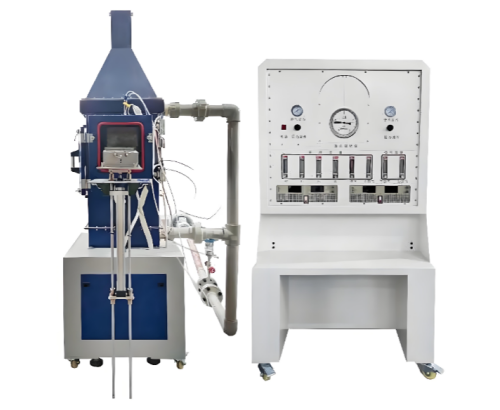
Oil mist separation efficiency test bench
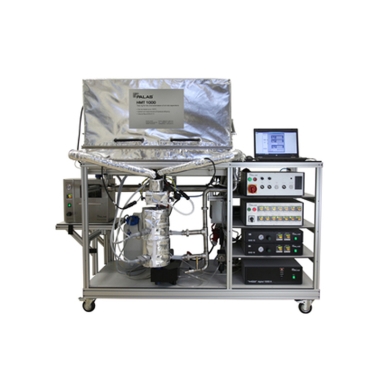


The Oil Mist Separation Efficiency Test Bench is a modular, high-performance testing system designed for precise evaluation of oil separators, coalescing filters, inertial separators, and electrostatic filtration systems. It enables reliable characterization of separation efficiency, loading and holding time, pressure loss, and fractional efficiency under real operating conditions.
Equipped with a heated light-scattering spectrometer, heated dilution system, and heated aerosol generator, the test bench supports isothermal measurements up to 120°C, ensuring stable, reproducible, and internationally comparable results.
Application
The system is suitable for a wide range of industrial, automotive, and laboratory applications, including:
Quality assurance of oil separators
Development of coalescing, cyclone, and inertial separation units
Evaluation of separator performance for:
– Leaked aerosols in combustion engines
– Oil mist downstream of compressors
– Machine tool cooling lubricants
– Minimum-quantity lubrication aerosols
In-situ particle sampling and field testing on engines
Research on oil mist behavior under varying temperature and flow conditions
Standards
This system is designed with reference to relevant international and Chinese standards, including:
GB/T 6165-2021 – Test method for high-efficiency air filters
General guidelines for aerosol separation and fractional efficiency measurement
Commonly used international particle measurement practices
Features
Modular construction, allowing components to be removed and used independently
Isothermal and isobaric measurement up to 120°C
High-resolution light scattering spectrometer for simultaneous particle size and number measurement
Fast, reproducible, and operator-independent measurements
Heated aerosol generation, dilution, sampling, and measurement pathways
Automatic system control with FTControl software
Automatic measurement of fractional efficiency and pressure-loss curves
High reproducibility and internationally comparable results
Easy to operate; minimal training required
Low maintenance costs and short setup time
Customer-initiated cleaning and calibration
Mobile platform for flexible field use
Technical parameters
| Measurement range (size) | 0.18 – 40 µm |
| Volume flow rate | 1 – 25 Nm3/h, 1 – 85 Nm3/h (Other specifications available upon request) |
| External dimensions | Approximately 1.600•2.000•800 mm (H•W•D) |
| Differential pressure measurement | 0 – 5.000 Pa (ande auf Anfrage) |
| Aerosol concentration | Up to 107 particles/cm3. equipped with 2 KHG 10 D |
| Compressed air supply | 6 – 8 bar |
Why Use Isothermal Measurement?
The viscosity of oil – and therefore the size and concentration of particles in the oil mist – varies as a function of engine temperature. Therefore, oil separators must be tested at different temperatures, for example, with different particle sizes (up to approximately 5-8 µm) and particle concentrations (approximately 10⁵-10⁷ particles/cm³), as well as different volumetric flow rates, in order to clearly characterize their separation capabilities. Variations in separator separation characteristics, such as due to changes in volumetric flow rate, temperature, filter load, etc., must be clearly determined through reliable online or field measurements. To avoid condensation and the effects of evaporation on the HMT 1000. the entire aerosol conduit (including the preparation, sampling, and measurement volumes) can be heated to 120°C. This allows for isothermal measurements of fractionation efficiency. Isothermal in-situ measurements, such as on an engine, are also possible.
The HMT 1000 testing system is mobile and features a modular layout. Therefore, individual components can also be used for other tests and particle measurements, such as in-situ measurements on an engine.
Test Procedures
System Preparation
Heat the aerosol conduit, dilution system, spectrometer, and generator to the required test temperature (up to 120°C).
Aerosol Generation
Activate the heated aerosol generator and allow it to reach stable concentration.
Flow Setting
Automatically set the volumetric flow according to test requirements.
Measurement Sequence
• Automatic switching between feed gas and clean gas measurement points
• Real-time acquisition of particle size distribution and concentration
• Measurement of pressure loss and fractional efficiency
Data Analysis
FTControl software automatically evaluates:
– Fractional separation efficiency
– Pressure-loss curves
– System temperature, humidity, and pressure data
– Loading and holding performance
Reporting
Test bench generates complete data sets and graphical outputs for quality control or R&D documentation.
Leave Message Get Price