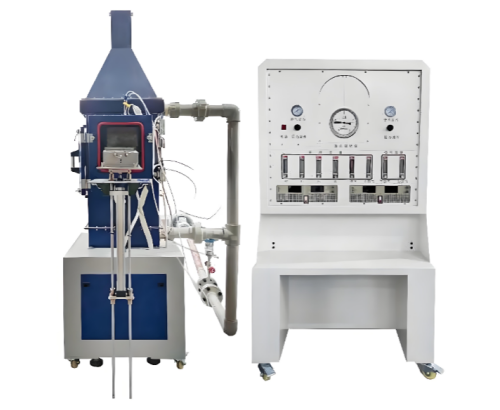
Mask filtration efficiency testing stand
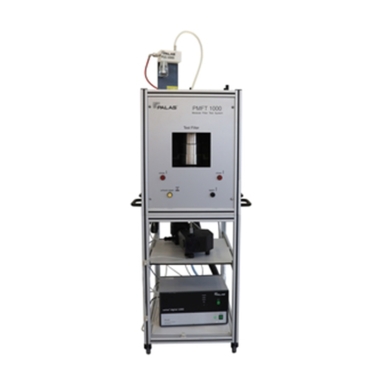


The Mask Filtration Efficiency Testing Stand is a laboratory and production-level test system used for quantitative evaluation of filtration efficiency, fractional efficiency, and airflow resistance of respiratory masks and flat filter media. The system supports multi-aerosol testing and wide particle size analysis, providing accurate and repeatable data for standard compliance, product development, and quality control.
Application
(1) Filtration efficiency testing of disposable filtering facepiece respirators (FFP1, FFP2, FFP3)
(2) Performance testing of particulate respirators complying with GB 2626 (KN / KP series)
(3) Fractional efficiency testing of N95, N99, N100, P95, P100 type respirators
(4) Efficiency and pressure drop testing of flat mask filter media and nonwoven filter materials
(5) Virus-size particle filtration analysis for respiratory masks (100 nm – 180 nm particle range)
(6) Differential pressure testing of masks under variable face velocities
(7) R&D evaluation of new filter materials and multilayer mask structures
(8) Quality control and batch verification for mask manufacturing lines
(9) Performance testing of HEPA-grade and fine particulate filter materials used in respiratory protection
Standards
(1) GB 2626 — Respiratory protective equipment — Non-powered air-purifying particle respirators
(2) EN 143 — Respiratory protective devices — Particle filters — Requirements, testing, marking
(3) EN 149 — Respiratory protective devices — Filtering half masks to protect against particles
(4) EN 13274-7 — Respiratory protective devices — Test methods — Determination of particle filter penetration
(5) ISO 16900-3 — Respiratory protective devices — Test methods — Particle filter testing
(6) NIOSH 42 CFR Part 84 — Approval of respiratory protective devices
(7) ISO 21083 — Respiratory protective devices — Particle filtration efficiency test methods
(8) GB/T 32610 — Technical specification of daily protective masks
Features
(1) Fractional filtration efficiency measurement across a wide particle size range from 0.10 µm to 40 µm
(2) High-resolution efficiency analysis for virus-sized particles with multiple size channels between 100 nm and 180 nm
(3) Compatible with solid, salt, and liquid aerosols without system modification
(4) Adjustable face velocity allowing simulation of different breathing and test conditions
(5) Simultaneous measurement of filtration efficiency and differential pressure
(6) Suitable for both rapid quality control testing and detailed R&D performance analysis
(7) Custom mask adapters available for different respirator designs
(8) Test principle exceeds the minimum performance requirements of referenced standards
Parameters
| Item | Specification |
|---|---|
| Measurement Range (Particle Size) | 0.10 – 40 µm |
| Volume Flow | 1 – 27 m³/h |
| Inflow Velocity | 5 – 100 cm/s (others on request) |
| Face Velocity Adjustment | 1.5 – 50 cm/s |
| Differential Pressure Range | 0 – 1200 Pa |
| Test Area of Medium | 100 cm² |
| Aerosol Types | Dusts (e.g. SAE dusts), salts (e.g. NaCl, KCl), liquid aerosols (e.g. DEHS) |
| Aerosol Concentration | Up to 1000 mg/m³ for SAE Fine without additional dilution |
| Compressed Air Supply | 6 – 8 bar |
| Power Supply | 115 / 230 V, 50 / 60 Hz |
| Installation Conditions | 19 – 23 °C |
| Dimensions (W × H × D) | Approx. 600 × 1800 × 900 mm |
FAQ
(1) What types of products can be tested with this system?
Respiratory masks, filtering facepiece respirators, flat filter media, and HEPA-grade filter materials can be tested.
(2) Can the system evaluate virus-sized particle filtration efficiency?
Yes. The system provides fractional efficiency analysis in the 100 nm to 180 nm particle size range.
(3) Which aerosols are supported for testing?
Solid dust aerosols, salt aerosols such as NaCl and KCl, and liquid aerosols such as DEHS are supported.
(4) Is the system suitable for production quality control?
Yes. It supports fast and repeatable testing suitable for routine quality control and batch verification.
(5) Can the system be used for R&D purposes?
Yes. The system provides detailed size-resolved efficiency data for filter material development and optimization.
(6) Are custom mask fixtures available?
Yes. Individual mask adapters can be customized according to specific respirator designs and dimensions.
Leave Message Get Price