Air Intake Filter Performance Test System
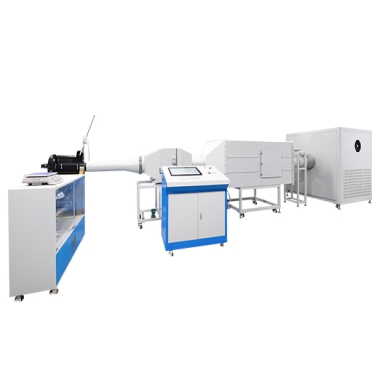


The Air Intake Filter Performance Test System is a professional testing solution designed to evaluate the filtration efficiency, airflow performance, pressure drop characteristics, and dust holding capacity of air intake filters used in automotive engines and industrial air-cleaning systems. The system simulates real operating conditions by controlling airflow and introducing standardized test dust to analyze filter performance throughout its service life. The Air Intake Filter Performance Test System complies with international standards such as ISO 5011, SAE J726, and GB/T 12485, making it suitable for filter development, certification testing, and production quality control.
Application
This test system is widely applied in the evaluation of automotive and industrial air filters, engine intake systems, and other air-cleaning components. It is suitable for R&D testing of new filter products, performance verification of different filter brands, and quality inspection by laboratories and production facilities. The system allows comprehensive assessment of filters at various loading stages and operating conditions, providing data critical for product design, certification, and maintenance planning.
Standards
(1) ISO 5011 – Inlet air cleaning equipment for internal combustion engines and compressors.
(2) SAE J726 – Air cleaner test code for automotive and diesel engine filters.
(3) GB/T 12485 – Test methods for air cleaners in internal combustion engines.
(4) ISO 12103-1 – Test dusts (A2 Fine and A4 Coarse) for efficiency and dust holding capacity evaluation.
Technical Parameters
| Item | Parameter | Value |
|---|---|---|
| Air flow rate | m³/h | 500 – 4800 (customizable) |
| Pressure drop | Pa | 0 – 10000 |
| Testable filter size | – | Unlimited for assemblies; adapters available for elements |
| Test dust | – | ISO 12103-1 A2 (Coarse) / A4 (Fine) |
| Dust feeder | – | QS-189 |
| Dimensions (with FFU) | mm | 6500 × 3500 × 1800 |
| Power supply | V, A | 400 VAC, 125 A |
| Control system | – | PLC + PC automation with touch interface |
Features
(1) Multi-functional testing capability including dust holding capacity, restriction vs. flow, initial resistance, incremental efficiency, and full-life efficiency.
(2) Automated and intelligent control system integrating electronic weighing, airflow, and pressure monitoring for real-time data acquisition.
(3) High-precision nozzle flow meter with automatic range switching for accurate airflow measurement.
(4) Compact and modular design compatible with various filter sizes and shapes using custom adapters.
(5) Reliable filtration system equipped with reinforced absolute filters (F8 V-bank) ensuring stable airflow and accurate measurements under load.
(6) Fully automated test sequences with step-by-step guidance to minimize operator errors.
(7) Integrated software enabling real-time visualization, automated report generation, historical data storage, and remote monitoring.
FAQ
(1)What performance characteristics can be evaluated for air intake filters?
This system evaluates key filter properties including filtration efficiency, pressure drop, airflow performance, and dust holding capacity. These results help manufacturers understand filter behavior under different operating conditions and improve product design.
(2)Why is dust loading testing important for engine air filters?
During actual operation, filters gradually accumulate dust, which affects airflow resistance and filtration performance. Dust loading tests simulate service conditions and help determine filter durability and maintenance requirements.
(3)Which standards are commonly used for air filter performance evaluation?
Automotive and industrial air filter testing commonly follows ISO 5011, SAE J726, and GB/T 12485. These standards define test methods for evaluating airflow characteristics, efficiency, and dust holding performance.
(4)Can the system test different types and sizes of air filters?
Yes. The modular design allows different filter shapes and sizes to be tested by using customized adapters. It is suitable for filter elements and complete air cleaner assemblies used in various applications.
(5)What factors should laboratories consider when selecting an air filter test system?
Laboratories should consider airflow range, pressure measurement capability, dust feeding accuracy, applicable standards, automation level, and data management functions to ensure reliable and repeatable filter performance evaluation.
Leave Message Get Price