Safety Helmet Anti-static Tester
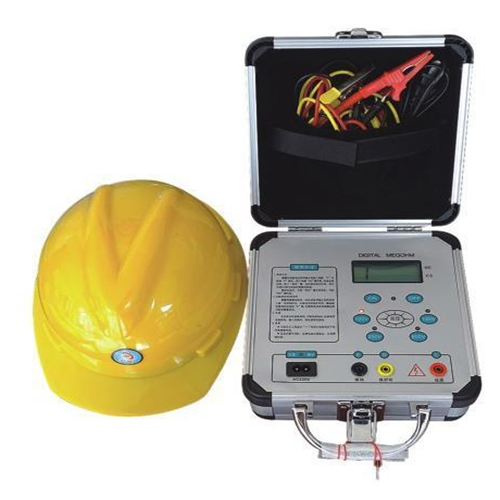


The Safety Helmet Anti-static Tester is designed to evaluate the antistatic performance of safety helmets and engineering plastics. It provides precise measurements of electrical resistance to prevent static charge buildup in hazardous environments. With a high degree of automation, intuitive operation, and portable design, this tester is widely used in helmet manufacturing facilities, quality inspection laboratories, and safety compliance verification units.
Application
This tester is suitable for a wide range of applications in both product testing and materials evaluation, including:
Helmet Manufacturers: Ensuring antistatic performance of finished safety helmets used in construction, mining, oil & gas, electrical maintenance, firefighting, and high-voltage operations.
Material Testing: Evaluating engineering plastics, thermoplastics, and polymer composites used in helmet shells for anti-static compliance.
Safety Compliance Testing: Verifying helmets according to workplace safety regulations and occupational health standards.
Research & Development: Supporting R&D for innovative helmet designs and materials with enhanced static dissipation properties.
Industrial Use: Assessing antistatic properties of protective equipment for electronics assembly, clean rooms, semiconductor manufacturing, and laboratories.
Quality Assurance Labs: Routine inspection of helmet batches for manufacturers and third-party certification bodies.
Specific products tested include:
Industrial safety helmets for construction sites, factories, and high-voltage maintenance.
Mining helmets and underground safety helmets.
Firefighting helmets and emergency response helmets.
High-voltage insulating helmets and arc flash helmets.
Engineering plastics used in helmet shells, visors, and internal supports.
Sports helmets for cycling, climbing, or skiing (where static control is relevant).
Standards
The instrument complies with both national and international standards, including:
GB/T 2812-2006 – Safety helmet test method (China)
GB/T 2811-2019 – Safety helmet (China)
EN 397:2012+A1:2012 – Industrial safety helmets (European Standard)
EN 50365:2002 – Electrical insulating helmets for low-voltage installations (Europe)
ANSI/ISEA Z89.1-2014 – American National Standard for Industrial Head Protection
CSA Z94.1-15 – Industrial protective headwear (Canada)
ISO 24450:2005 – Helmets for high-voltage electrical work (International)
IEC 61482-2:2018 – Arc flash protective helmets (International)
ASTM F1447-18 – Standard specification for helmets used in recreational activities
Features
Critical Safety Measurement: Measures electrical resistance to prevent static hazards.
High Automation: Automatic range conversion and simple operation panel for efficient testing.
Portable Design: Integrated lightweight construction for field and lab use.
Wide Test Range: Measures from 1×10⁴Ω to 2×10¹⁰Ω.
Multiple Voltage Options: DC test voltages of 100V, 250V, 500V, or 1000V.
Reliable Accuracy: Indication error within ±1%.
Versatile Testing: Applicable to finished helmets and raw material samples.
LED Display: Large screen showing resistance values clearly in real time.
Multiple Trigger Options: Internal, manual, or external triggers.
Technical Parameters
| Parameter | Specification |
|---|---|
| Measurement Range | 1×10⁴Ω — 2×10¹⁰Ω |
| Indication Error | ±1% |
| Test Voltage | 100VDC, 250VDC, 500VDC, 1000VDC (selectable) |
| Electrode Material | Metal foil |
| Electrode Dimensions | Length 100mm ±1mm, Width 1mm ±0.1mm, parallel placement |
| Trigger Modes | Internal, manual, external |
| Conductive Glue Resistance | <1kΩ |
| Display | LED digital display |
| Automatic Function | Automatic range conversion |
| Portability | Integrated lightweight design |
Accessories
Test electrodes – 1 pair (metal foil)
Conductive glue/paste – 1 set
Power cable – 1 set
User manual – 1 copy
Test Procedures
Place the helmet or material sample on the test fixture.
Attach electrodes using conductive glue to ensure proper electrical contact.
Select the desired test voltage (100V, 250V, 500V, 1000V DC).
Initiate the measurement using internal, manual, or external trigger.
Observe and record the resistance value on the LED display.
Repeat the test for additional samples as needed.
Leave Message Get Price