Automotive Interior Materials Combustion Tester
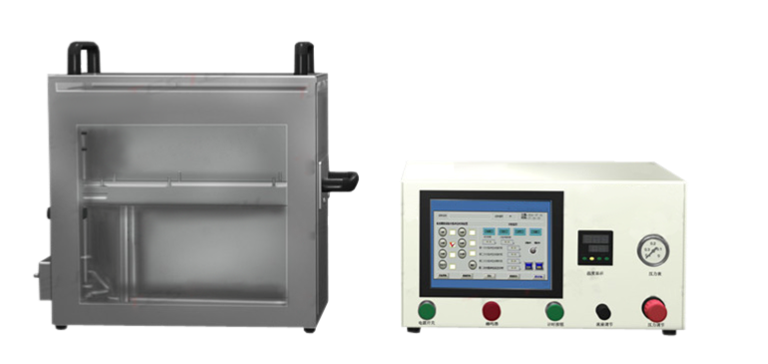


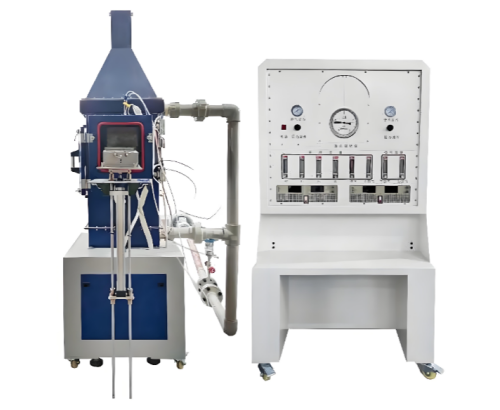
The Automotive Interior Materials Combustion Tester is designed according to ISO 3795 and related international standards to evaluate the horizontal burning performance of interior materials used in automobiles, including passenger cars, multi-purpose vehicles, trucks, and buses. The instrument integrates the testing and control systems in a single unit, allowing convenient on-site installation and calibration. The control system features automatic ignition, digital display of temperature and time, and reliable, stable operation for accurate burning assessments.
Applications
(1) Testing the horizontal flame spread and burning behavior of automotive seats, dashboards, door panels, headliners, and carpeting.
(2) Assessing interior materials for passenger cars, commercial vehicles, buses, and trucks.
(3) Evaluating composite interior materials, coatings, laminates, and foams used in automotive interiors.
(4) Supporting research and development of new automotive interior materials with improved fire performance.
(5) Conducting quality control and compliance testing in automotive manufacturing and third-party fire safety laboratories.
Standards
(1) FMVSS 302: Flammability of Interior Materials (United States)
(2) ISO 3795: Road Vehicles — Determination of Burning Behaviour of Interior Materials
(3) GB/T 8410-2006: Automotive Interior Materials Combustion Characteristics (China)
(4) SAE J369:2003: Standard for Flammability of Automotive Interior Materials (USA)
(5) HESD6003-99: Honda Automotive Standard
(6) NESM0094:2003: Nissan Automotive Standard
(7) ES-X60410:2001: Mitsubishi Automotive Standard
(8) TRANS/WP29/78/Rev.1:1997 Appendix 4: EU Regulation for Vehicle Interior Material Flammability
(9) TL1010:1997: Volkswagen Standard
(10) GS 97038-2003: BMW Standard
(11) GM 9070P:1996: General Motors Standard
Product Features
(1) Integrated design combining testing chamber and control system for convenient setup.
(2) Stainless steel chamber with durable, corrosion-resistant construction.
(3) Ventilation holes at the bottom: 10 holes, horizontal spacing 63.5 mm, vertical spacing 127 mm, diameter 19 mm.
(4) Burner internal diameter: Φ9.5 mm; flame tip distance to free end of sample: 19 mm.
(5) Tempered glass observation door for safe visual monitoring.
(6) Stainless steel sample holder and template for consistent placement.
(7) Internal steel ruler for measuring burning length with 1 mm precision.
(8) Imported Bunsen burner (USA) with flame adjustment 20–100 mm; flame measurement device set at 38 mm.
(9) Automatic ignition and timer with 0.1 s precision; 15 s auto-extinguish feature.
(10) Digital display of time and temperature for accurate test monitoring.
Technical Parameters
| Parameter | Specification |
|---|---|
| Dimensions (W×D×H) | 200 × 381 × 356 mm |
| Power Supply | AC 220 V, 50/60 Hz, 10 A |
| Instrument Weight | Approx. 50 kg |
| Burner Internal Diameter | Φ9.5 mm |
| Flame Tip Distance to Sample | 19 mm |
| Flame Height | Adjustable, 20–100 mm; measurement 38 mm |
| Ventilation Holes | 10 holes, 19 mm diameter; spacing 63.5 mm (horizontal), 127 mm (vertical) |
| Timer Precision | 0.1 s |
| Automatic Extinguish | 15 s |
FAQ
Q1: What types of automotive interior materials can be tested?
A1: The tester can evaluate dashboards, seats, door panels, headliners, carpeting, foams, laminates, and composite materials used in vehicles.
Q2: How is the flame applied to the sample?
A2: A small butane/Bunsen flame is applied horizontally at a precise distance (19 mm) from the free end of the sample, with adjustable flame height.
Q3: How are the test results recorded?
A3: Time and flame measurements are digitally displayed and recorded; burning length is measured using the internal steel ruler.
Q4: Is the instrument compatible with international automotive standards?
A4: Yes, it meets ISO 3795, FMVSS 302, SAE J369, EU, Honda, Nissan, Mitsubishi, Volkswagen, BMW, and General Motors standards.
Q5: Can multiple tests be performed safely?
A5: Yes, the chamber includes a tempered glass observation door and controlled ventilation to ensure safe repeated testing.
Leave Message Get Price